Department of General Surgery, Xuanwu Hospital, Capital Medical University, Beijing 100053, China.
Peking University Hospital, Beijing 100870, China.
Neural Plast. 2020 Nov 24;2020:8894372. doi: 10.1155/2020/8894372. eCollection 2020.
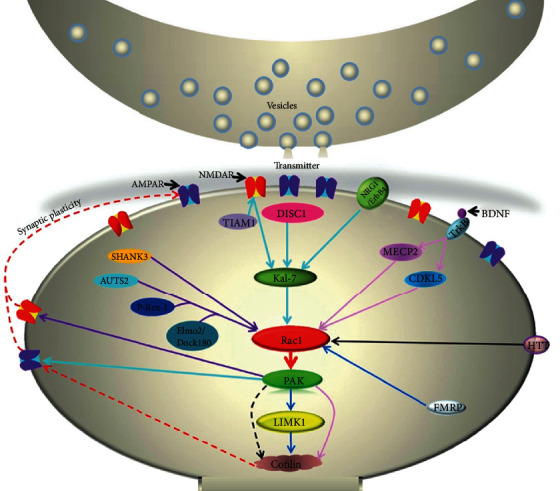
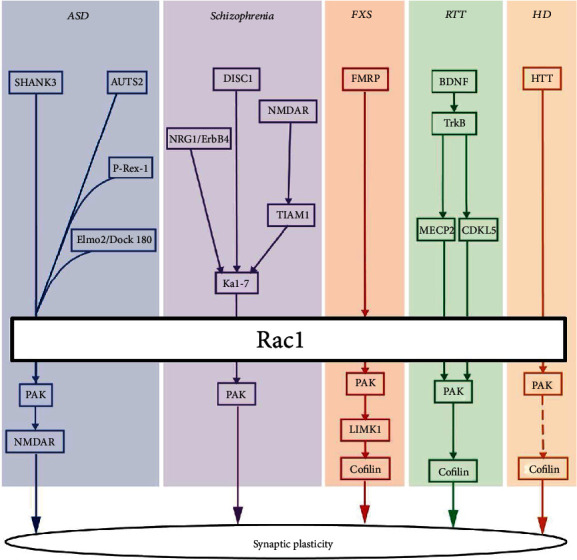
Ras-related C3 botulinum toxin substrate 1 (Rac1) is a small GTPase that is well known for its sensitivity to the environmental stress of a cell or an organism. It senses the external signals which are transmitted from membrane-bound receptors and induces downstream signaling cascades to exert its physiological functions. Rac1 is an important regulator of a variety of cellular processes, such as cytoskeletal organization, generation of oxidative products, and gene expression. In particular, Rac1 has a significant influence on certain brain functions like neuronal migration, synaptic plasticity, and memory formation regulation of actin dynamics in neurons. Abnormal Rac1 expression and activity have been observed in multiple neurological diseases. Here, we review recent findings to delineate the role of Rac1 signaling in neurodevelopmental disorders associated with abnormal spine morphology, synaptogenesis, and synaptic plasticity. Moreover, certain novel inhibitors of Rac1 and related pathways are discussed as potential avenues toward future treatment for these diseases.
Ras 相关 C3 肉毒杆菌毒素底物 1(Rac1)是一种小 GTP 酶,以其对细胞或生物体环境应激的敏感性而闻名。它感知来自膜结合受体的外部信号,并诱导下游信号级联反应以发挥其生理功能。Rac1 是多种细胞过程的重要调节剂,如细胞骨架组织、氧化产物的产生和基因表达。特别是,Rac1 对某些大脑功能有重大影响,如神经元迁移、突触可塑性和记忆形成、神经元中肌动蛋白动力学的调节。在多种神经疾病中观察到 Rac1 表达和活性异常。在这里,我们回顾了最近的发现,以描绘 Rac1 信号在与异常脊柱形态、突触发生和突触可塑性相关的神经发育障碍中的作用。此外,还讨论了某些 Rac1 及其相关途径的新型抑制剂,作为未来治疗这些疾病的潜在途径。