Infectious Diseases Department, Hospital Clínic Barcelona, August Pi i Sunyer Biomedical Research Institute, Barcelona, Spain.
Department of Stem Cell Transplantation and Cellular Therapy, and.
Blood. 2020 Dec 10;136(24):2741-2753. doi: 10.1182/blood.2020005884.
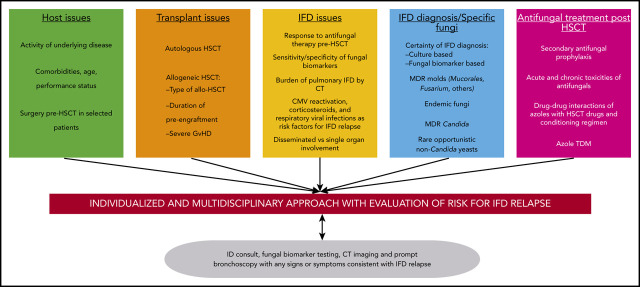
Hematopoietic transplantation is the preferred treatment for many patients with hematologic malignancies. Some patients may develop invasive fungal diseases (IFDs) during initial chemotherapy, which need to be considered when assessing patients for transplantation and treatment posttransplantation. Given the associated high risk of relapse and mortality in the post-hematopoietic stem cell transplantation (HSCT) period, IFDs, especially invasive mold diseases, were historically considered a contraindication for HSCT. Over the last 3 decades, advances in antifungal drugs and early diagnosis have improved IFD outcomes, and HSCT in patients with a recent IFD has become increasingly common. However, an organized approach for performing transplantation in patients with a prior IFD is scarce, and decisions are highly individualized. Patient-, malignancy-, transplantation procedure-, antifungal treatment-, and fungus-specific issues affect the risk of IFD relapse. Effective surveillance to detect IFD relapse post-HSCT and careful drug selection for antifungal prophylaxis are of paramount importance. Antifungal drugs have their own toxicities and interact with immunosuppressive drugs such as calcineurin inhibitors. Immune adjunct cytokine or cellular therapy and surgery can be considered in selected cases. In this review, we critically evaluate these factors and provide guidance for the complex decision making involved in the peri-HSCT management of these patients.
造血干细胞移植是许多血液系统恶性肿瘤患者的首选治疗方法。一些患者在初始化疗期间可能会发生侵袭性真菌病(IFD),在评估患者是否适合移植和移植后治疗时需要考虑到这一点。鉴于造血干细胞移植(HSCT)后复发和死亡率高的相关风险,IFD,特别是侵袭性霉菌病,在历史上被认为是 HSCT 的禁忌症。在过去的 30 年中,抗真菌药物和早期诊断的进步改善了 IFD 的预后,并且在近期发生 IFD 的患者中进行 HSCT 已变得越来越普遍。然而,对于有既往 IFD 的患者进行移植的方法并不完善,决策高度个体化。患者、恶性肿瘤、移植程序、抗真菌治疗和真菌特异性问题都会影响 IFD 复发的风险。有效的监测以检测 HSCT 后 IFD 的复发,并仔细选择抗真菌预防药物至关重要。抗真菌药物具有其自身的毒性,并与免疫抑制剂(如钙调神经磷酸酶抑制剂)相互作用。在某些情况下可以考虑使用免疫辅助细胞因子或细胞疗法和手术。在这篇综述中,我们批判性地评估了这些因素,并为这些患者 HSCT 围手术期管理中涉及的复杂决策提供了指导。