NeoCare, Université de Toulouse, ENVT, Toulouse, France.
CESECAH, Lieu-dit Monsable, Lezoux, France.
PLoS One. 2020 Dec 10;15(12):e0243820. doi: 10.1371/journal.pone.0243820. eCollection 2020.
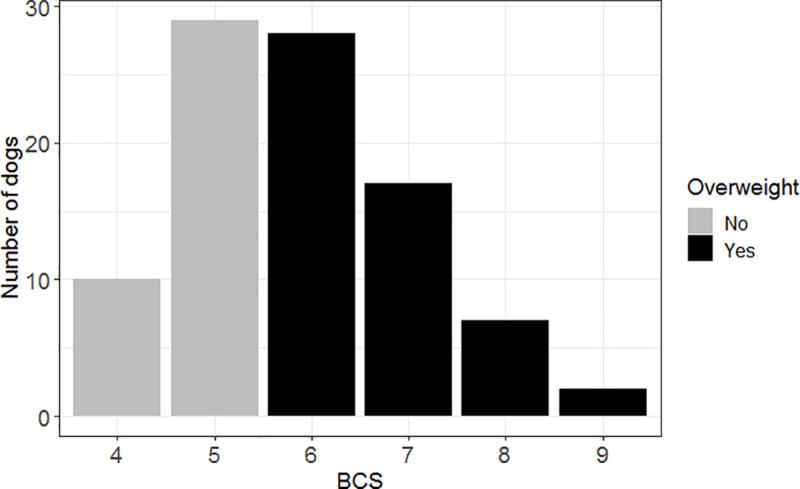
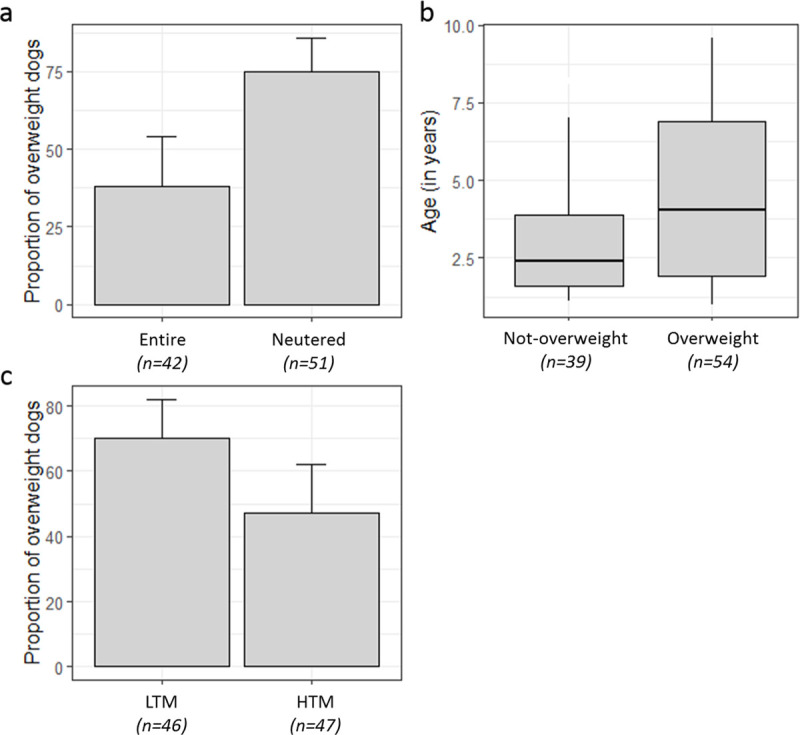
Several studies in humans indicate that low birth weight predisposes individuals to obesity in later life. Despite the constant increase in prevalence of obesity in the canine population and the major health consequences of this affection, few investigations have been carried out on the association between birth weight and the development of overweight in dogs. The purpose of the current study was to examine the association between birth weight and some other neonatal characteristics and overweight at adulthood in a population of purebred Labrador dogs. Information was collected about the sex, age, neuter status, birth weight, and growth rates (between 0-2 days and 2-15 days of age) in 93 Labrador dogs raised under similar environmental conditions until two months old. The body condition scores (BCS, scale of 1-9) of these dogs at adulthood were recorded, with BCS equal to or greater than 6 classified as overweight. Dogs were split into two groups based on the median birth weight in the population: lower than the median (LTM) and higher than the median (HTM). A logistic regression model was applied to analyse associations between the general characteristics of the dogs (sex, age, neuter status), early life parameters (birth weight, growth rates) and overweight at adulthood. Birth weight was the only early-life parameter found to be associated with overweight (p value = 0.032) with a prevalence of overweight of 70% among the dogs with LTM birth weight vs. 47% in dogs born with HTM birth weight. Overweight was also associated with age and neuter status (p value = 0.029 and 0.005 respectively). Our results suggest that, as in humans, dogs with the lowest birth weights are more likely to become overweight at adulthood. More studies are needed to further examine this relationship and to explore the underlying mechanisms. A subsequent objective could be to identify preventive strategies such as an adapted early nutrition programme for at-risk individuals.
几项针对人类的研究表明,低出生体重使个体在以后的生活中容易肥胖。尽管犬类肥胖的患病率不断增加,而且这种疾病会带来严重的健康后果,但针对犬类出生体重与超重发展之间的关系,很少有研究进行过探讨。本研究的目的是检查在一个纯种拉布拉多犬群体中,出生体重与其他一些新生儿特征以及成年后超重之间的关联。在 93 只拉布拉多犬中收集了信息,这些犬在相似的环境条件下饲养至两个月大,信息包括性别、年龄、绝育状态、出生体重和生长速度(0-2 天和 2-15 天之间)。这些犬成年时的身体状况评分(BCS,范围为 1-9)记录在案,BCS 等于或大于 6 被归类为超重。根据群体中的中位数出生体重将犬分为两组:低于中位数(LTM)和高于中位数(HTM)。应用逻辑回归模型分析犬的一般特征(性别、年龄、绝育状态)、早期生活参数(出生体重、生长速度)与成年后超重之间的关联。只有早期生活参数出生体重与超重相关(p 值=0.032),出生体重低于中位数的犬超重率为 70%,而出生体重高于中位数的犬超重率为 47%。超重还与年龄和绝育状态相关(p 值分别为 0.029 和 0.005)。我们的结果表明,与人类一样,出生体重最低的犬成年后更容易超重。需要进行更多的研究来进一步探讨这种关系,并研究潜在的机制。后续的目标可以是确定预防策略,例如针对高危个体的适应性早期营养计划。