Piussi Ramana, Broman Daniel, Musslinder Erik, Beischer Susanne, Thomeé Roland, Hamrin Senorski Eric
Sportrehab Sports Medicine Clinic, Stampgatan 14, SE-411 01, Gothenburg, Sweden.
Sahlgrenska Sports Medicine Center, Gothenburg, Sweden.
BMC Sports Sci Med Rehabil. 2020 Dec 10;12(1):77. doi: 10.1186/s13102-020-00222-8.
The recovery of muscle function after an Anterior Cruciate Ligament (ACL) reconstruction is most commonly reported as limb-to-limb differences using the Limb Symmetry Index (LSI), which is not free from limitations. The purpose of this study was to compare the proportion of patients who recover their Preoperative Absolute Muscle Strength (PAMS) 8 and 12 months after ACL reconstruction with the proportion of patients who recover their symmetrical knee strength. A secondary aim was to assess the relationship between psychological Patient-Reported Outcomes (PROs) and recovering PAMS at 8 and 12 months after ACL reconstruction and rehabilitation.
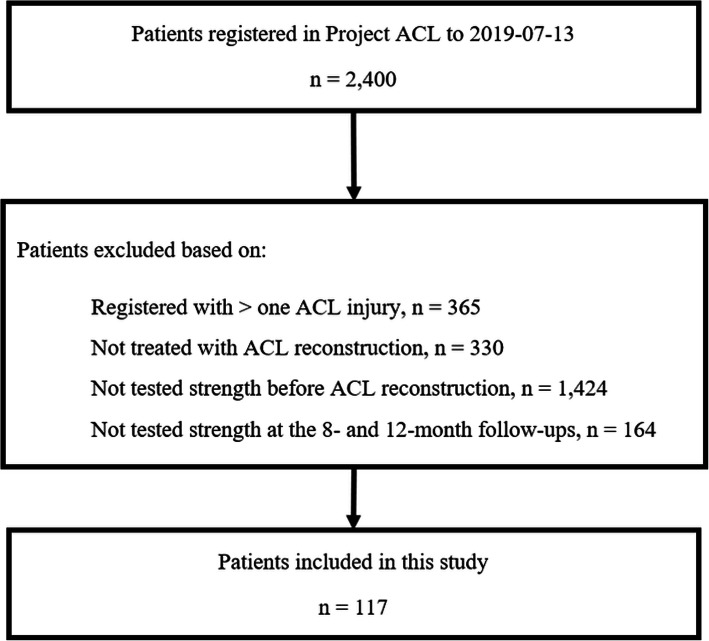
Preoperative, 8- and 12-month results from quadriceps and hamstring strength tests and PROs for 117 patients were extracted from a rehabilitation registry. Individual preoperative peak torques from strength tests were compared with results from the 8- and 12-month follow-ups respectively. Patients were defined as having recovered their PAMS upon reaching 90% of their preoperative peak torque for both quadriceps and hamstring strength. Patients were defined as having recovered their LSI upon reaching a value ≥90% when comparing the results for their injured knee with those of their healthy knee. Correlations between the recovery of PAMS and PROs at 8 and 12 months were analyzed.
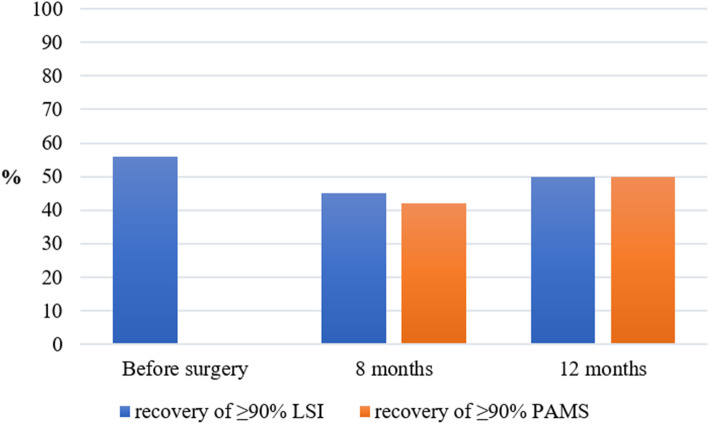
There was no difference in the proportion of patients who recovered their PAMS compared with patients who recovered their LSI. In all, 30% and 32% of the patients who recovered their LSI had not recovered their PAMS at 8 months and 12 months respectively. In the patients who had recovered their PAMS, 24% and 31% had not recovered their symmetrical LSI at 8 months and 12 months respectively. There was no significant correlation between the recovery of PAMS and psychological PROs.
The use of both PAMS and LSI provides more detailed information on the recovery of muscle strength after ACL reconstruction. The recovery of PAMS was not correlated with psychological traits, which implies that both PROs and PAMS are important when evaluating patients after ACL reconstruction.
This trial was not registered.
前交叉韧带(ACL)重建术后肌肉功能的恢复情况,最常使用肢体对称指数(LSI)来报告肢体间差异,但该指数存在局限性。本研究的目的是比较ACL重建术后8个月和12个月恢复术前绝对肌肉力量(PAMS)的患者比例与恢复对称膝关节力量的患者比例。次要目的是评估患者报告的心理结局(PROs)与ACL重建及康复术后8个月和12个月恢复PAMS之间的关系。
从康复登记处提取117例患者术前、术后8个月和12个月的股四头肌和腘绳肌力量测试结果及PROs。将力量测试的术前个体峰值扭矩分别与8个月和12个月随访结果进行比较。当股四头肌和腘绳肌力量达到术前峰值扭矩的90%时,患者被定义为恢复了PAMS。当患侧膝关节与健侧膝关节结果比较达到≥90%的值时,患者被定义为恢复了LSI。分析8个月和12个月时PAMS恢复与PROs之间的相关性。
恢复PAMS的患者比例与恢复LSI的患者比例没有差异。总体而言,恢复LSI的患者中,分别有30%和32%在8个月和12个月时未恢复PAMS。在恢复PAMS的患者中,分别有24%和31%在8个月和12个月时未恢复对称的LSI。PAMS的恢复与心理PROs之间没有显著相关性。
使用PAMS和LSI可提供关于ACL重建术后肌肉力量恢复的更详细信息。PAMS的恢复与心理特征无关,这意味着在评估ACL重建术后患者时,PROs和PAMS都很重要。
本试验未注册。