Högberg Johan, Lindskog Jakob, Sundberg Axel, Piussi Ramana, Simonsson Rebecca, Samuelsson Kristian, Thomeé Roland, Hamrin Senorski Eric
Sportrehab Sports Medicine Clinic, Stampgatan 14, Gothenburg, SE-411 01, Sweden.
Sahlgrenska Sports Medicine Center, Gothenburg, Sweden.
BMC Sports Sci Med Rehabil. 2024 Jun 18;16(1):134. doi: 10.1186/s13102-024-00923-4.
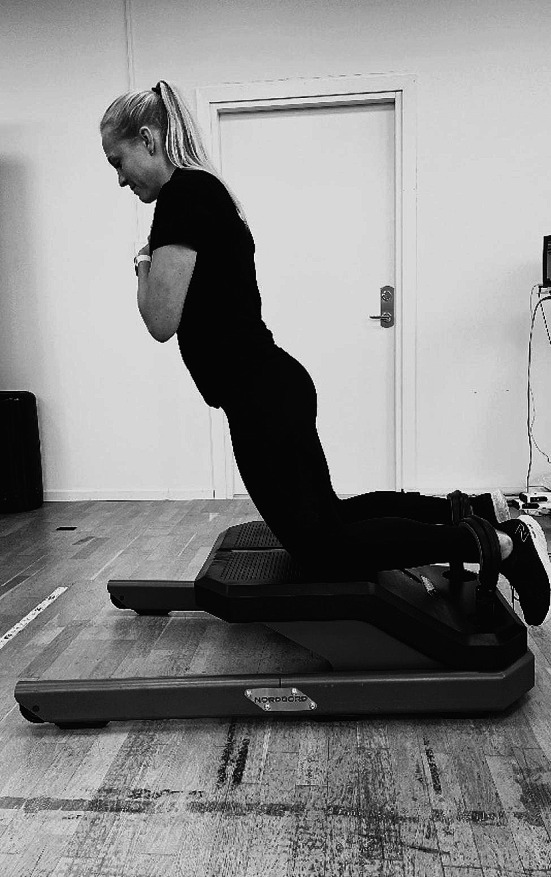
The relationship between hamstring strength and hop performance after anterior cruciate ligament (ACL) reconstruction with hamstring tendon (HT) autografts has not been well elucidated. The aim was to investigate the relationship between eccentric hamstring strength, assessed with the NordBord, and concentric hamstring strength, assessed with the Biodex, with hop performance at 8 and 12 months after ACL reconstruction.
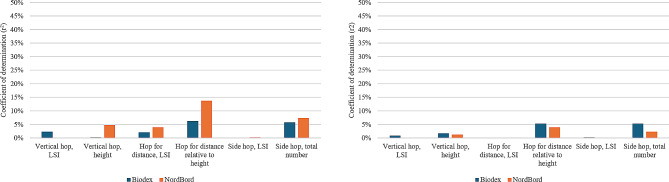
Registry study. Patients ≥ 16 years who had undergone primary ACL reconstruction with HT autograft, followed by muscle strength and hop tests at 8 and 12 months were included. Correlations of the relative hamstring strength (Nm/kg or N/kg) and limb symmetry index (LSI) with hop performance were analyzed. Pearson's correlation coefficient, and coefficient of determination (r) were used for statistical analysis.
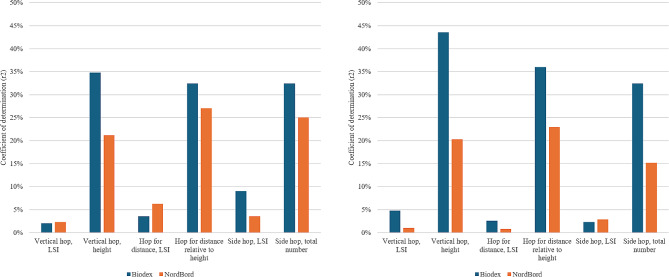
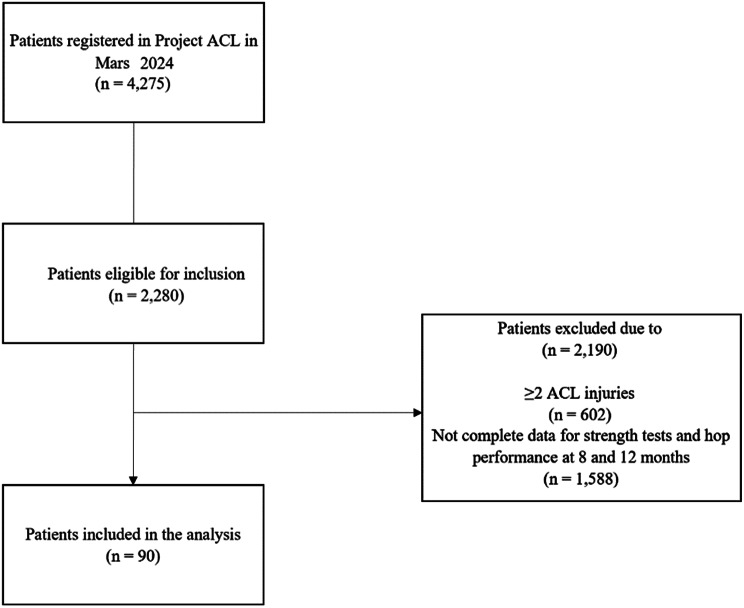
A total of 90 patients were included, of which 48 (53%) were women. The mean age at ACL reconstruction was 27.0 ± 8.0 years. Relative hamstring strength had significant positive correlations with hop performance, ranging from r = 0.25-0.66, whereas hamstring strength LSI had significant positive correlations which ranged from r = 0.22-0.37 at 8 and 12 months after ACL reconstruction. At 12 months, the relative hamstring strength in the Biodex explained 32.5-43.6% of the hop performance in vertical hop height, hop for distance relative to height, and the total number of side hops, whereas the relative hamstring strength in the NordBord explained 15.2-23.0% of the hop performance.
The relative hamstring strength in the Biodex test explained 32.5-43.6% of the hop performance, whereas the relative hamstring strength in the NordBord explained 15.2-23.0%. Thus, our findings suggest that relative hamstring strength, especially in the hip-flexed position may be a better indicator of hop performance at 8 and 12 months after ACL reconstruction in patients treated with HT autograft.
在前交叉韧带(ACL)采用腘绳肌腱(HT)自体移植重建后,腘绳肌力量与单腿跳表现之间的关系尚未得到充分阐明。目的是研究使用NordBord评估的离心腘绳肌力量和使用Biodex评估的向心腘绳肌力量与ACL重建后8个月和12个月时单腿跳表现之间的关系。
登记研究。纳入年龄≥16岁、接受过HT自体移植进行初次ACL重建、并在8个月和12个月时进行肌肉力量和单腿跳测试的患者。分析相对腘绳肌力量(牛顿米/千克或牛顿/千克)和肢体对称指数(LSI)与单腿跳表现的相关性。采用Pearson相关系数和决定系数(r)进行统计分析。
共纳入90例患者,其中48例(53%)为女性。ACL重建时的平均年龄为27.0±8.0岁。相对腘绳肌力量与单腿跳表现呈显著正相关,r值范围为0.25至0.66,而腘绳肌力量LSI在ACL重建后8个月和12个月时呈显著正相关,r值范围为0.22至0.37。在12个月时,Biodex测试中的相对腘绳肌力量解释了垂直单腿跳高度、相对于身高的单腿跳距离以及侧方单腿跳总数中32.5%至43.6%的单腿跳表现,而NordBord测试中的相对腘绳肌力量解释了15.2%至23.0%的单腿跳表现。
Biodex测试中的相对腘绳肌力量解释了32.5%至43.6%的单腿跳表现,而NordBord测试中的相对腘绳肌力量解释了15.2%至23.0%。因此,我们的研究结果表明,相对腘绳肌力量,尤其是在髋关节屈曲位置时,可能是接受HT自体移植治疗的患者在ACL重建后8个月和12个月时单腿跳表现的更好指标。