Paydar Shahram, Karami Mohammad Yasin, Nezhad Golnoush Sadat Mahmoudi, Rezaei Rouhollah, Makarem Alireza, Noorafshan Ali, Mohseni Shahin
Trauma Research Center, Shahid Rajaee (Emtiaz) Trauma Hospital, Shiraz University of Medical Sciences, Shiraz, Iran.
Department of Urology, Shiraz University of Medical Sciences, Shiraz, Iran.
J Emerg Trauma Shock. 2020 Jul-Sep;13(3):196-200. doi: 10.4103/JETS.JETS_17_19. Epub 2020 Sep 18.
Hyperfibrinolysis is a state of increased clot resolution often seen in trauma patients with ongoing hemorrhage. Tranexamic acid (TXA) inhibits fibrinolysis preventing clot resolution affecting hemorrhage continuation and is used by intravenous administration.
The purpose of this study was to evaluate the local tranexamic acid application for hemostatic control in an experimental animal liver injury model.
This study was an experimental prospective treatment study to check the local TXA effects on liver injury. This study was approved by the Ethics Committee.
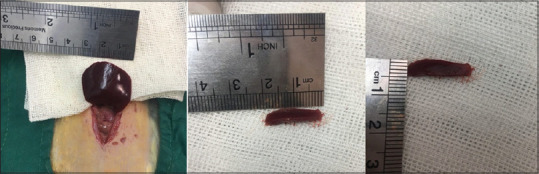
Twenty adult male Sprague-Dawley white rats were equally randomized to two groups after a standardized liver injury was conducted under anesthesia. One group were "liver-packed" with gauze (TXA [-]) and the other group with gauze soaked in TXA (TXA [+]). Bleeding from the injured middle liver lobe was measured at 2 and 15 min, and at 48h second-look surgery, with euthanasia conducted at 14 days. The liver was sent for histopathological and stereological analysis.
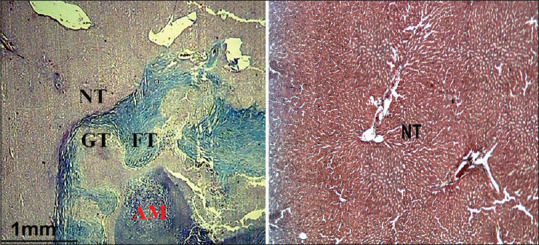
There was no difference in bleeding at 2 or 15 min after packing; however, larger amount of free blood at 48 h in the TXA (-) group was noticed. Five animals in the TXA (-) were alive at 14 days compared to eight animals in the TXA (+) group. Significantly larger volume density of fibrosis, granulation tissue, and amorphous tissue were seen in the TXA (+) group compared to the TXA (-) group at the stereological analysis.
Local TXA application on the injured liver surface might offer better hemostatic control than packing alone. Further studies are mandated before the clinical application of our findings.
高纤溶状态是一种常见于持续出血的创伤患者中凝块溶解增加的状态。氨甲环酸(TXA)抑制纤溶,防止凝块溶解,影响出血持续情况,通常通过静脉给药使用。
本研究旨在评估在实验性动物肝损伤模型中局部应用氨甲环酸进行止血控制的效果。
本研究是一项实验性前瞻性治疗研究,以检查局部TXA对肝损伤的影响。本研究经伦理委员会批准。
20只成年雄性Sprague-Dawley白色大鼠在麻醉下进行标准化肝损伤后,被平均随机分为两组。一组用纱布“填塞肝脏”(TXA[-]),另一组用浸泡有TXA的纱布(TXA[+])。在2分钟和15分钟时测量受伤肝中叶的出血量,并在48小时二次手术时测量,14天实施安乐死。肝脏送去进行组织病理学和体视学分析。
填塞后2分钟或15分钟时出血量无差异;然而,在48小时时发现TXA(-)组的游离血量更多。14天时,TXA(-)组有5只动物存活,而TXA(+)组有8只动物存活。在体视学分析中,与TXA(-)组相比,TXA(+)组的纤维化、肉芽组织和无定形组织的体积密度明显更大。
在受伤的肝脏表面局部应用TXA可能比单纯填塞提供更好的止血控制。在将我们的研究结果应用于临床之前,需要进一步研究。