Faculty of Medicine, Institute of Clinical Medicine, University of Oslo, Oslo, Norway.
Department of Infectious Diseases, Oslo University Hospital, Oslo, Norway.
Front Immunol. 2020 Nov 12;11:579849. doi: 10.3389/fimmu.2020.579849. eCollection 2020.
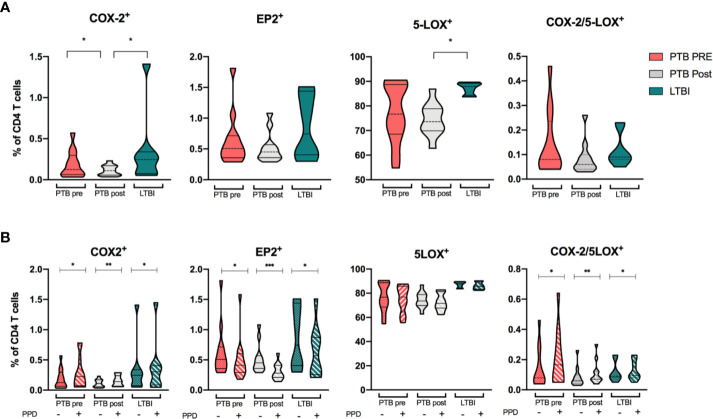
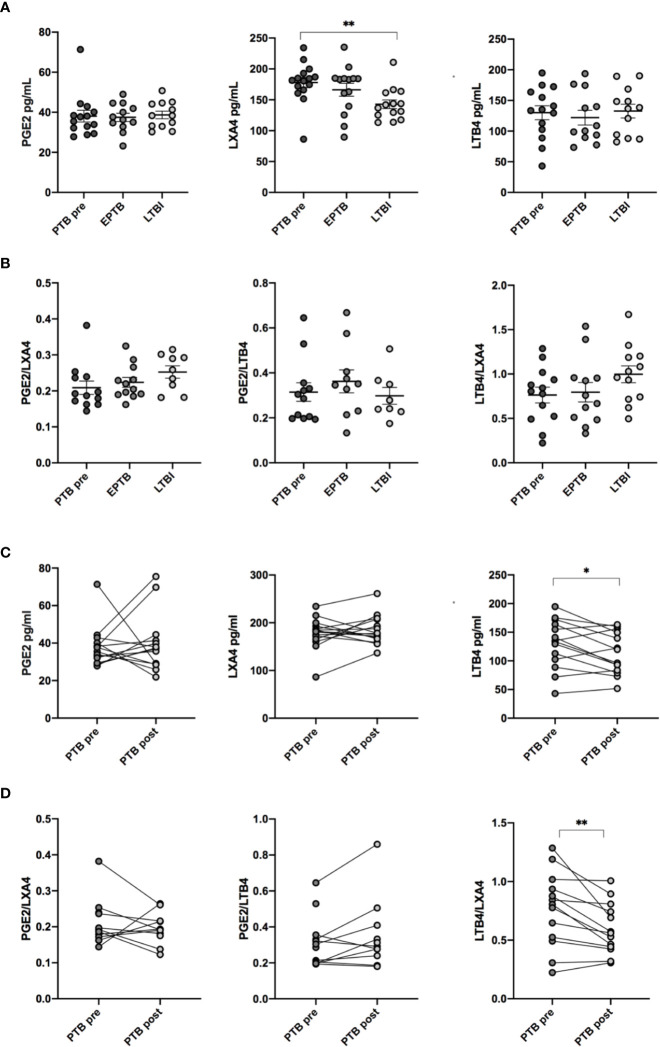
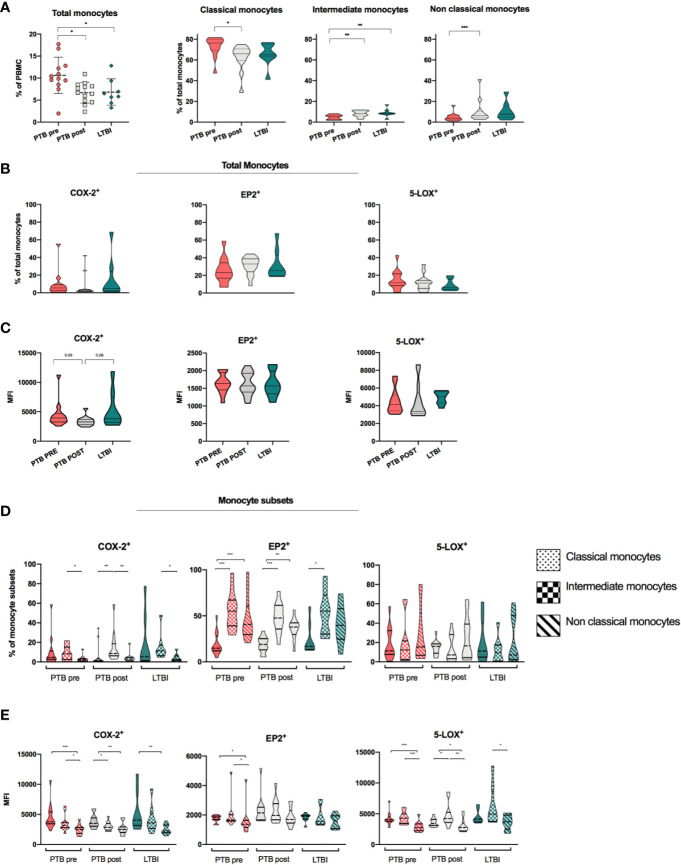
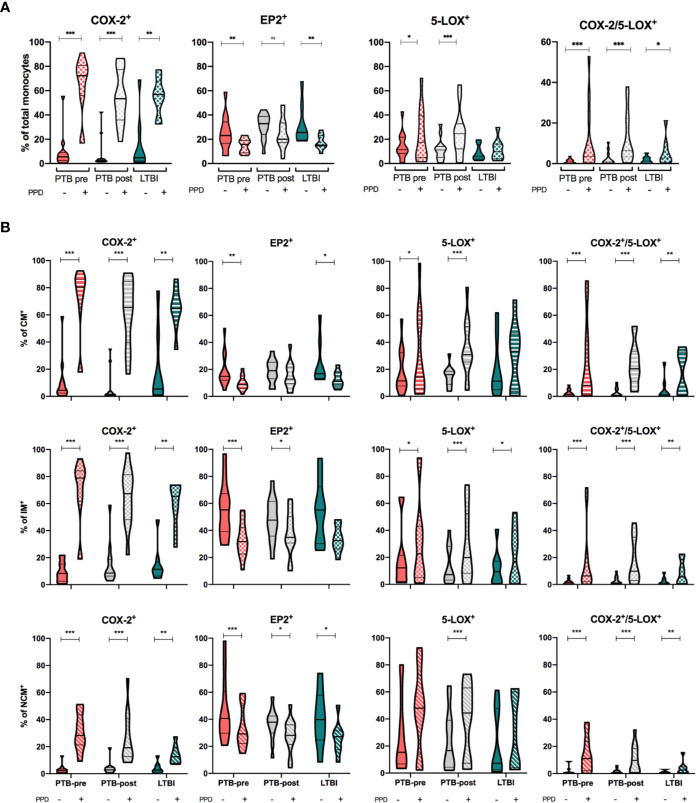
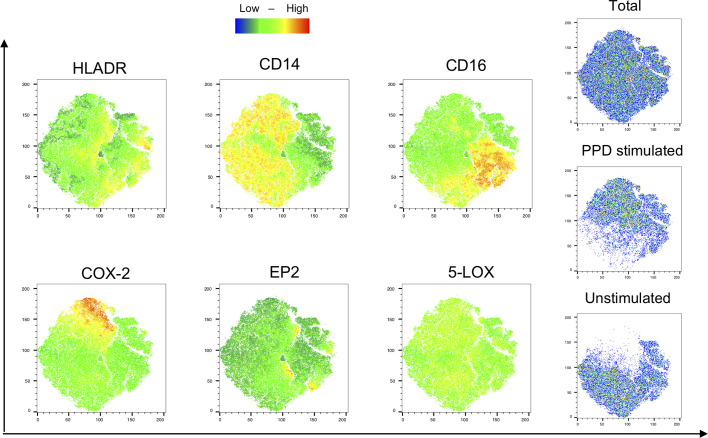
Eicosanoids modulate both innate and adaptive immune responses in infection and have been suggested as possible Host Directed Therapy (HDT) targets, but more knowledge of eicosanoid dynamics in infection is required. We investigated the levels and ratios of eicosanoid mediators and their cellular sources, monocyte subsets and CD4 T cells in Tuberculosis (TB) patients with various clinical states of infection. Patients consenting to prospective enrolment in a TB quality registry and biorepository, 16 with pulmonary TB (before and at-end-of treatment), 14 with extrapulmonary TB and 17 latently infected (LTBI) were included. Plasma levels of Prostaglandin E2 (PGE2), Lipoxin A4 (LXA4), and Leukotriene B4 (LTB4) were measured by enzyme-linked immunosorbent assay. Monocyte subsets and CD4 T cells and their expression of Cyclooxygenase-2 (COX-2), Prostaglandin receptor EP2 (EP2), and 5-Lipoxygenase (5-LOX) were analyzed by flow cytometry with and without Purified Protein Derivate (PPD)-stimulation. Pulmonary TB patients had elevated levels of the anti-inflammatory mediator LXA4 at diagnosis compared to LTBI (p < 0.01), while levels of PGE2 and LTB4 showed no difference between clinical states of infection. LTB4 was the only mediator to be reduced upon treatment (p < 0.05), along with the ratio LTB4/LXA4 (p < 0.01). Pulmonary TB patients had higher levels of total monocytes at diagnosis compared to end-of-treatment and LTBI (both p < 0.05), and a relative increase in the classical monocyte subset. All monocyte subsets had low basal expression of COX-2 and 5-LOX, which were markedly increased upon PPD stimulation. By contrast, the expression of EP2 was reduced upon stimulation. CD4 T cells expressed low basal COX-2 activity that increased modestly upon stimulation, whereas their basal expression of 5-LOX was considerable. In conclusion, the level of eicosanoids in plasma seem to vary between clinical states of infection. Mediators in the eicosanoid system are present in monocytes and CD4 T cells. The expression of eicosanoids in monocytes are responsive to mycobacterial stimulation independent of disease state, but subsets are heterogeneous with regard to eicosanoid-mediator expression. Further exploration of eicosanoid mediators as targets for HDT in TB are warranted.
类二十烷酸在 感染中调节先天和适应性免疫反应,并被认为是可能的宿主定向治疗 (HDT) 靶点,但需要更多关于 感染中类二十烷酸动态的知识。我们研究了不同 感染临床状态的结核病 (TB) 患者中类二十烷酸介质的水平和比值及其细胞来源、单核细胞亚群和 CD4 T 细胞。同意前瞻性纳入 TB 质量登记和生物库的患者,16 例患有肺结核 (治疗前和治疗结束时)、14 例患有肺外结核和 17 例潜伏性感染 (LTBI) 被纳入研究。通过酶联免疫吸附试验测量前列腺素 E2 (PGE2)、脂氧素 A4 (LXA4) 和白三烯 B4 (LTB4) 的血浆水平。通过流式细胞术分析单核细胞亚群和 CD4 T 细胞及其环加氧酶-2 (COX-2)、前列腺素受体 EP2 (EP2) 和 5-脂氧合酶 (5-LOX) 的表达,同时进行和不进行纯化蛋白衍生物 (PPD) 刺激。与 LTBI 相比,肺结核患者在诊断时具有更高水平的抗炎介质 LXA4(p < 0.01),而 PGE2 和 LTB4 水平在 感染的临床状态之间没有差异。只有 LTB4 在治疗后降低 (p < 0.05),同时 LTB4/LXA4 比值降低 (p < 0.01)。与治疗结束时和 LTBI 相比,肺结核患者在诊断时具有更高水平的总单核细胞 (均 p < 0.05),并且经典单核细胞亚群相对增加。所有单核细胞亚群的 COX-2 和 5-LOX 基础表达均较低,经 PPD 刺激后明显增加。相比之下,EP2 的表达在刺激后减少。CD4 T 细胞表达低基础 COX-2 活性,刺激后适度增加,而其 5-LOX 的基础表达则相当可观。总之,血浆中环二十烷酸的水平似乎在 感染的临床状态之间有所不同。类二十烷酸系统中的介质存在于单核细胞和 CD4 T 细胞中。在不受疾病状态影响的情况下,单核细胞对分枝杆菌刺激的类二十烷酸表达具有反应性,但亚群在类二十烷酸介质表达方面存在异质性。进一步探索作为结核病 HDT 靶点的类二十烷酸介质是有必要的。