Schmidli Manuel Roland, Sadowska Aleksandra, Cvitas Iva, Gantenbein Benjamin, Lischer Heidi E L, Forterre Simone, Hitzl Wolfgang, Forterre Franck, Wuertz-Kozak Karin
Division of Small Animal Surgery and Orthopaedics, Department of Clinical Veterinary Medicine, Vetsuisse Faculty, University of Bern, Bern, Switzerland.
Department of Health Sciences and Technology, Institute for Biomechanics, Eidgenössische Technische Hochschule Zurich, Zurich, Switzerland.
Front Vet Sci. 2020 Nov 16;7:547644. doi: 10.3389/fvets.2020.547644. eCollection 2020.
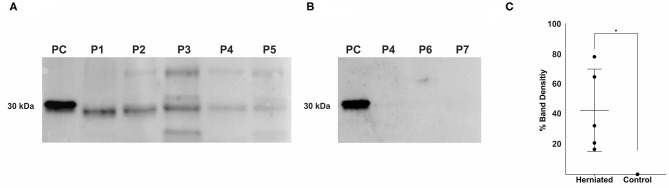
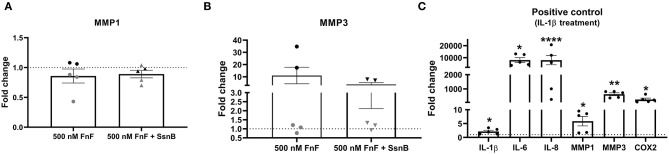
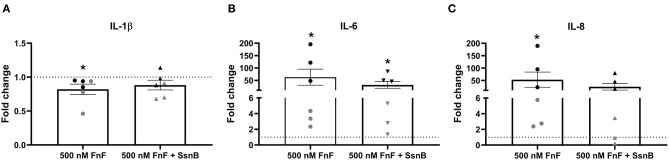
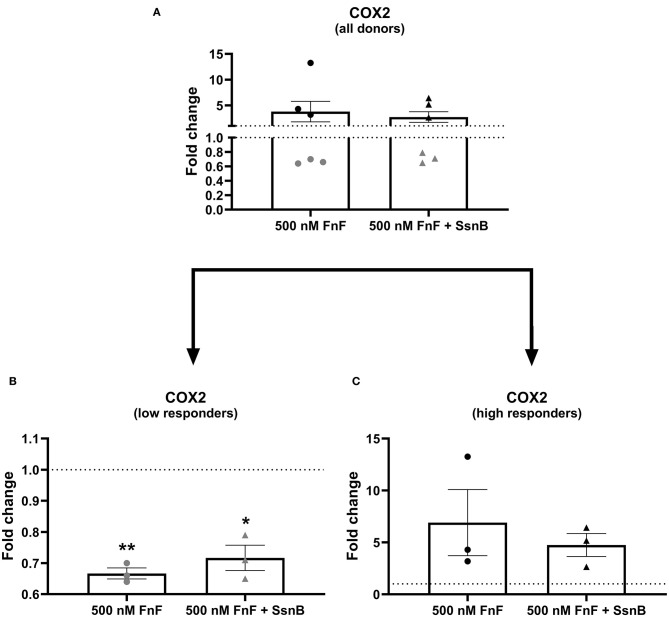
Canine intervertebral disc disease (IVDD) represents a significant clinical problem in veterinary medicine, with similarities to the human pathology. Host-derived damage-associated molecular patterns like fibronectin fragments (FnF) that develop during tissue dysfunction may be of specific relevance to IVD pathologies by inducing an inflammatory response in resident cells. This project aimed to determine the presence and pathobiological role of FnF during IVD herniation in dogs, with a focus on inflammation. Herniated nucleus pulposus (NP) material from five dogs as well as non-herniated adjacent NP material from three dogs was collected during spinal surgery required due to acute IVD herniation. The presence of different types of FnF were determined by Western blot analysis. NP cells isolated from six herniated canine IVDs were then exposed to 30 kDa FnF. NP cell inflammation and catabolism was examined by investigating the expression of IL-1β, IL-6, IL-8, and COX-2, as well as MMP-1 and MMP-3 by qPCR (all targets) and ELISA (IL-6, PGE). Amongst multiple sized FnF (30, 35, 45, and >170kDa), N-terminal fragments at a size of ~30 kDa were most consistently expressed in all five herniated IVDs. Importantly, these fragments were exclusively present in herniated, but not in non-herniated IVDs. Exposure of canine NP cells to 500 nM 30 kDa FnF caused a significant upregulation of IL-6 (62.5 ± 79.9, = 0.032) and IL-8 (53.0 ± 75.7, = 0.031) on the gene level, whereas IL-6 protein analysis was inconclusive. Donor-donor variation was observed in response to FnF treatment, whereby this phenomenon was most evident for COX-2, with three donors demonstrating a significant downregulation (0.67 ± 0.03, = 0.003) and three donors showing upregulation (6.9 ± 5.5, = 0.21). Co-treatment with Sparstolonin B, a TRL-2/TRL-4 antagonist, showed no statistical difference to FnF treatment alone in all tested target genes. Given the presence of the 30 kDa FnF in canine herniated IVDs and the proinflammatory effect of 30 kDa FnF on NP cells, we concluded that the accumulation of FnF may be involved in the pathogenesis of canine IVDD. These results correspond to the findings in humans with IVDD.
犬椎间盘疾病(IVDD)是兽医学中一个重要的临床问题,与人类病理学有相似之处。宿主来源的损伤相关分子模式,如在组织功能障碍期间产生的纤连蛋白片段(FnF),可能通过诱导驻留细胞中的炎症反应而与椎间盘病变具有特定相关性。本项目旨在确定FnF在犬椎间盘突出症期间的存在及其病理生物学作用,重点关注炎症。在因急性椎间盘突出症而进行的脊柱手术中,收集了5只犬的突出髓核(NP)材料以及3只犬的未突出相邻NP材料。通过蛋白质印迹分析确定不同类型FnF的存在。然后将从6个突出的犬椎间盘分离的NP细胞暴露于30 kDa FnF。通过qPCR(所有靶点)和ELISA(IL-6、PGE)研究IL-1β、IL-6、IL-8和COX-2以及MMP-1和MMP-3的表达,以检测NP细胞炎症和分解代谢。在多种大小的FnF(30、35、45和>170 kDa)中,约30 kDa大小的N端片段在所有5个突出的椎间盘组织中表达最为一致。重要的是,这些片段仅存在于突出的椎间盘组织中,而不存在于未突出的椎间盘组织中。将犬NP细胞暴露于500 nM 30 kDa FnF会导致基因水平上IL-6(62.5±79.9,P = 0.032)和IL-8(53.0±75.7,P = 0.031)的显著上调,而IL-6蛋白分析结果不明确。在对FnF治疗的反应中观察到供体间差异,其中这种现象在COX-2中最为明显,3个供体表现出显著下调(0.67±0.03,P = 0.003),3个供体表现出上调(6.9±5.5,P = 0.21)。用TRL-2/TRL-4拮抗剂Sparstolonin B共同处理在所有测试的靶基因中与单独FnF处理相比没有统计学差异。鉴于30 kDa FnF存在于犬突出的椎间盘组织中以及30 kDa FnF对NP细胞的促炎作用,我们得出结论,FnF的积累可能参与犬IVDD的发病机制。这些结果与人类IVDD的研究结果一致。