Alpdagtas Saadet, Ilhan Elif, Uysal Ebru, Sengor Mustafa, Ustundag Cem Bulent, Gunduz Oguzhan
APL Bioeng. 2020 Dec 1;4(4):041506. doi: 10.1063/5.0021554. eCollection 2020 Dec.
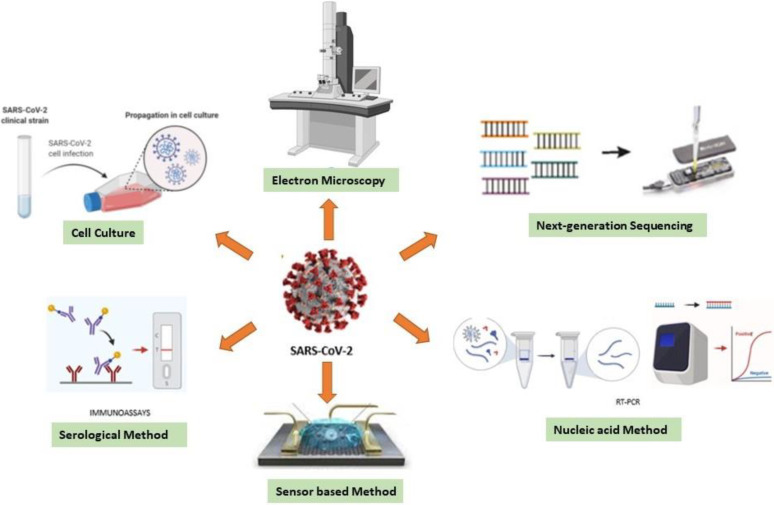
Severe acute respiratory syndrome coronavirus 2 (SARS-CoV-2) is the agent responsible for the coronavirus disease of 2019 (COVID-19), which triggers lung failure, pneumonia, and multi-organ dysfunction. This enveloped, positive sense and single-stranded RNA virus can be transmitted through aerosol droplets, direct and indirect contacts. Thus, SARS-CoV-2 is highly contagious and has reached a pandemic level in a few months. Since COVID-19 has caused numerous human casualties and severe economic loss posing a global threat, the development of readily available, accurate, fast, and cost-effective diagnostic techniques in hospitals and in any places where humans spread the virus is urgently required. COVID-19 can be diagnosed by clinical findings and several laboratory tests. These tests may include virus isolation, nucleic acid-based molecular assays like real-time polymerase chain reactions, antigen or antibody-based immunological assays such as rapid immunochromatographic tests, enzyme-linked immunosorbent assays, immunofluorescence techniques, and indirect fluorescent antibody techniques, electrochemical sensors, etc. However, current methods should be developed by novel approaches for sensitive, specific, and accurate diagnosis of COVID-19 cases to control and prevent this outbreak. Thus, this review will cover an overview and comparison of multiple reports and commercially available kits that include molecular tests, immunoassays, and sensor-based diagnostic methods for diagnosis of COVID-19. The pros and cons of these methods and future perspectives will be thoroughly evaluated and discussed.
严重急性呼吸综合征冠状病毒2(SARS-CoV-2)是引发2019冠状病毒病(COVID-19)的病原体,该疾病会导致肺衰竭、肺炎和多器官功能障碍。这种包膜的、正链单链RNA病毒可通过气溶胶飞沫、直接和间接接触传播。因此,SARS-CoV-2具有高度传染性,并在几个月内达到了大流行程度。由于COVID-19已造成众多人员伤亡和严重经济损失,对全球构成威胁,因此迫切需要在医院以及任何人类传播该病毒的场所开发便捷、准确、快速且经济高效的诊断技术。COVID-19可通过临床症状和多项实验室检测进行诊断。这些检测可能包括病毒分离、基于核酸的分子检测,如实时聚合酶链反应、基于抗原或抗体的免疫检测,如快速免疫层析检测、酶联免疫吸附测定、免疫荧光技术和间接荧光抗体技术、电化学传感器等。然而,目前的方法应通过新方法进行改进,以实现对COVID-19病例的灵敏、特异和准确诊断,从而控制和预防此次疫情爆发。因此,本综述将涵盖多篇报告和市售试剂盒的概述与比较,这些报告和试剂盒包括用于诊断COVID-19的分子检测、免疫测定和基于传感器的诊断方法。将对这些方法的优缺点及未来前景进行全面评估和讨论。