Amaral Teresa, Niessner Heike, Sinnberg Tobias, Thomas Ioannis, Meiwes Andreas, Garbe Claus, Garzarolli Marlene, Rauschenberg Ricarda, Eigentler Thomas, Meier Friedegund
Center for Dermatooncology, Department of Dermatology, Eberhard Karls University of Tuebingen, Tuebingen, Germany.
Health Care Direction, Portuguese Air Force, Lisbon, Portugal.
Neurooncol Adv. 2020 Oct 22;2(1):vdaa140. doi: 10.1093/noajnl/vdaa140. eCollection 2020 Jan-Dec.
Patients with melanoma brain metastasis (MBM) still carry a dismal prognosis. Preclinical data originated in xenograft models showed that buparlisib therapy was highly effective in therapy-naïve MBM.
In this open-label, phase II trial, we investigate the safety and efficacy of monotherapy with buparlisib, a PI3K inhibitor, in patients with asymptomatic MBM who were not candidates for local therapy. These patients had also progressed under immunotherapy if BRAF wild-type or under targeted therapy with BRAF/MEK inhibitors if carrying a BRAFV600E/K mutation. The primary endpoint was the intracranial disease control rate assessed by the investigators. The secondary endpoints were overall response rate, duration of response (DOR) of intracranial disease, overall response, progression-free survival (PFS), overall survival (OS), safety, and tolerability of buparlisib.
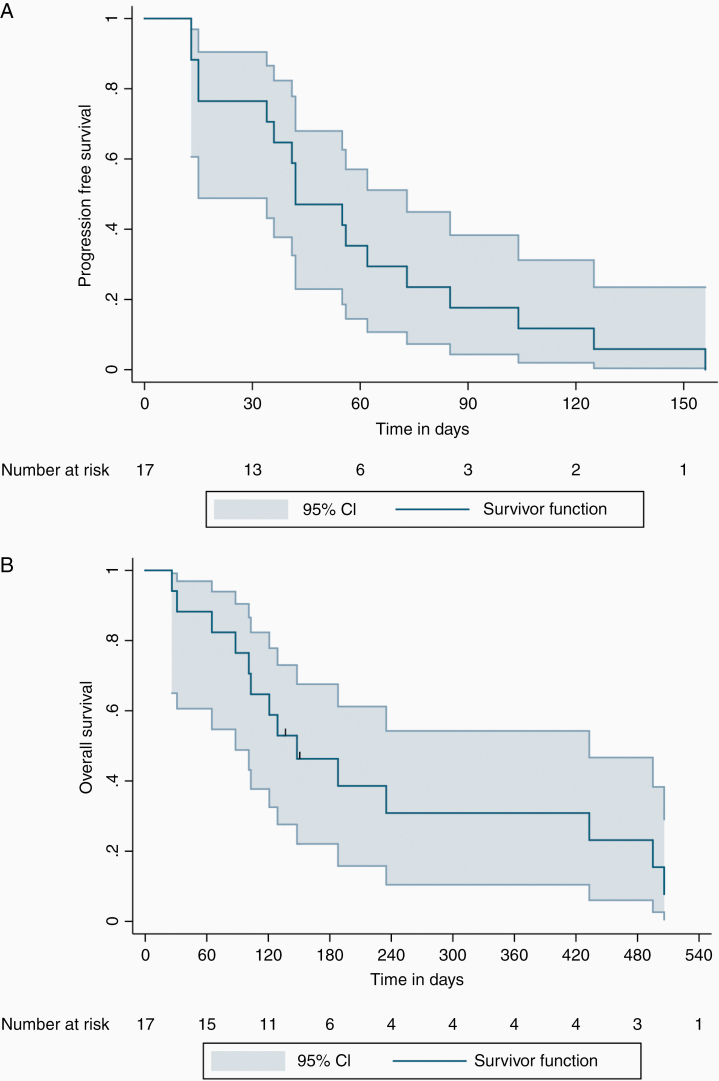
A total of 20 patients were screened and 17 patients were treated with buparlisib. Twelve patients had progressed under more than 2 systemic therapy lines and 17 had received at least 1 previous local therapy. There were no intracranial responses. Three patients achieved intracranial stable disease; the median DOR was 117 days. The median PFS was 42 days (95% confidence interval [CI]: 23-61 days) and the median OS was 5.0 months (95% CI: 2.24-7.76 months). No new safety signs were observed.
Buparlisib was well tolerated but no intracranial responses were observed. These results might be explained in part by the inclusion of only heavily pretreated patients. However, preclinical data strongly support the rationale to explore PI3K inhibitor-based combinations in patients with MBM displaying hyperactivation of the PI3K-AKT pathway.
黑色素瘤脑转移(MBM)患者的预后仍然很差。源自异种移植模型的临床前数据表明,布帕利昔治疗对未经治疗的MBM非常有效。
在这项开放标签的II期试验中,我们研究了PI3K抑制剂布帕利昔单药治疗无症状MBM且不适合局部治疗患者的安全性和有效性。如果是BRAF野生型,这些患者在免疫治疗下病情进展;如果携带BRAFV600E/K突变,则在接受BRAF/MEK抑制剂靶向治疗下病情进展。主要终点是研究者评估的颅内疾病控制率。次要终点是总体缓解率、颅内疾病的缓解持续时间(DOR)、总体缓解、无进展生存期(PFS)、总生存期(OS)、布帕利昔的安全性和耐受性。
共筛选了20例患者,17例患者接受了布帕利昔治疗。12例患者在超过2线全身治疗后病情进展,17例患者至少接受过1次先前的局部治疗。没有颅内缓解。3例患者达到颅内疾病稳定;中位DOR为117天。中位PFS为42天(95%置信区间[CI]:23 - 61天),中位OS为5.0个月(95%CI:2.24 - 7.76个月)。未观察到新的安全信号。
布帕利昔耐受性良好,但未观察到颅内缓解。这些结果可能部分归因于仅纳入了预处理严重的患者。然而,临床前数据有力地支持了在显示PI3K - AKT途径过度激活的MBM患者中探索基于PI3K抑制剂的联合治疗的理论依据。