Department of Orthopaedics, Tianjin Hospital, Tianjin, China.
Department of Bone and Soft Tissue Tumors, Tianjin Medical University Cancer Institute and Hospital, National Clinical Research Center for Cancer, Key Laboratory of Cancer Prevention and Therapy, Tianjin's Clinical Research Center for Cancer, Tianjin, China.
Orthop Surg. 2021 Feb;13(1):134-144. doi: 10.1111/os.12851. Epub 2020 Dec 10.
The aim of this study was to examine the survival rate of patients with different bone sarcomas and to investigate homogenous and heterogenous prognostic factors for different types of bone sarcomas.
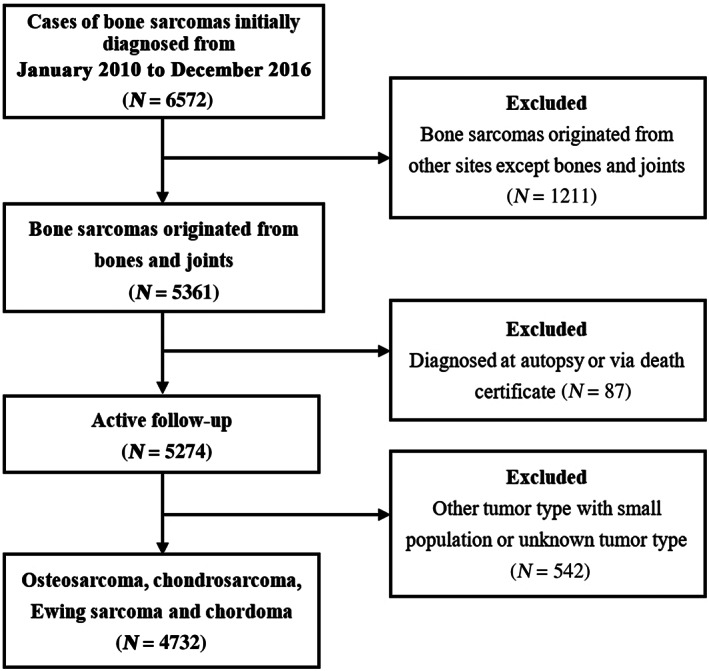
This is a retrospective analysis of records from the Surveillance, Epidemiology, and End Result (SEER) database. Clear information on the distant metastasis of cancer is provided in the SEER database for patients diagnosed between January 2010 and December 2016. Data for the four types of malignant bone sarcomas were extracted, including osteosarcoma, chondrosarcoma, Ewing sarcoma, and chordoma. Patients with bone sarcomas originated from other sites, diagnosed at autopsy, or indicated in death certification were excluded. The overall survival was calculated for the entire cohort and across different bone sarcomas using the Kaplan-Meier method. A subgroup analysis of the different survival rates of four types of bone sarcomas in various levels of each variable was conducted and the differences were tested with the log-rank test. Cox proportional hazard regression analysis was performed to determine the prognostic factors. Variables with P < 0.05 in the univariate Cox regression analysis were further analyzed using a multivariate Cox regression analysis. The prognostic factors in four groups of bone sarcomas were compared to determine the homogenous and heterogenous factors.
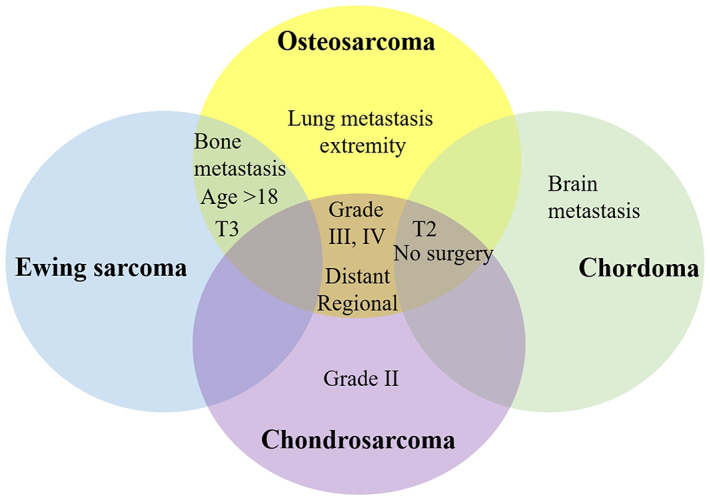
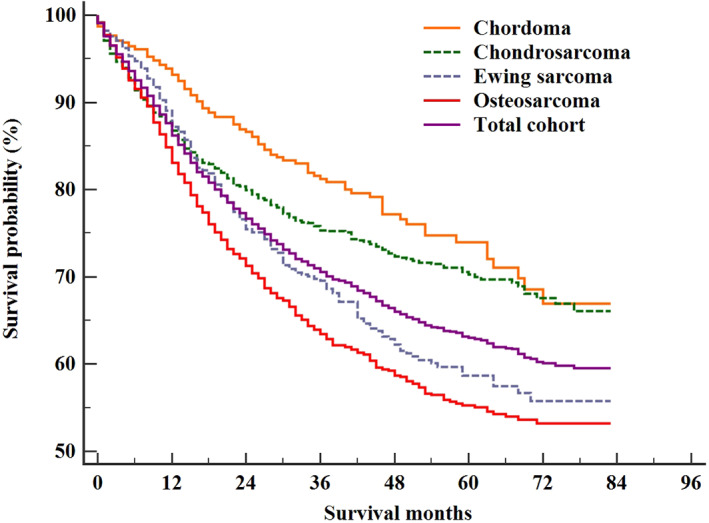
A total of 4732 patients were included with a follow up of 25 (0-83) months. The mean age of patients was 39.7 ± 24.1 years. The 1-year, 3-year, and 5-year overall survival rate for the entire cohort was 86.2% (95% confidence interval [CI]: 85.2%-87.2%), 70.5% (95% CI: 68.9%-72.1%), and 63.0% (95% CI: 61.2%-64.8%), respectively. Factors including age older than 40 years, higher grade, regional and distant stage, tumor in the extremities, T2 stage, bone and lung metastases, and non-surgery were significantly associated with the poor survival of the entire cohort. The mean overall survival duration of patients with chordoma, chondrosarcoma, Ewing sarcoma, and osteosarcoma was 66.86 (95% CI: 64.06-69.66), 63.53 (95% CI: 61.81-65.25), 58.06 (95% CI: 55.49-60.62) and 54.91 (95% CI: 53.14-56.69) months, respectively. Compared with chordoma, the hazard ratio (HR) and 95% CI for patients with chondrosarcoma, Ewing sarcoma, and osteosarcoma were 1.30 (95% CI: 1.04-1.62; P = 0.023), 1.69 (95% CI: 1.33-2.14; P < 0.001), and 2.00 (95% CI: 1.61-2.48; P <0.001), respectively. Different bone sarcomas showed homogenous and heterogenous prognostic factors.
Different clinicopathological characteristics and prognoses were revealed in patients with osteosarcoma, chondrosarcoma, Ewing sarcoma, and chordoma. The risk factors can potentially guide prognostic prediction and sarcoma-specific treatment.
本研究旨在探讨不同骨肉瘤患者的生存率,并探讨不同类型骨肉瘤的同质和异质预后因素。
这是对 Surveillance, Epidemiology, and End Result(SEER)数据库记录的回顾性分析。SEER 数据库为 2010 年 1 月至 2016 年 12 月期间诊断的患者提供了有关癌症远处转移的明确信息。提取了包括骨肉瘤、软骨肉瘤、尤文肉瘤和脊索瘤在内的四种恶性骨肉瘤的数据。排除了来自其他部位的骨肉瘤患者、尸检诊断或死亡证明中指出的患者。使用 Kaplan-Meier 方法计算整个队列和不同骨肉瘤的总生存率。对四种类型骨肉瘤在不同变量水平的不同生存率进行亚组分析,并使用对数秩检验检验差异。使用 Cox 比例风险回归分析确定预后因素。单因素 Cox 回归分析中 P<0.05 的变量进一步使用多因素 Cox 回归分析进行分析。比较四组骨肉瘤的预后因素,以确定同质和异质因素。
共纳入 4732 例患者,随访 25(0-83)个月。患者的平均年龄为 39.7±24.1 岁。整个队列的 1 年、3 年和 5 年总生存率分别为 86.2%(95%置信区间 [CI]:85.2%-87.2%)、70.5%(95% CI:68.9%-72.1%)和 63.0%(95% CI:61.2%-64.8%)。年龄大于 40 岁、高级别、局部和远处分期、四肢肿瘤、T2 期、骨和肺转移以及非手术等因素与整个队列的不良生存显著相关。脊索瘤、软骨肉瘤、尤文肉瘤和骨肉瘤患者的平均总生存时间分别为 66.86(95% CI:64.06-69.66)、63.53(95% CI:61.81-65.25)、58.06(95% CI:55.49-60.62)和 54.91(95% CI:53.14-56.69)个月。与脊索瘤相比,软骨肉瘤、尤文肉瘤和骨肉瘤患者的风险比(HR)和 95%CI 分别为 1.30(95%CI:1.04-1.62;P=0.023)、1.69(95%CI:1.33-2.14;P<0.001)和 2.00(95%CI:1.61-2.48;P<0.001)。不同的骨肉瘤表现出同质和异质的预后因素。
骨肉瘤、软骨肉瘤、尤文肉瘤和脊索瘤患者表现出不同的临床病理特征和预后。这些风险因素可能有助于预后预测和肉瘤特异性治疗。