Department of Pharmaceutical and Pharmacological Sciences, KU Leuven, Leuven, Belgium.
Hospital Pharmacy, The Erasmus University Medical Center, Molewaterplein 40, 3015 GD, Rotterdam, The Netherlands.
BioDrugs. 2021 Jan;35(1):75-87. doi: 10.1007/s40259-020-00456-5.
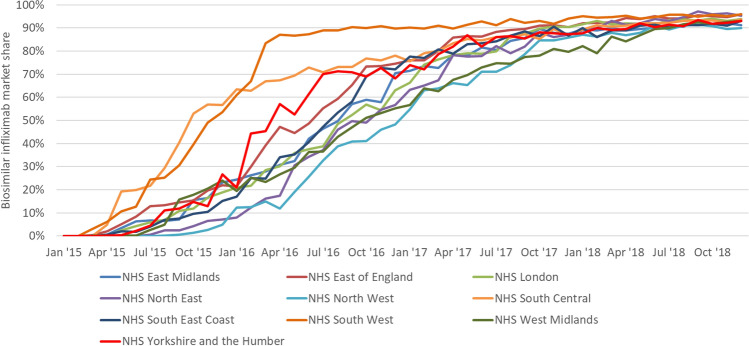
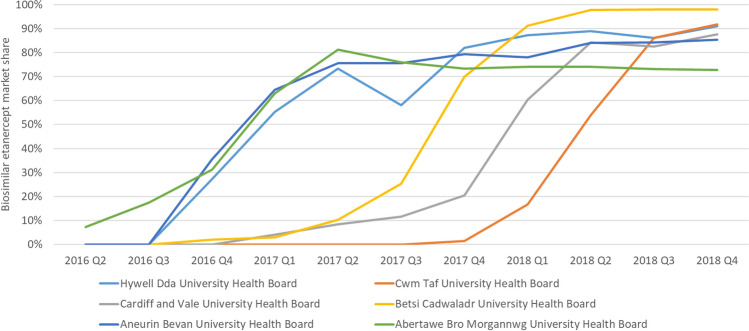
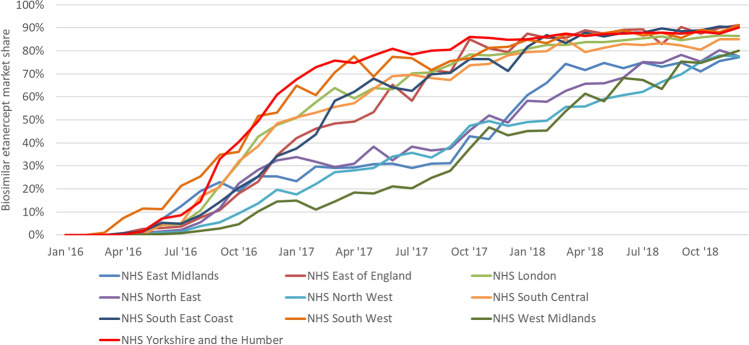
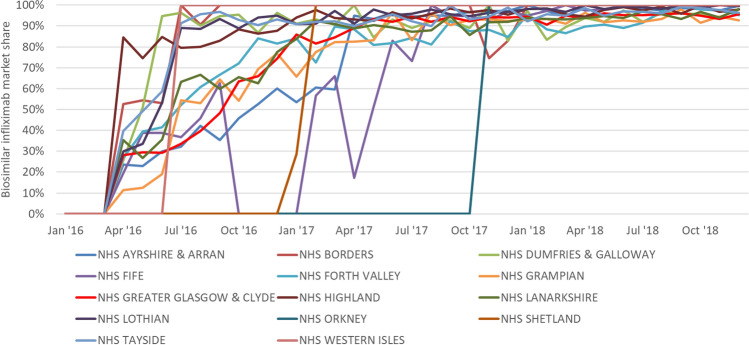
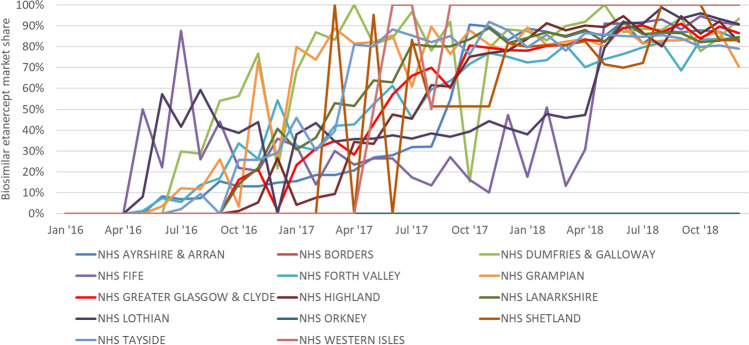
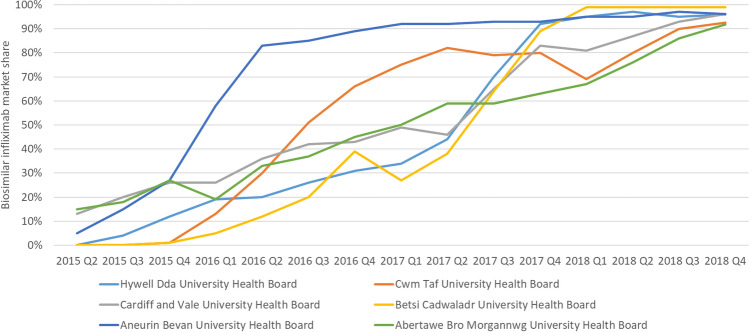
Regions within England, Scotland and Wales show variation in rate of adoption of biosimilar infliximab and etanercept.
This study aims to examine how local decisions and practices in regions within England, Scotland and Wales might explain initial variation in market dynamics of biosimilar and originator infliximab and etanercept.
Market data provided by the National Health Service (NHS) on biosimilar and originator infliximab and etanercept uptake were analysed for the 10 historical regions of England, 14 health boards in Scotland and 7 health boards in Wales (2015-2018). Findings were discussed in ten semi-structured interviews: on a national level with an industry representative (1), on a regional level with NHS employees in England (6), Scotland (1) and Wales (1), and on a local level with a representative of a clinical commissioning group in England (1).
Tenders for infliximab and etanercept in England, Scotland and Wales have consistently resulted in a biosimilar as the best value biological. Early and late biosimilar adopters are seen, with overall convergence towards high biosimilar market shares over time. Qualitative results suggest that biosimilar adoption was positively influenced by (a) a price difference between biosimilar and originator product making it worthwhile to switch patients; (b) a good relationship between commissioner and provider in England resulting in gain share agreements; (c) leadership on biosimilars in regional NHS offices in England or Scottish and Welsh health boards; (d) key opinion leaders or leading hospitals that start using biosimilars early and gain experience.
This study has shown that the savings potential drives biosimilar use. Regions with a proactive attitude, good stakeholder relationships, and clinician engagement were identified as early adopters.
英格兰、苏格兰和威尔士的各个地区在英夫利昔单抗和依那西普生物类似药的采用率方面存在差异。
本研究旨在考察英格兰、苏格兰和威尔士各地区的本地决策和实践如何解释英夫利昔单抗和依那西普生物类似药和原研药市场动态的初始差异。
对英格兰的 10 个历史地区、苏格兰的 14 个卫生委员会和威尔士的 7 个卫生委员会(2015-2018 年)的 NHS 提供的生物类似药和原研药英夫利昔单抗和依那西普的市场数据进行分析。在国家层面上与行业代表(1 人)、英格兰(6 人)、苏格兰(1 人)和威尔士(1 人)的 NHS 员工进行了 10 次半结构访谈,并对结果进行了讨论,在英格兰的一个临床委托小组的代表(1 人)进行了当地层面的讨论。
英格兰、苏格兰和威尔士的英夫利昔单抗和依那西普招标一直导致生物类似药成为最佳价值的生物制剂。早期和晚期的生物类似药采用者都出现了,随着时间的推移,整体向高生物类似药市场份额趋同。定性结果表明,生物类似药的采用受到以下因素的积极影响:(a)生物类似药与原研产品之间的价格差异,使患者转换值得;(b)英格兰的委托人与提供者之间的良好关系,促成了增益份额协议;(c)英格兰 NHS 办公室或苏格兰和威尔士卫生委员会的区域内对生物类似药的领导;(d)早期开始使用生物类似药并积累经验的关键意见领袖或领先医院。
本研究表明,节省潜力推动了生物类似药的使用。具有积极态度、良好利益相关者关系和临床医生参与的地区被确定为早期采用者。