Implementation Science Center for Cancer Control and Prevention Research Center, Brown School, Washington University in St. Louis, One Brookings Drive, St. Louis, MO, 63130, USA.
Department of Surgery (Division of Public Health Sciences), Washington University School of Medicine, Washington University in St. Louis, St. Louis, MO, 63110, USA.
Int J Behav Nutr Phys Act. 2020 Dec 11;17(1):162. doi: 10.1186/s12966-020-01070-y.
School wellness programming is important for promoting healthy lifestyles and academic achievement in youth; however, research is needed on methods that can help schools implement and sustain such programs on their own. The purpose of this study was to investigate factors within and outside the school environment that influenced school capacity for implementation and potential sustainability of wellness programming.
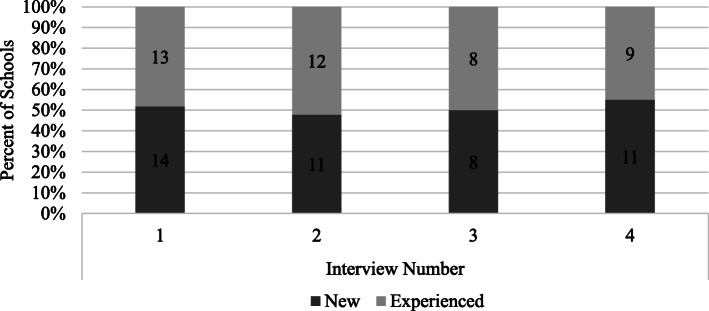
As part of the School Wellness Integration Targeting Child Health (SWITCH®) intervention, elementary school wellness teams (N = 30) were guided through a capacity-building process focused on promoting the adoption of healthy lifestyle behaviors in students. Data on implementation were collected through three standardized surveys and interviews (pre-mid-post) and a post-implementation interview. Indicators of organizational capacity were assessed using the School Wellness Readiness Assessment (SWRA). Paired t-tests were run to assess changes in implementation (classroom, physical education, and lunchroom settings), capacity, and stakeholder engagement over time. One-way analysis of variance (ANOVA) tests were run to examine how implementation of best practices (low, moderate, high) explained differences in capacity gains. Qualitative data were analyzed through inductive and deductive analysis, following the Consolidated Framework for Implementation Research (CFIR).
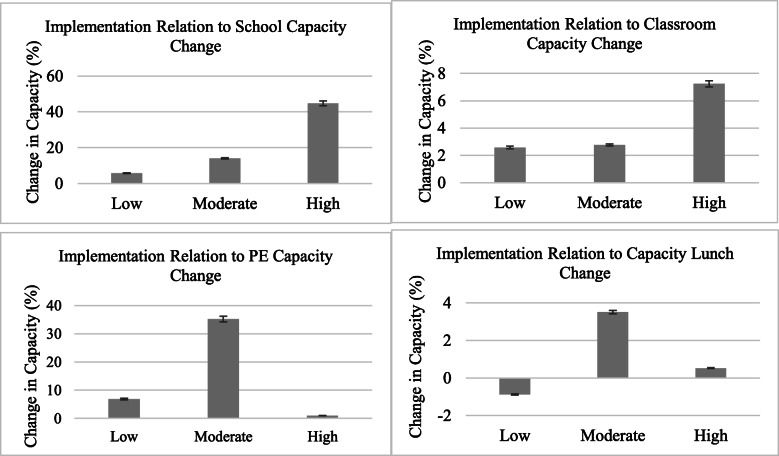
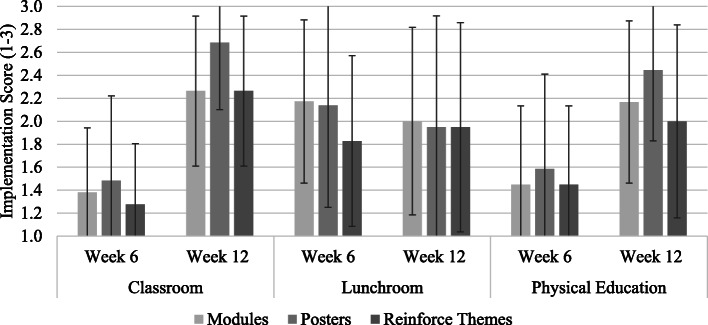
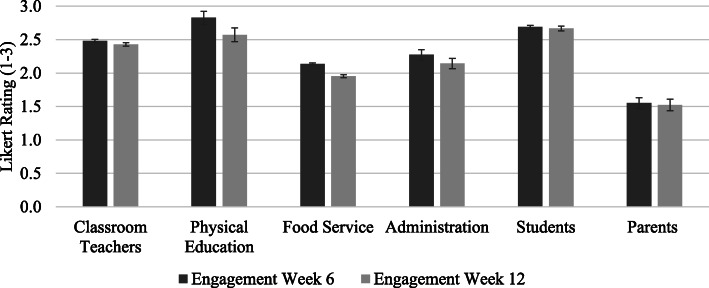
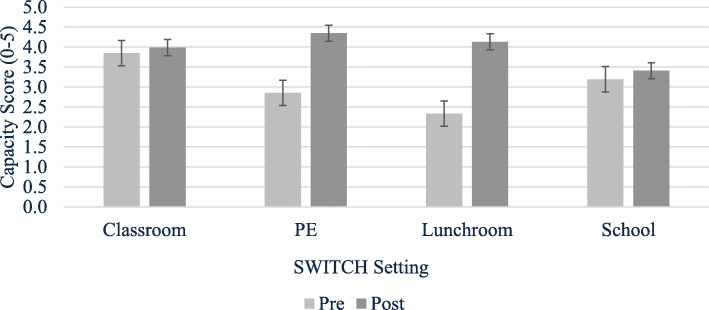
Paired t-tests showed non-significant increases in school and setting-specific capacity and implementation of SWITCH best practices over time, in addition to a consistent level of engagement from key stakeholders. ANOVA results revealed non-significant associations between implementation group and gains in school capacity (F [2, 24] = 1.63; p = .21), class capacity (F [2, 24]=0.20 p = .82), lunchroom capacity (F [2, 24]=0.29; p = .78), and physical education (F [2, 24]=1.45; p = .25). Qualitative data demonstrated that factors within the outer setting (i.e., engaging community partners) facilitated programming. Inner-setting factors (i.e., relationships with administration and staff) influenced implementation. Implementation process themes (e.g., planning, adaptation of resources to meet school capacity/needs, and engaging students as leaders) were cited as key facilitators. Schools discussed factors affecting sustainability, such as school culture and knowledge of school wellness policy.
The results from this implementation study document the importance of allowing schools to adapt programming to meet their local needs, and highlight the strengths of measuring multiple implementation outcomes. Increased support is needed for schools regarding the formation and improvement of wellness policies as a means to enhance sustainability over time.
学校健康计划对于促进青少年的健康生活方式和学业成就非常重要;然而,需要研究能够帮助学校自行实施和维持此类计划的方法。本研究的目的是调查学校环境内外影响健康计划实施能力和潜在可持续性的因素。
作为学校健康综合促进儿童健康(SWITCH®)干预的一部分,小学健康团队(N=30)接受了一项能力建设过程的指导,重点是促进学生养成健康的生活方式行为。通过三个标准化调查和访谈(预-中-后)以及实施后的访谈收集实施数据。使用学校健康准备评估(SWRA)评估组织能力指标。进行配对 t 检验以评估随时间推移实施(课堂、体育和午餐室环境)、能力和利益相关者参与的变化。单因素方差分析(ANOVA)检验用于检查最佳实践(低、中、高)的实施情况如何解释能力提升的差异。通过归纳和演绎分析对定性数据进行分析,遵循实施研究综合框架(CFIR)。
配对 t 检验显示,随着时间的推移,SWITCH 最佳实践的学校和环境特定能力和实施没有显著增加,主要利益相关者的参与度也保持一致。方差分析结果显示,实施组与学校能力(F [2, 24]=1.63;p=0.21)、班级能力(F [2, 24]=0.20;p=0.82)、午餐室能力(F [2, 24]=0.29;p=0.78)和体育教育(F [2, 24]=1.45;p=0.25)之间没有显著关联。定性数据表明,外部环境中的因素(即吸引社区合作伙伴)促进了计划的开展。内部环境因素(例如,与管理层和员工的关系)影响实施。实施过程主题(例如,规划、调整资源以满足学校能力/需求以及让学生担任领导者)被认为是关键的促进因素。学校讨论了影响可持续性的因素,例如学校文化和对学校健康政策的了解。
这项实施研究的结果记录了允许学校根据当地需求调整计划的重要性,并强调了衡量多种实施结果的优势。需要为学校提供更多支持,以制定和完善健康政策,以随着时间的推移提高可持续性。