Duke-Margolis Center for Health Policy, 100 Fuqua Drive, Box 90120, Durham, NC, 27708, USA.
Duke University School of Medicine, Department of Population Health Sciences, 215 Morris Street, Durham, NC, 27701, USA.
Implement Sci. 2020 Dec 11;15(1):108. doi: 10.1186/s13012-020-01070-3.
Implementation of multifaceted interventions typically involves many diverse elements working together in interrelated ways, including intervention components, implementation strategies, and features of local context. Given this real-world complexity, implementation researchers may be interested in a new mathematical, cross-case method called Coincidence Analysis (CNA) that has been designed explicitly to support causal inference, answer research questions about combinations of conditions that are minimally necessary or sufficient for an outcome, and identify the possible presence of multiple causal paths to an outcome. CNA can be applied as a standalone method or in conjunction with other approaches and can reveal new empirical findings related to implementation that might otherwise have gone undetected.
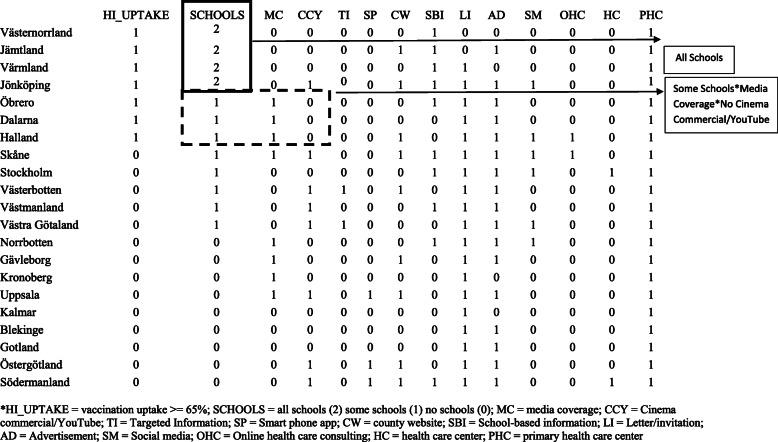
We applied CNA to a publicly available dataset from Sweden with county-level data on human papillomavirus (HPV) vaccination campaigns and vaccination uptake in 2012 and 2014 and then compared CNA results to the published regression findings.
The original regression analysis found vaccination uptake was positively associated only with the availability of vaccines in schools. CNA produced different findings and uncovered an additional solution path: high vaccination rates were achieved by either (1) offering the vaccine in all schools or (2) a combination of offering the vaccine in some schools and media coverage.
CNA offers a new comparative approach for researchers seeking to understand how implementation conditions work together and link to outcomes.
多方面干预措施的实施通常涉及许多不同的元素以相互关联的方式共同作用,包括干预组成部分、实施策略以及当地环境的特点。鉴于这种现实世界的复杂性,实施研究人员可能对一种新的数学、跨案例方法——协同分析(CNA)感兴趣,该方法旨在明确支持因果推断,回答关于结果所需或充分的条件组合的研究问题,并确定通向结果的多个因果路径的可能存在。CNA 可以作为独立的方法或与其他方法结合使用,并且可以揭示与实施相关的新的经验发现,否则这些发现可能会被忽略。
我们将 CNA 应用于瑞典的一个公开数据集,该数据集包含 2012 年和 2014 年县一级的人乳头瘤病毒(HPV)疫苗接种运动和接种率数据,然后将 CNA 结果与已发表的回归结果进行比较。
原始回归分析发现,疫苗接种率仅与学校提供疫苗的情况呈正相关。CNA 得出了不同的发现,并揭示了另一条解决方案路径:通过(1)在所有学校提供疫苗或(2)在一些学校提供疫苗和媒体报道相结合,实现了高疫苗接种率。
CNA 为寻求理解实施条件如何共同作用并与结果相关联的研究人员提供了一种新的比较方法。