MRC Cognition and Brain Sciences Unit, University of Cambridge, 15 Chaucer Road, Cambridge, CB2 7EF, UK.
Department of Experimental Psychology, University of Oxford, Anna Watts Building, Radcliffe Observatory Quarter, Woodstock Road, Oxford, OX2 6GG, UK.
Mol Autism. 2020 Dec 11;11(1):98. doi: 10.1186/s13229-020-00403-9.
The relationships between specific genetic aetiology and phenotype in neurodevelopmental disorders are complex and hotly contested. Genes associated with intellectual disability (ID) can be grouped into networks according to gene function. This study explored whether individuals with ID show differences in autism spectrum characteristics (ASC), depending on the functional network membership of their rare, pathogenic de novo genetic variants.
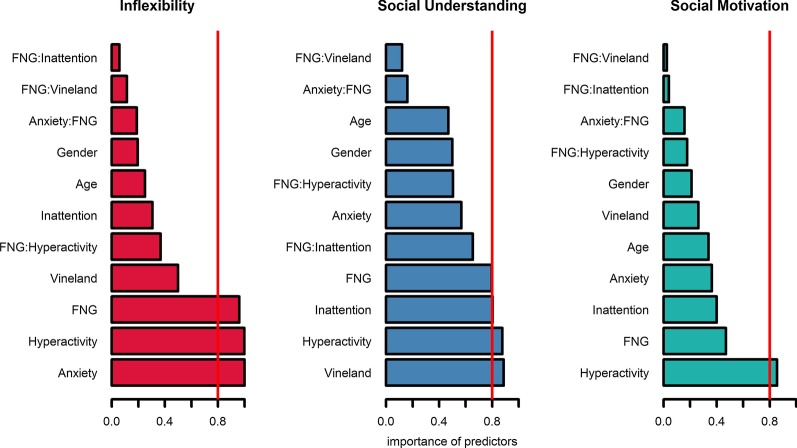
Children and young people with ID of known genetic origin were allocated to two broad functional network groups: synaptic physiology (n = 29) or chromatin regulation (n = 23). We applied principle components analysis to the Social Responsiveness Scale to map the structure of ASC in this population and identified three components-Inflexibility, Social Understanding and Social Motivation. We then used Akaike information criterion to test the best fitting models for predicting ASC components, including demographic factors (age, gender), non-ASC behavioural factors (global adaptive function, anxiety, hyperactivity, inattention), and gene functional networks.
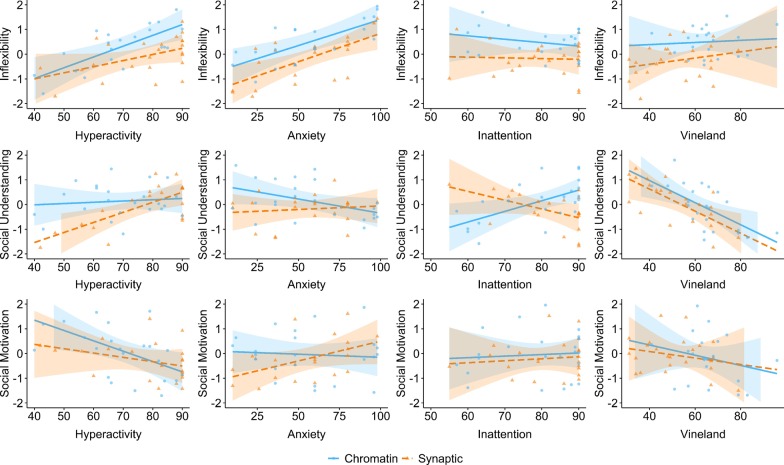
We found that, when other factors are accounted for, the chromatin regulation group showed higher levels of Inflexibility. We also observed contrasting predictors of ASC within each network group. Within the chromatin regulation group, Social Understanding was associated with inattention, and Social Motivation was predicted by hyperactivity. Within the synaptic group, Social Understanding was associated with hyperactivity, and Social Motivation was linked to anxiety.
Functional network definitions were manually curated based on multiple sources of evidence, but a data-driven approach to classification may be more robust. Sample sizes for rare genetic diagnoses remain small, mitigated by our network-based approach to group comparisons. This is a cross-sectional study across a wide age range, and longitudinal data within focused age groups will be informative of developmental trajectories across network groups.
We report that gene functional networks can predict Inflexibility, but not other ASC dimensions. Contrasting behavioural associations within each group suggest network-specific developmental pathways from genomic variation to autism. Simple classification of neurodevelopmental disorder genes as high risk or low risk for autism is unlikely to be valid or useful.
神经发育障碍中特定遗传病因与表型之间的关系复杂且存在争议。与智力障碍(ID)相关的基因可根据基因功能分为网络。本研究探讨了具有 ID 的个体是否因罕见致病性新生基因突变的功能网络成员而异,表现出不同的自闭症谱系特征(ASC)。
将具有已知遗传起源的 ID 儿童和年轻人分配到两个广泛的功能网络组:突触生理学(n=29)或染色质调节(n=23)。我们应用主成分分析对社会反应量表进行分析,以绘制该人群中 ASC 的结构,并确定了三个成分-刻板性、社交理解和社交动机。然后,我们使用赤池信息量准则来测试预测 ASC 成分的最佳拟合模型,包括人口统计学因素(年龄、性别)、非 ASC 行为因素(整体适应功能、焦虑、多动、注意力不集中)和基因功能网络。
我们发现,在考虑其他因素的情况下,染色质调节组表现出更高水平的刻板性。我们还观察到每个网络组内 ASC 的预测因素存在差异。在染色质调节组中,社交理解与注意力不集中有关,社交动机与多动有关。在突触组中,社交理解与多动有关,社交动机与焦虑有关。
功能网络定义是基于多种来源的证据手动整理的,但基于数据的分类方法可能更稳健。罕见遗传诊断的样本量仍然较小,我们的网络分组比较方法缓解了这一问题。这是一项跨年龄范围的横断面研究,在特定年龄组内进行纵向数据将有助于了解网络分组之间的发展轨迹。
我们报告称,基因功能网络可以预测刻板性,但不能预测其他 ASC 维度。每个组内的对比行为关联表明,从基因组变异到自闭症,存在网络特异性的发育途径。简单地将神经发育障碍基因分类为自闭症的高风险或低风险不太可能是有效或有用的。