Division of Nephrology & Hypertension, University of Cincinnati, Kidney C.A.R.E. Program, Cincinnati, OH.
Adv Chronic Kidney Dis. 2020 Sep;27(5):383-389. doi: 10.1053/j.ackd.2020.07.004. Epub 2020 Jul 17.
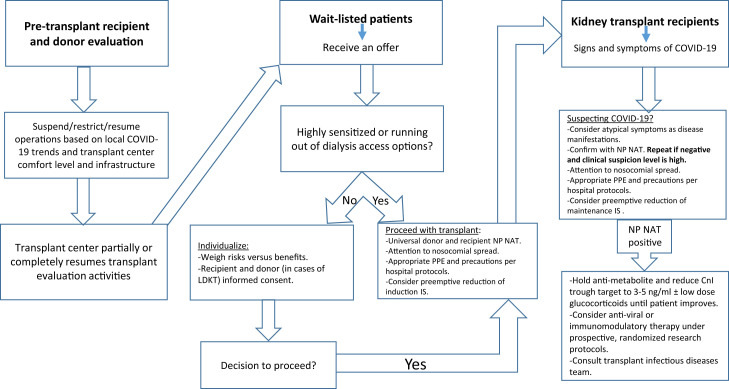
The coronavirus disease 2019 (COVID-19) pandemic, caused by the severe acute respiratory syndrome coronavirus 2, has led to the death of hundreds of thousands of people worldwide. If infected, older individuals and those with diabetes, hypertension, cardiovascular disease, and compromised immune systems are at higher risk for unfavorable outcomes. These comorbidities are prevalent in patients with kidney disease, hence the significant burden of COVID-19 on kidney transplant programs. Multiple case series of kidney transplant recipients with COVID-19 have shown increased mortality compared to nontransplant patients. To date, we do not have high-level evidence to inform immunosuppression minimization strategies in infected transplant recipients. Most centers however have adopted early antimetabolite withdrawal in addition to other interventions. This review summarizes the published COVID-19 literature as it relates to outcomes and immunosuppression management in kidney transplant recipients. It also discusses challenges pertaining to pretransplant evaluation and wait-listed patients.
新型冠状病毒病 2019(COVID-19)大流行是由严重急性呼吸系统综合征冠状病毒 2 引起的,导致全球数万人死亡。如果感染,老年人以及患有糖尿病、高血压、心血管疾病和免疫系统受损的人发生不良后果的风险更高。这些合并症在患有肾脏疾病的患者中很常见,因此 COVID-19 对肾脏移植项目造成了重大负担。多项 COVID-19 肾移植受者的病例系列研究表明,与非移植患者相比,死亡率更高。迄今为止,我们没有高水平的证据来为感染的移植受者提供免疫抑制最小化策略。然而,大多数中心除了其他干预措施外,还采用了早期停用抗代谢物。这篇综述总结了已发表的与 COVID-19 相关的肾移植受者的结局和免疫抑制管理的文献。它还讨论了与移植前评估和候补患者相关的挑战。