Department of Sociology and Anthropology, University of Texas at El Paso; 500 West University Avenue, El Paso, TX 79968, USA.
Environ Res. 2021 Feb;193:110586. doi: 10.1016/j.envres.2020.110586. Epub 2020 Dec 10.
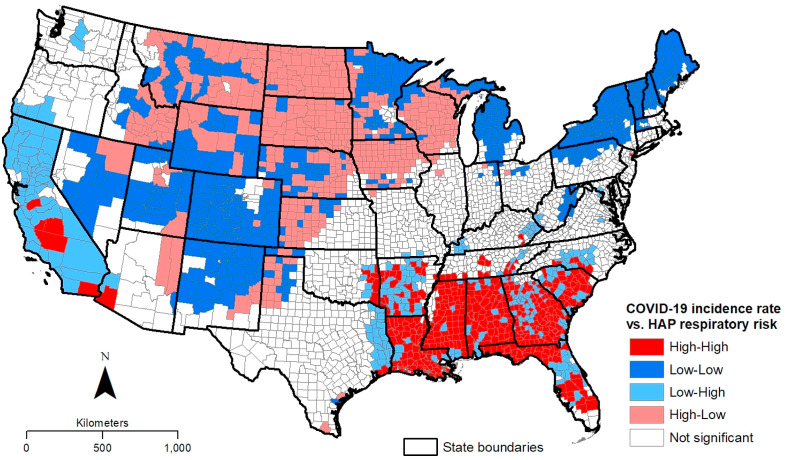
Recent research suggests greater COVID-19 prevalence in areas burdened with higher exposure to chronic air pollution, but previous studies have not examined if socially disadvantaged populations are more likely to reside in communities located at the convergence of both COVID-19 and air pollution health risks. This article presents a national scale U.S. study that investigates whether racial/ethnic minorities, socioeconomically deprived residents, and other vulnerable groups are significantly overrepresented in counties where significantly higher COVID-19 incidence spatially coincides with higher respiratory health risks from outdoor exposure to hazardous air pollutants (HAPs). COVID-19 data from the Johns Hopkins Center for Systems Science and Engineering database are linked to respiratory risk estimates from the U.S. Environmental Protection Agency's National Air Toxics Assessment and variables from the 2018 American Community Survey. Bivariate local measures of spatial association are implemented to identify county clusters representing relationships between COVID-19 incidence rate and respiratory risk from HAP exposure. Socio-demographic characteristics of these clusters are compared using bivariate statistical tests and multivariable generalized estimating equations. Counties where greater COVID-19 incidence coincides significantly with higher HAP respiratory risk contain disproportionately higher percentages of non-Hispanic Black, socioeconomically deprived, and uninsured residents than all other U.S. counties, after controlling for spatial clustering, population density, older age, and other contextual factors. These significant socio-demographic inequities represent an important starting point for more detailed investigations of places facing the double burden of elevated COVID-19 prevalence and air pollution exposure, and also emphasize the urgent need to develop mitigation strategies for addressing both COVID-19 and chronic air pollution in socially vulnerable communities.
最近的研究表明,在慢性空气污染暴露程度较高的地区,COVID-19 的患病率更高,但以前的研究并未考察社会弱势群体是否更有可能居住在 COVID-19 和空气污染健康风险交汇的社区。本文介绍了一项美国全国范围内的研究,该研究调查了在 COVID-19 发病率明显较高且与室外接触危险空气污染物(HAP)导致呼吸道健康风险较高的地区,是否存在种族/族裔少数群体、经济贫困居民和其他弱势群体的比例显著过高的情况。约翰霍普金斯大学系统科学与工程中心数据库中的 COVID-19 数据与美国环境保护署国家空气毒物评估中的呼吸风险估计以及 2018 年美国社区调查中的变量相关联。实施了二元局部空间关联度量,以确定代表 COVID-19 发病率与 HAP 暴露导致呼吸道风险之间关系的县集群。使用二元统计检验和多变量广义估计方程比较这些集群的社会人口统计学特征。在控制空间聚类、人口密度、年龄较大和其他背景因素后,与更高的 HAP 呼吸风险显著相关的 COVID-19 发病率更高的县比美国所有其他县包含不成比例的更高比例的非西班牙裔黑人、经济贫困和没有保险的居民。这些显著的社会人口不平等现象代表了对面临 COVID-19 患病率和空气污染暴露双重负担的地方进行更详细调查的重要起点,也强调了迫切需要制定缓解策略,以解决社会弱势群体面临的 COVID-19 和慢性空气污染问题。