Section of Environmental Epidemiology and Toxicology, Office of Public Health, Louisiana Department of Health, Baton Rouge, Louisiana, United States of America.
PLoS One. 2022 Feb 23;17(2):e0264336. doi: 10.1371/journal.pone.0264336. eCollection 2022.
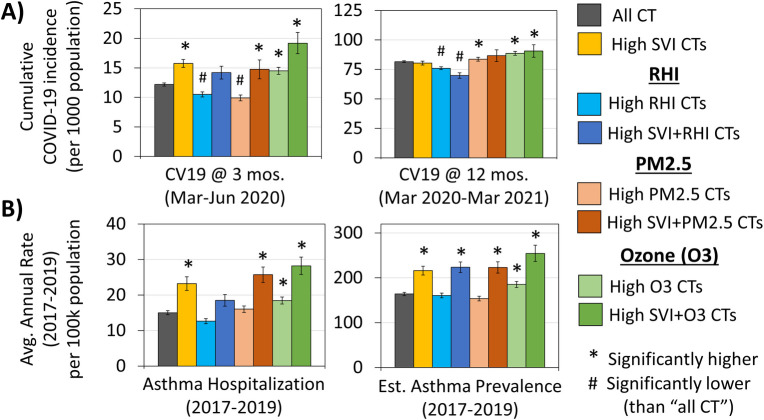
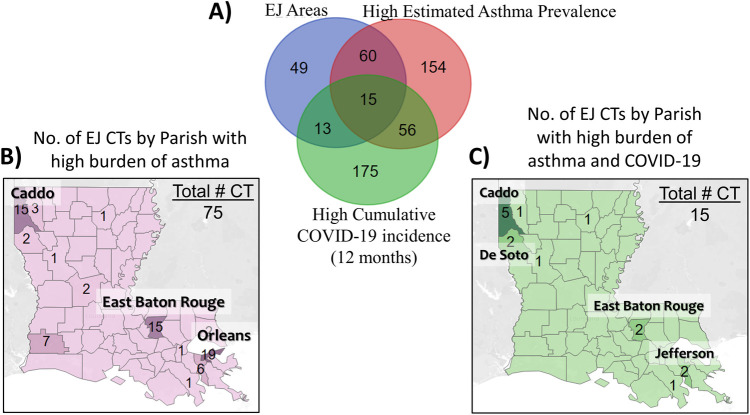
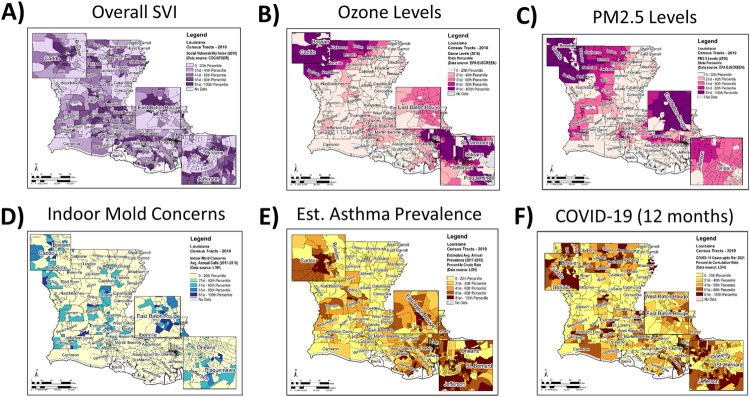
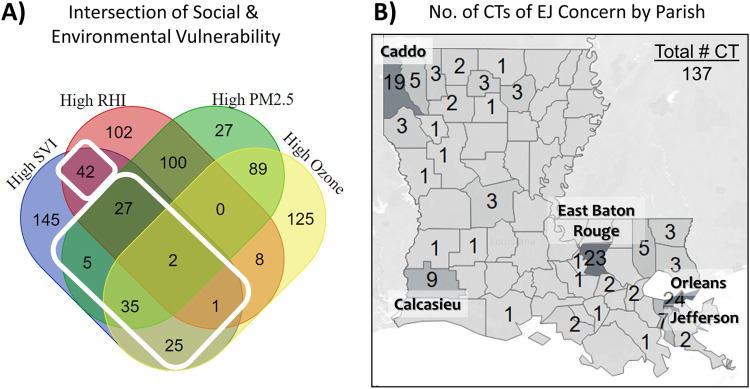
The COVID-19 pandemic has disproportionately affected the socially and environmentally vulnerable, including through indirect effects on other health conditions. Asthma is one such condition, which may be exacerbated by both prolonged adverse in-home exposures if quarantining in unhealthy homes and prolonged outdoor exposures if the ambient air quality is unhealthy or hazardous. As both are often the case in Environmental Justice (EJ) communities, here we have analyzed data at the census tract (CT) level for Louisiana to assess any correlation between social and environmental vulnerability, and health issues like COVID-19 and asthma. Higher Social Vulnerability Index (SVI), Particulate Matter less than 2.5 μm in diameter (PM2.5) and Ozone levels were associated with higher rates of cumulative COVID-19 incidence at various time points during the pandemic, as well as higher average annual asthma hospitalization rates and estimated asthma prevalence. Further, cumulative COVID-19 incidence during the first three months of the pandemic was moderately correlated with both asthma hospitalizations and estimated prevalence, suggesting similar underlying factors may be affecting both conditions. Additionally, 137 CTs were identified where social and environmental vulnerabilities co-existed, of which 75 (55%) had high estimated prevalence of asthma. These areas are likely to benefit from asthma outreach that considers both social and environmental risk factors. Fifteen out of the 137 CTs (11%) not only had higher estimated prevalence of asthma but also a high burden of COVID-19. Further research in these areas may help to elucidate any common social determinants of health that underlie both asthma and COVID-19 burdens, as well as better clarify the possible role of the environment as related to the COVID-19 burden in Louisiana.
COVID-19 大流行对社会和环境脆弱的人群造成了不成比例的影响,包括通过对其他健康状况的间接影响。哮喘就是这样一种情况,如果在不健康的家中隔离,可能会因长期的不利家庭内暴露而加剧,如果环境空气质量不健康或有害,也可能会因长期的户外暴露而加剧。由于这两种情况在环境正义(EJ)社区中经常发生,因此我们在这里分析了路易斯安那州的普查区(CT)层面的数据,以评估社会和环境脆弱性与 COVID-19 和哮喘等健康问题之间的任何相关性。较高的社会脆弱性指数(SVI)、直径小于 2.5μm 的颗粒物(PM2.5)和臭氧水平与大流行期间各个时间点 COVID-19 累计发病率的较高率、平均每年哮喘住院率和估计的哮喘患病率相关。此外,大流行前三个月 COVID-19 的累计发病率与哮喘住院率和估计患病率中度相关,表明可能有类似的潜在因素影响这两种情况。此外,确定了 137 个社会和环境脆弱性并存的 CT,其中 75 个(55%)有高估计的哮喘患病率。这些地区可能受益于考虑社会和环境风险因素的哮喘外展活动。在这 137 个 CT 中有 15 个(11%)不仅有较高的估计哮喘患病率,而且 COVID-19 负担也很高。在这些地区进行进一步的研究可能有助于阐明潜在的共同健康社会决定因素,这些因素是哮喘和 COVID-19 负担的基础,并更好地阐明环境与路易斯安那州 COVID-19 负担之间的可能关系。