National Taiwan University Children's Hospital, Taipei, Taiwan.
iMediPlus Inc., Hsinchu, Taiwan.
Sci Rep. 2020 Dec 11;10(1):21797. doi: 10.1038/s41598-020-77994-z.
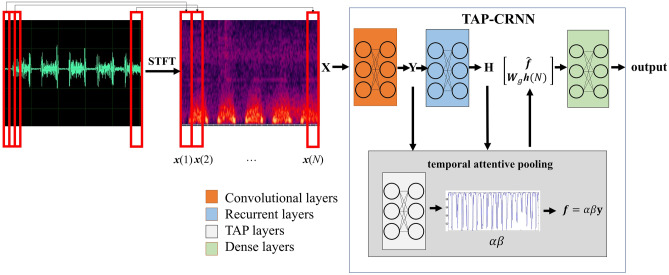
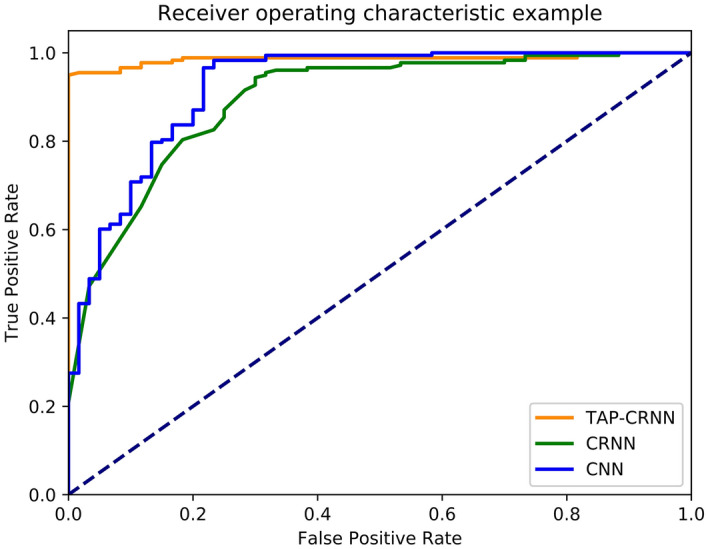
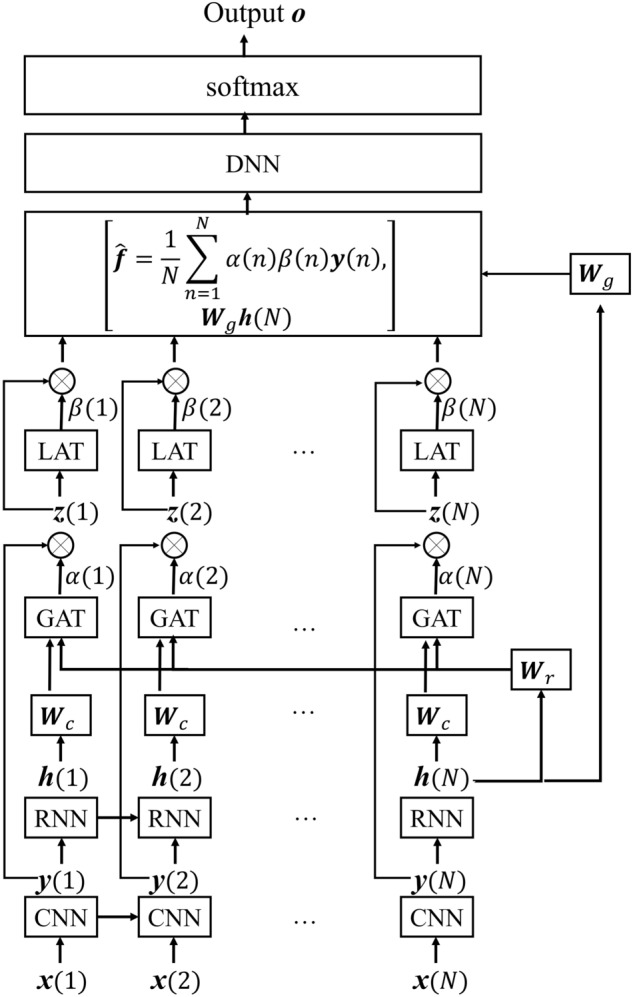
Recognizing specific heart sound patterns is important for the diagnosis of structural heart diseases. However, the correct recognition of heart murmur depends largely on clinical experience. Accurately identifying abnormal heart sound patterns is challenging for young and inexperienced clinicians. This study is aimed at the development of a novel algorithm that can automatically recognize systolic murmurs in patients with ventricular septal defects (VSDs). Heart sounds from 51 subjects with VSDs and 25 subjects without a significant heart malformation were obtained in this study. Subsequently, the soundtracks were divided into different training and testing sets to establish the recognition system and evaluate the performance. The automatic murmur recognition system was based on a novel temporal attentive pooling-convolutional recurrent neural network (TAP-CRNN) model. On analyzing the performance using the test data that comprised 178 VSD heart sounds and 60 normal heart sounds, a sensitivity rate of 96.0% was obtained along with a specificity of 96.7%. When analyzing the heart sounds recorded in the second aortic and tricuspid areas, both the sensitivity and specificity were 100%. We demonstrated that the proposed TAP-CRNN system can accurately recognize the systolic murmurs of VSD patients, showing promising potential for the development of software for classifying the heart murmurs of several other structural heart diseases.
识别特定的心脏音模式对于结构性心脏病的诊断很重要。然而,心脏杂音的正确识别在很大程度上取决于临床经验。对于年轻且经验不足的临床医生来说,准确识别异常的心脏音模式具有挑战性。本研究旨在开发一种新的算法,该算法可以自动识别室间隔缺损(VSD)患者的收缩期杂音。本研究获得了 51 例 VSD 患者和 25 例无明显心脏畸形患者的心脏音。随后,将音轨分为不同的训练集和测试集,以建立识别系统并评估性能。自动杂音识别系统基于一种新颖的基于时间注意力池化卷积递归神经网络(TAP-CRNN)模型。在使用包含 178 个 VSD 心音和 60 个正常心音的测试数据进行性能分析时,获得了 96.0%的灵敏度和 96.7%的特异性。在分析记录在第二主动脉瓣和三尖瓣区的心脏音时,灵敏度和特异性均为 100%。我们证明,所提出的 TAP-CRNN 系统可以准确识别 VSD 患者的收缩期杂音,为开发用于分类几种其他结构性心脏病的心脏杂音的软件展示了良好的应用前景。