Franck Martin, Thon Cosima, Schütte Kerstin, Malfertheiner Peter, Link Alexander
Department of Gastroenterology, Hepatology and Endocrinology, Hannover Medical School, Hannover 30625, Germany.
Department of Gastroenterology, Hepatology and Infectious Diseases, Otto-von-Guericke University Magdeburg, Magdeburg 39120, Germany.
World J Hepatol. 2020 Nov 27;12(11):1031-1045. doi: 10.4254/wjh.v12.i11.1031.
MicroRNAs (miRNAs) have been suggested as biomarkers for malignant diseases including hepatocellular carcinoma (HCC). Specifically, hsa-miR-21-5p (miR-21) is among the most frequently deregulated miRNA in cancer. The diagnostic and prognostic value of miR-21 has been demonstrated in HCC tissue, mostly in the Asian population. Although the impact of various factors has been recently reported for circulating hsa-miR-122-5p (miR-122), at present only limited knowledge is available for miR-21.
To evaluate the value of miR-21 for the assessment of prognosis in HCC patients and to delineate the influence of clinical and preanalytical factors on miR-21 level in sera.
Patients with confirmed HCC from our European cohort with predominantly alcohol-associated liver damage were included in the study. All subjects were characterized according to their clinical and laboratory work-up and overall survival data were obtained. Quantitative real-time polymerase chain reaction was performed for miR-21 and spiked-in cel-miR-39-3p. The results were compared to previously reported miR-122 data.
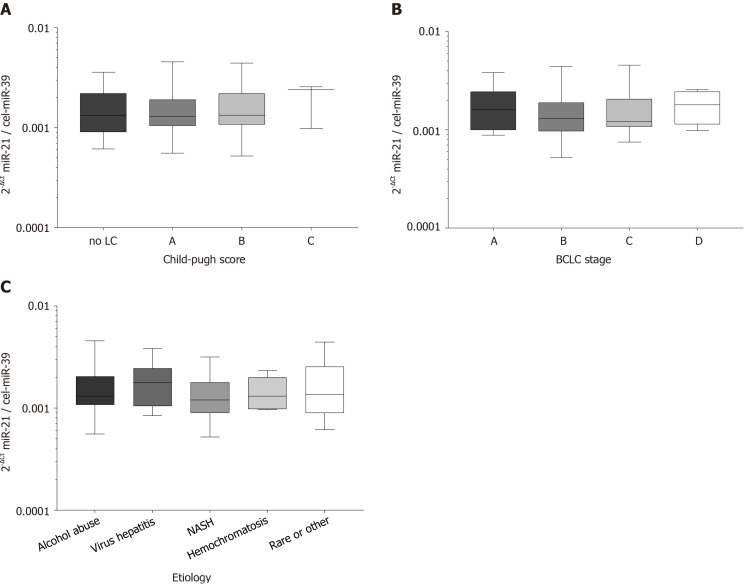
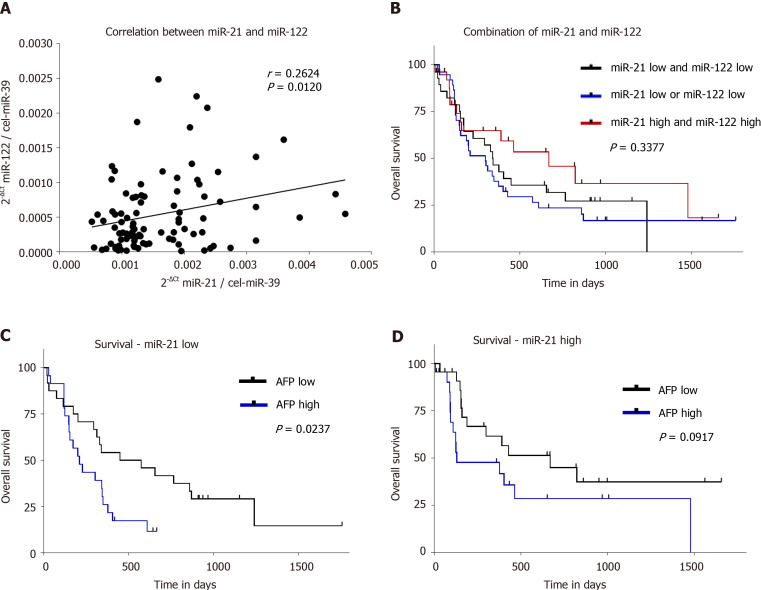
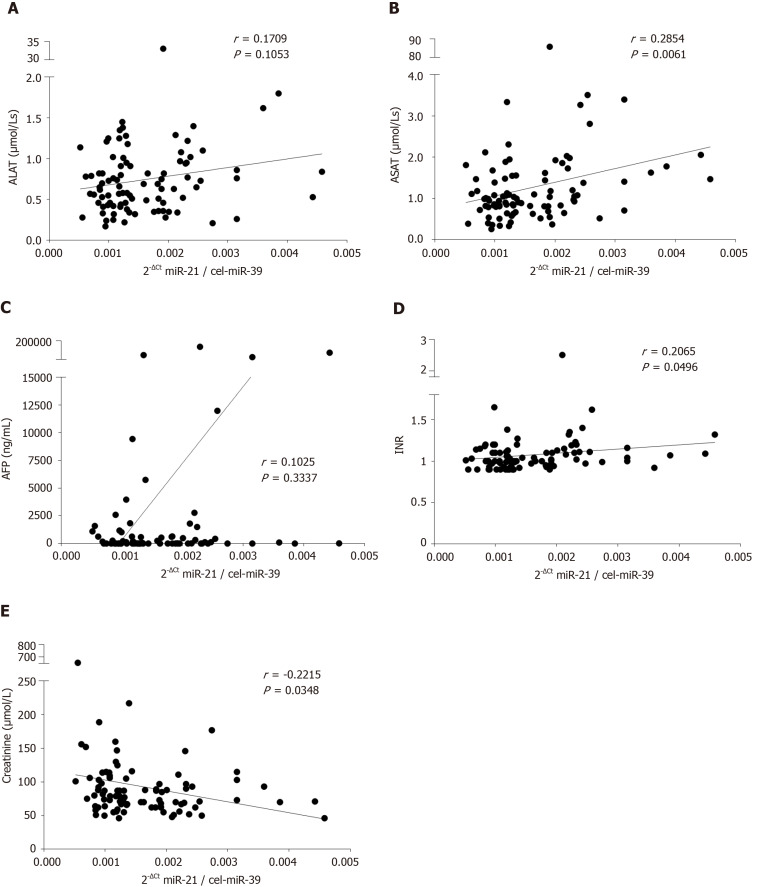
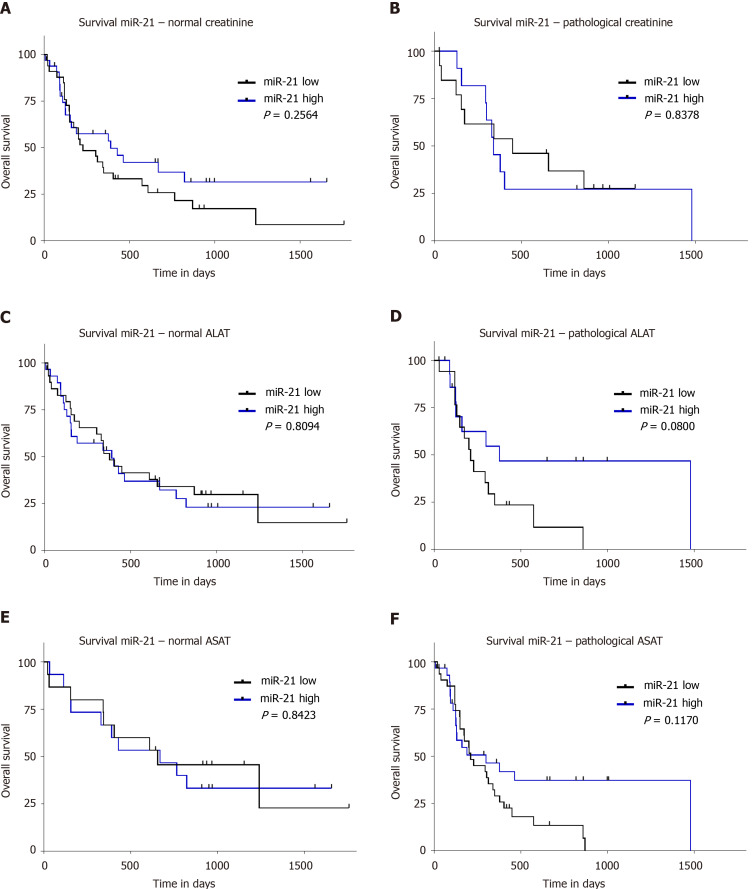
Survival of HCC patients was comparable between patients with low and high serum miR-21 concentration. No association was observed between miR-21 level in sera and Child-Pugh score, Barcelona Clinic Liver Cancer staging system, or etiology of HCC/liver disease. Age, gender, or pretreatment had no association with miR-21 level. A positive correlation was observed between miR-21 and aspartate aminotransferase ( = 0.2854, = 0.0061), serum miR-122 ( = 0.2624, = 0.0120), and the International Normalized Ratio ( = 0.2065, = 0.0496). Negative correlation of miR-21 with serum creatinine ( = -0.2215, = 0.0348) suggests renal function as a potential influencing factor in miR-21 biogenesis in blood.
The results from this work do not support clinically relevant prognostic value of circulating miR-21 in HCC patients in real-life settings. Following systematic evaluation, we identified renal function and aspartate aminotransferase as potential factors that may affect miR-21 concentration in blood. This knowledge should be considered in future miRNA-based biomarker studies not only for HCC but also for other diseases.
微小RNA(miRNA)已被认为是包括肝细胞癌(HCC)在内的恶性疾病的生物标志物。具体而言,hsa-miR-21-5p(miR-21)是癌症中最常失调的miRNA之一。miR-21的诊断和预后价值已在HCC组织中得到证实,主要是在亚洲人群中。尽管最近已有报道各种因素对循环中的hsa-miR-122-5p(miR-)的影响,但目前关于miR-21的知识仍然有限。
评估miR-21在评估HCC患者预后中的价值,并描述临床和分析前因素对血清中miR-21水平的影响。
本研究纳入了我们欧洲队列中确诊为HCC且主要为酒精相关性肝损伤的患者。所有受试者均根据其临床和实验室检查结果进行特征描述,并获得总体生存数据。对miR-21和掺入的cel-miR-39-3p进行定量实时聚合酶链反应。将结果与先前报道的miR-122数据进行比较。
血清miR-21浓度低和高的HCC患者的生存率相当。血清中miR-21水平与Child-Pugh评分、巴塞罗那临床肝癌分期系统或HCC/肝病的病因之间未观察到相关性。年龄、性别或预处理与miR-21水平无关。miR-21与天冬氨酸转氨酶呈正相关(=0.2854,=0.0061)、血清miR-122(=0.2624,=0.0120)以及国际标准化比值(=0.2065,=0.0496)。miR-21与血清肌酐呈负相关(=-0.2215,=0.0348),提示肾功能是血液中miR-21生物合成的潜在影响因素。
这项工作的结果不支持在现实生活环境中循环miR-21对HCC患者具有临床相关的预后价值。经过系统评估,我们确定肾功能和天冬氨酸转氨酶是可能影响血液中miR-21浓度的潜在因素。未来基于miRNA的生物标志物研究不仅应考虑HCC,还应考虑其他疾病,都应考虑到这一知识。