Liu Liang, Lu Hao, Li Yanan, Cao Zhiguo
National Key Laboratory of Science and Technology on Multi-Spectral Information Processing, School of Artificial Intelligence and Automation, Huazhong University of Science and Technology, Wuhan, 430074 Hubei, China.
The University of Adelaide, Adelaide, SA 5005, Australia.
Plant Phenomics. 2020 Aug 21;2020:1375957. doi: 10.34133/2020/1375957. eCollection 2020.
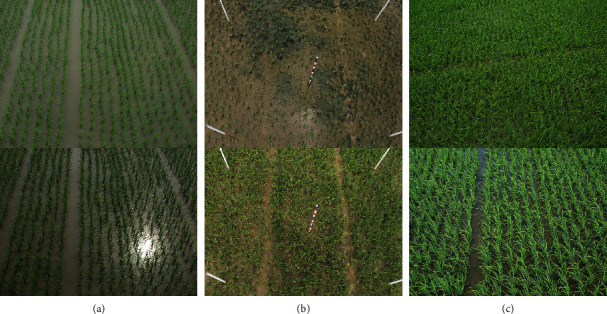
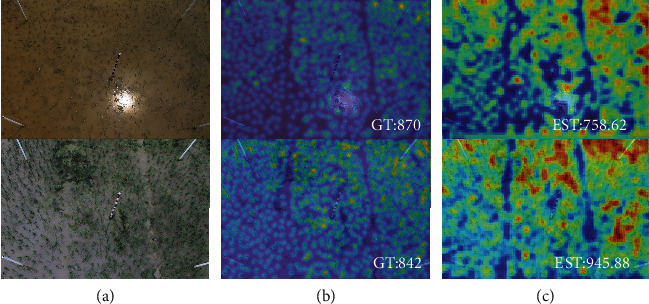
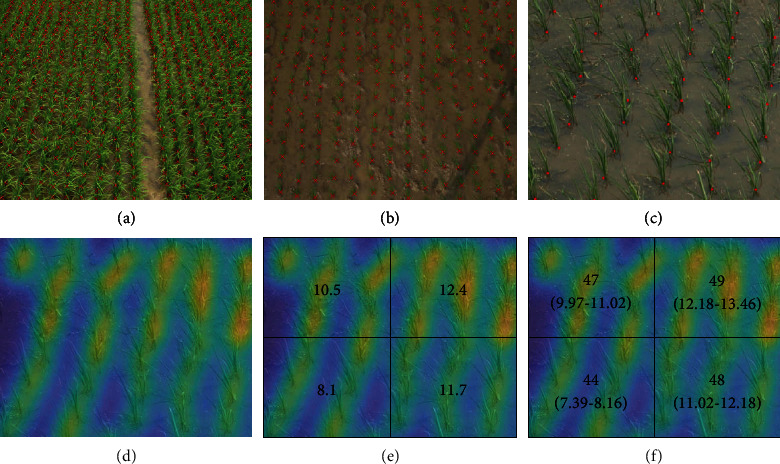
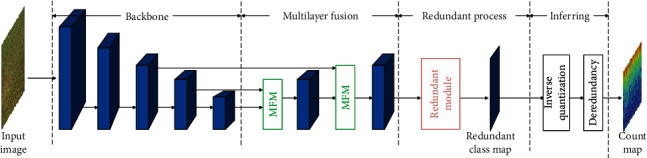
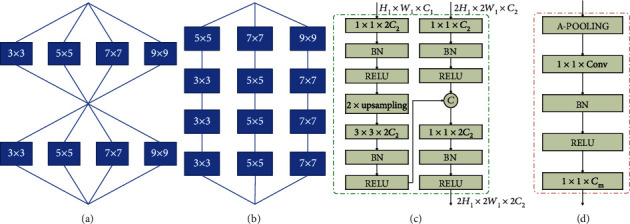
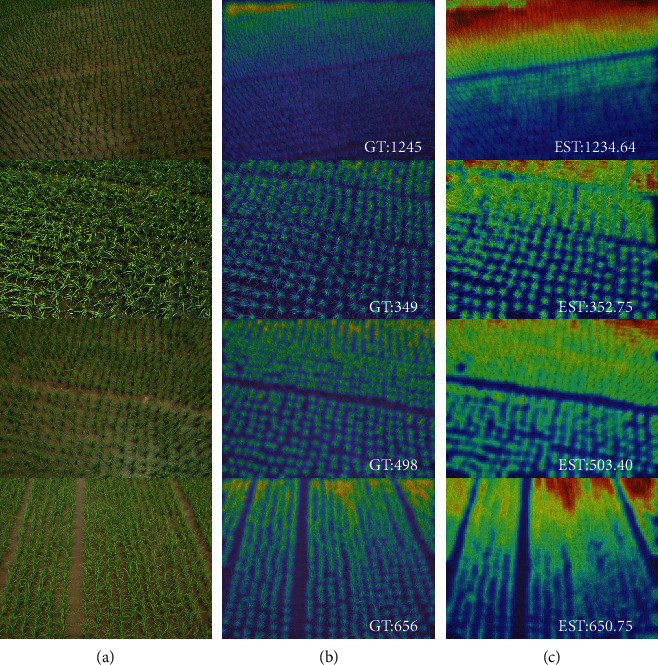
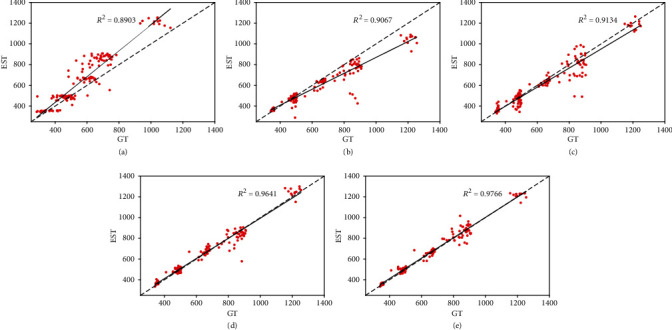
Rice density is closely related to yield estimation, growth diagnosis, cultivated area statistics, and management and damage evaluation. Currently, rice density estimation heavily relies on manual sampling and counting, which is inefficient and inaccurate. With the prevalence of digital imagery, computer vision (CV) technology emerges as a promising alternative to automate this task. However, challenges of an in-field environment, such as illumination, scale, and appearance variations, render gaps for deploying CV methods. To fill these gaps towards accurate rice density estimation, we propose a deep learning-based approach called the Scale-Fusion Counting Classification Network (SFCNet) that integrates several state-of-the-art computer vision ideas. In particular, SFCNet addresses appearance and illumination changes by employing a multicolumn pretrained network and multilayer feature fusion to enhance feature representation. To ameliorate sample imbalance engendered by scale, SFCNet follows a recent blockwise classification idea. We validate SFCNet on a new rice plant counting (RPC) dataset collected from two field sites in China from 2010 to 2013. Experimental results show that SFCNet achieves highly accurate counting performance on the RPC dataset with a mean absolute error (MAE) of 25.51, a root mean square error (MSE) of 38.06, a relative MAE of 3.82%, and a of 0.98, which exhibits a relative improvement of 48.2% w.r.t. MAE over the conventional counting approach CSRNet. Further, SFCNet provides high-throughput processing capability, with 16.7 frames per second on 1024 × 1024 images. Our results suggest that manual rice counting can be safely replaced by SFCNet at early growth stages. Code and models are available online at https://git.io/sfc2net.
水稻密度与产量估算、生长诊断、种植面积统计以及管理和损害评估密切相关。目前,水稻密度估算严重依赖人工采样和计数,效率低下且不准确。随着数字图像的普及,计算机视觉(CV)技术成为自动化这项任务的一种有前途的替代方法。然而,田间环境的挑战,如光照、尺度和外观变化,使得CV方法的应用存在差距。为了填补这些差距以实现准确的水稻密度估算,我们提出了一种基于深度学习的方法,称为尺度融合计数分类网络(SFCNet),该方法整合了几种先进的计算机视觉理念。特别是,SFCNet通过采用多列预训练网络和多层特征融合来增强特征表示,以解决外观和光照变化问题。为了缓解尺度导致的样本不平衡问题,SFCNet遵循了最近的逐块分类思想。我们在一个新的水稻植株计数(RPC)数据集上对SFCNet进行了验证,该数据集是从2010年到2013年在中国的两个田间地点收集的。实验结果表明,SFCNet在RPC数据集上实现了高度准确的计数性能,平均绝对误差(MAE)为25.51,均方根误差(MSE)为38.06,相对MAE为3.82%,相关系数为0.98,与传统计数方法CSRNet相比,MAE相对提高了48.2%。此外,SFCNet具有高通量处理能力,在1024×1024图像上每秒可处理16.7帧。我们的结果表明,在水稻生长早期阶段,人工计数可以安全地被SFCNet取代。代码和模型可在https://git.io/sfc2net上在线获取。