Pournajafian Alireza, Ghodraty Mohammad Reza, Shafighnia Shora, Rokhtabnak Faranak, Khatibi Ali, Tavoosian Sina, Ghayoomi Mansoureh
Department of Anaesthesiology, Firoozgar Hospital. Iran University of Medical Sciences, Tehran, Iran.
Turk J Anaesthesiol Reanim. 2020 Dec;48(6):454-459. doi: 10.5152/TJAR.2020.18999. Epub 2020 Feb 17.
Catheter-related bladder discomfort (CRBD) that manifests as agitation and bladder hyperactivity is a common problem in young male patients. Local anaesthetics are typically recommended for this problem. Hence, this study was conducted to determine the effect of intravesical diluted bupivacaine on CRBD in young male patients during postanaesthetic recovery.
This double-blinded randomised clinical trial included 68 consecutive patients, aged 20-60 years, who underwent urinary catheterisation during surgery and anaesthesia at a university hospital during 2017-2018. Patients were randomly assigned to receive either 50 ml of intravesical diluted (0.2%) bupivacaine (n=37) or normal saline (n=31). The incidence and severity of CRBD were then evaluated in PACU and compared between the two groups.
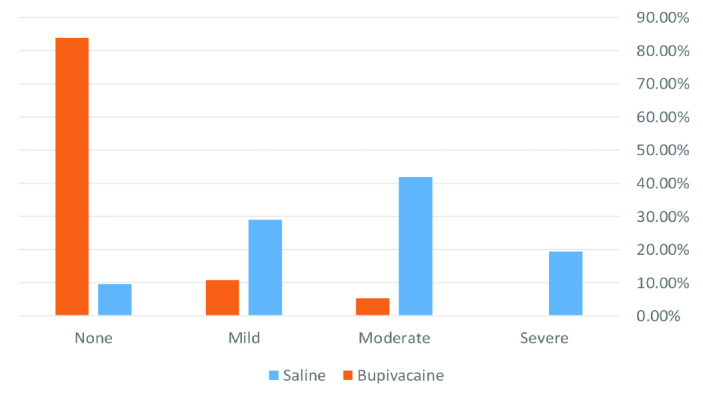
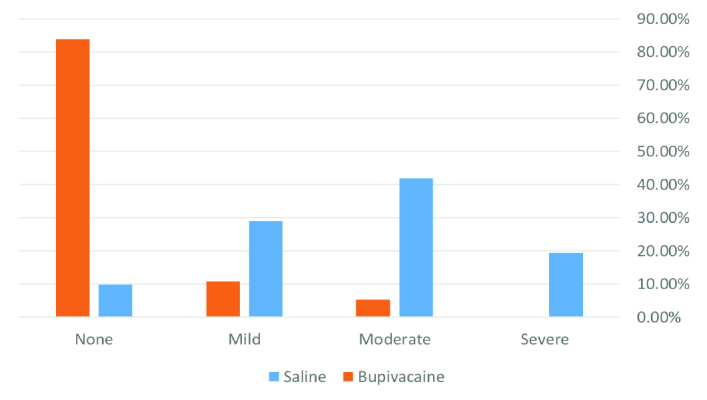
In this study, 16.2% of patients in the bupivacaine group and 83.9% in the saline group had discomfort at arrival in the recovery room, exhibiting a significant intergroup difference (p=0.0001). Moreover, after 15-20 min, the incidence of CRBD was 16.2% and 90.3% in the bupivacaine and normal saline groups, respectively, which again demonstrated a significant statistical difference (p=0.0001). In addition, the severity of CRBD was lower in the bupivacaine group, during both periods (p=0.005). The saline group reported significantly higher use of pethidine and midazolam (p=0.005).
It may be concluded that intravesical diluted bupivacaine can significantly decrease the incidence and severity of CRBD in young male patients during recovery from anaesthesia. Therefore, the use of this method is highly recommended.
表现为躁动和膀胱活动亢进的导尿管相关膀胱不适(CRBD)是年轻男性患者中的常见问题。对于这个问题,通常推荐使用局部麻醉剂。因此,本研究旨在确定膀胱内注入稀释布比卡因对年轻男性患者麻醉后恢复期间CRBD的影响。
这项双盲随机临床试验纳入了68例年龄在20至60岁之间的连续患者,他们于2017年至2018年在一家大学医院接受手术和麻醉期间进行了导尿术。患者被随机分配接受50毫升膀胱内稀释(0.2%)布比卡因(n = 37)或生理盐水(n = 31)。然后在麻醉后恢复室评估CRBD的发生率和严重程度,并在两组之间进行比较。
在本研究中,布比卡因组16.2%的患者和生理盐水组83.9%的患者在进入恢复室时出现不适,组间差异显著(p = 0.0001)。此外,15 - 20分钟后,布比卡因组和生理盐水组CRBD的发生率分别为16.2%和90.3%,再次显示出显著的统计学差异(p = 0.0001)。此外,在两个时间段内,布比卡因组CRBD的严重程度均较低(p = 0.005)。生理盐水组报告使用哌替啶和咪达唑仑的比例显著更高(p = 0.005)。
可以得出结论,膀胱内注入稀释布比卡因可显著降低年轻男性患者麻醉恢复期间CRBD的发生率和严重程度。因此,强烈推荐使用这种方法。