Power Guerra Nicole, Müller Luisa, Pilz Kristin, Glatzel Annika, Jenderny Daniel, Janowitz Deborah, Vollmar Brigitte, Kuhla Angela
Rudolf-Zenker-Institute for Experimental Surgery, Medical University Rostock, 18057 Rostock, Germany.
Department of Psychosomatic Medicine and Psychotherapy, University of Rostock, 18147 Rostock, Germany.
Biomedicines. 2020 Dec 9;8(12):587. doi: 10.3390/biomedicines8120587.
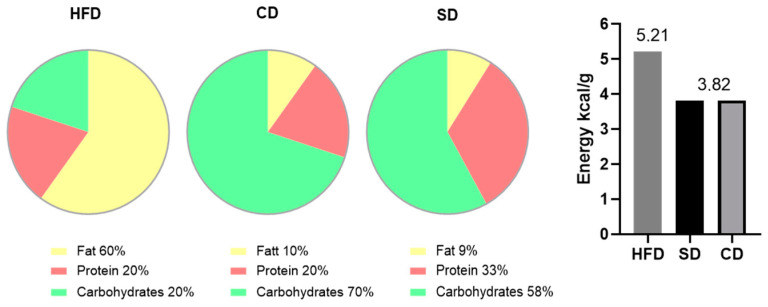
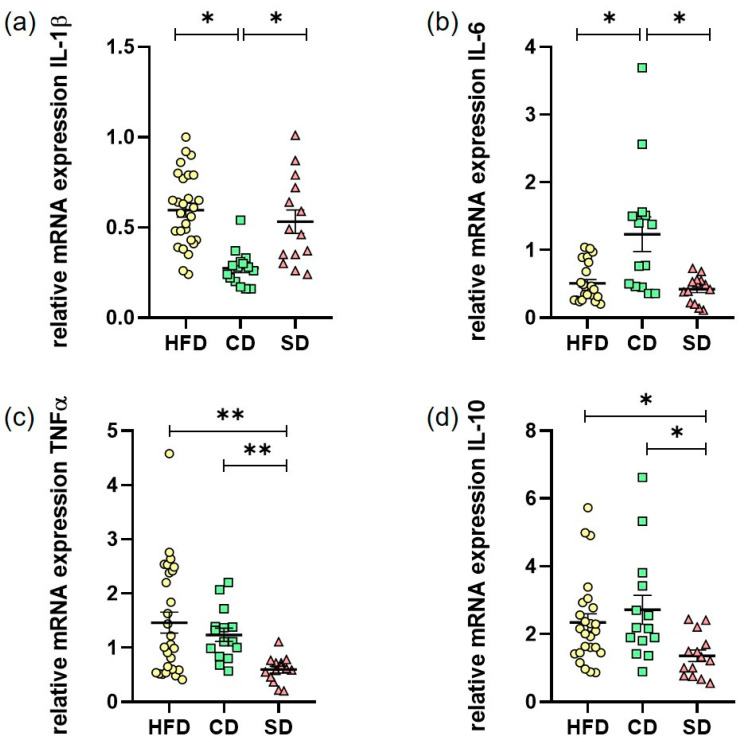
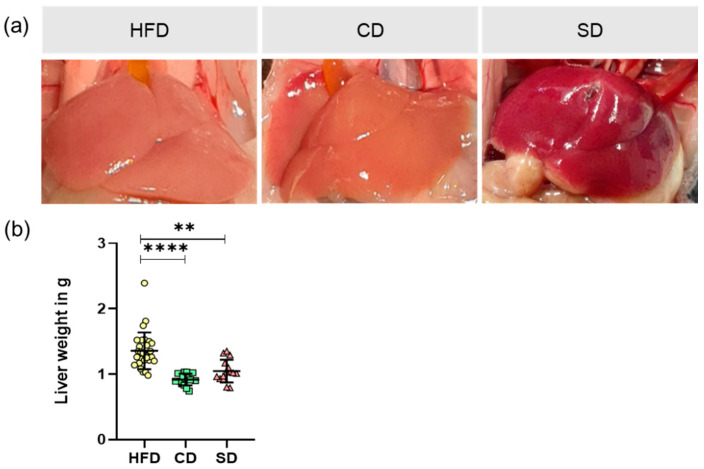
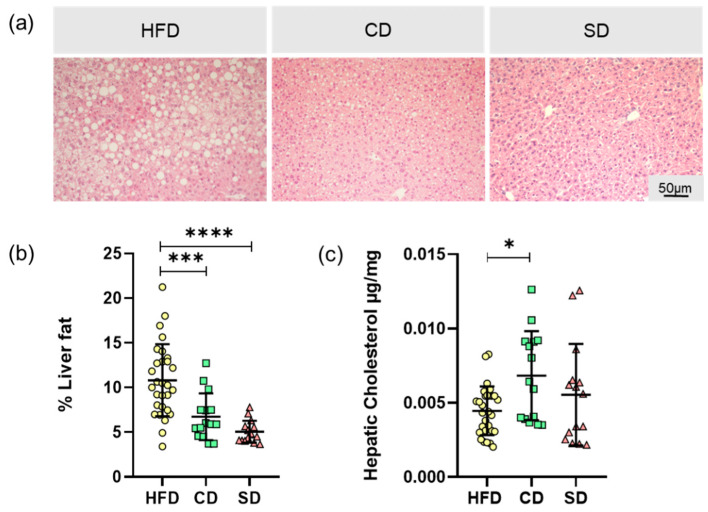
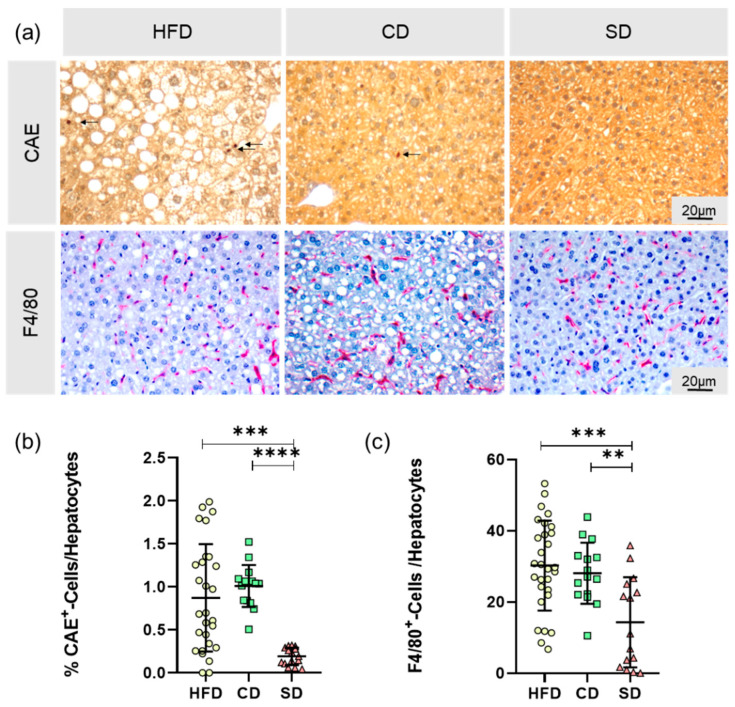
The literature describes a close correlation between metabolic disorders and abnormal immune responses, like low-grade inflammation (LGI), which may be one mechanistic link between obesity and various comorbidities, including non-alcoholic fatty liver disease (NAFLD). In our study, we investigated the influence of dietary composition on obesity-derived LGI in the liver. We used a dietary induced obesity mouse model of C57BL/6J mice fed with high fat diet (HFD, 60% fat, 20% protein, 20% carbohydrates) and two different controls. One was rich in carbohydrates (10% fat, 20% protein, 70% carbohydrates), further referred to as the control diet (CD), and the other one is referred to as the standard diet (SD), with a more balanced macronutrient content (9% fat, 33% protein, 58% carbohydrates). Our results showed a significant increased NAFLD activity score in HFD compared to both controls, but livers of the CD group also differed in their macroscopic appearance from healthy livers. Hepatic fat content showed significantly elevated cholesterol concentrations in the CD group. Histologic analysis of the cellular immune response in the liver showed no difference between HFD and CD and expression analysis of immunologic mediators like interleukin (IL)-1β, IL-6, IL-10 and tumor necrosis factor alpha also point towards a pro-inflammatory response to CD, comparable to LGI in HFD. Therefore, when studying diet-induced obesity with a focus on inflammatory processes, we encourage researchers to carefully select controls and not use a control diet disproportionally rich in carbohydrates.
文献表明,代谢紊乱与异常免疫反应之间存在密切关联,如低度炎症(LGI),这可能是肥胖与包括非酒精性脂肪性肝病(NAFLD)在内的各种合并症之间的一种机制联系。在我们的研究中,我们调查了饮食组成对肝脏中肥胖衍生的LGI的影响。我们使用了一种饮食诱导肥胖的小鼠模型,用高脂肪饮食(HFD,60%脂肪,20%蛋白质,20%碳水化合物)喂养C57BL/6J小鼠,并设置了两个不同的对照组。一个富含碳水化合物(10%脂肪,20%蛋白质,70%碳水化合物),进一步称为对照饮食(CD),另一个称为标准饮食(SD),其宏量营养素含量更为均衡(9%脂肪,33%蛋白质,58%碳水化合物)。我们的结果显示,与两个对照组相比,HFD组的NAFLD活动评分显著增加,但CD组肝脏的宏观外观也与健康肝脏不同。CD组的肝脏脂肪含量显示胆固醇浓度显著升高。肝脏细胞免疫反应的组织学分析表明,HFD组和CD组之间没有差异,白细胞介素(IL)-1β、IL-6、IL-10和肿瘤坏死因子α等免疫介质的表达分析也表明,CD组存在促炎反应,与HFD组的LGI相当。因此,在研究以炎症过程为重点的饮食诱导肥胖时,我们鼓励研究人员仔细选择对照组,不要使用碳水化合物含量过高的对照饮食。