Garcia Jose M, Biller Beverly M K, Korbonits Márta, Popovic Vera, Luger Anton, Strasburger Christian J, Chanson Philippe, Swerdloff Ronald, Wang Christina, Fleming Rosa Rosanna, Cohen Fredric, Ammer Nicola, Mueller Gilbert, Kelepouris Nicky, Strobl Frank, Ostrow Vlady, Yuen Kevin C J
GRECC VA Puget Sound HCS/University of Washington, Seattle, Washington, USA.
Massachusetts General Hospital, Neuroendocrine Unit, Boston, Massachusetts, USA.
Endocr Connect. 2021 Jan;10(1):76-83. doi: 10.1530/EC-20-0491.
The macimorelin test is approved for the diagnosis of adult growth hormone deficiency (AGHD) based on its efficacy vs the insulin tolerance test (ITT). Macimorelin has a significant advantage over ITT in avoiding hypoglycemia. Analyses were conducted to determine whether macimorelin performance is affected by age, BMI, or sex, and evaluate its performance vs ITT over a range of GH cutpoints.
Post hoc analyses of data from a previous randomized phase 3 study included participants aged 18-66 years with BMI <37 kg/m2 and high (Group A), intermediate (Group B), or low (Group C) likelihood for AGHD based on pituitary history, and matched controls (Group D).
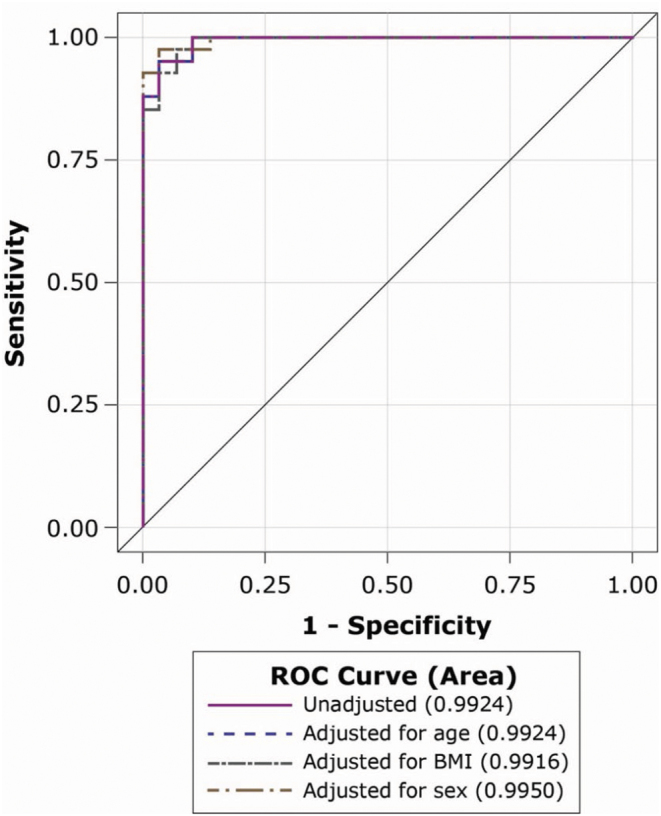
Probability of AGHD was estimated using unadjusted, age-adjusted, BMI-adjusted, and sex-adjusted logistic models. Area under the curve (AUC) of the estimated receiver operating characteristic (ROC) curve (range, 0-1; 1 = perfect) was compared for adjusted vs unadjusted models. Separate analyses evaluated agreement, sensitivity, and specificity for macimorelin and ITT using cutpoints of 2.8, 4.0, 5.1, and 6.5 ng/mL.
For participants in Group A (n = 41) and Group D (n = 29), unadjusted, age-adjusted, BMI-adjusted, and sex-adjusted models had ROC AUCs (95% CIs) of 0.9924 (0.9807-1), 0.9924 (0.9807-1), 0.9916 (0.9786-1), and 0.9950 (0.9861-1), respectively.
Macimorelin performance was not meaningfully affected by age, BMI, or sex, indicating robustness for AGHD diagnosis. Of the 4 GH cutpoints evaluated, the cutpoint of 5.1 ng/mL provided maximal specificity (96%) and high sensitivity (92%) and was in good overall agreement with the ITT at the same cutpoint (87%).
基于与胰岛素耐量试验(ITT)相比的疗效,麦角新碱试验已被批准用于诊断成人生长激素缺乏症(AGHD)。麦角新碱在避免低血糖方面比ITT具有显著优势。进行分析以确定麦角新碱的性能是否受年龄、体重指数(BMI)或性别影响,并在一系列生长激素切点范围内评估其与ITT相比的性能。
对先前一项随机3期研究的数据进行事后分析,纳入年龄在18 - 66岁、BMI < 37 kg/m²且根据垂体病史诊断为AGHD可能性高(A组)、中(B组)或低(C组)的参与者,以及匹配的对照组(D组)。
使用未调整、年龄调整、BMI调整和性别调整的逻辑模型估计AGHD的概率。比较调整后与未调整模型的估计受试者工作特征(ROC)曲线下面积(AUC)(范围为0 - 1;1表示完美)。使用2.8、4.0、5.1和6.5 ng/mL的切点对麦角新碱和ITT的一致性、敏感性和特异性进行单独分析。
对于A组(n = 41)和D组(n = 29)的参与者,未调整、年龄调整、BMI调整和性别调整模型的ROC AUC(95%置信区间)分别为0.9924(0.9807 - 1)、0.9924(0.9807 - 1)、0.9916(0.9786 - 1)和0.9950(0.9861 - 1)。
麦角新碱的性能未受到年龄、BMI或性别的显著影响,表明其在AGHD诊断中具有稳健性。在评估的4个生长激素切点中,5.1 ng/mL的切点提供了最大特异性(96%)和高敏感性(92%),并且在相同切点与ITT总体一致性良好(87%)。