Bastiani Luca, Fortunato Loredana, Pieroni Stefania, Bianchi Fabrizio, Adorni Fulvio, Prinelli Federica, Giacomelli Andrea, Pagani Gabriele, Maggi Stefania, Trevisan Caterina, Noale Marianna, Jesuthasan Nithiya, Sojic Aleksandra, Pettenati Carla, Andreoni Massimo, Antonelli Incalzi Raffaele, Galli Massimo, Molinaro Sabrina
Institute of Clinical Physiology, National Research Council, Pisa, Italy.
Institute of Biomedical Technologies, National Research Council, Milano, Italy.
J Med Internet Res. 2021 Jan 6;23(1):e23897. doi: 10.2196/23897.
Confirmed COVID-19 cases have been registered in more than 200 countries, and as of July 28, 2020, over 16 million cases have been reported to the World Health Organization. This study was conducted during the epidemic peak of COVID-19 in Italy. The early identification of individuals with suspected COVID-19 is critical in immediately quarantining such individuals. Although surveys are widely used for identifying COVID-19 cases, outcomes, and associated risks, no validated epidemiological tool exists for surveying SARS-CoV-2 infection in the general population.
We evaluated the capability of self-reported symptoms in discriminating COVID-19 to identify individuals who need to undergo instrumental measurements. We defined and validated a method for identifying a cutoff score.
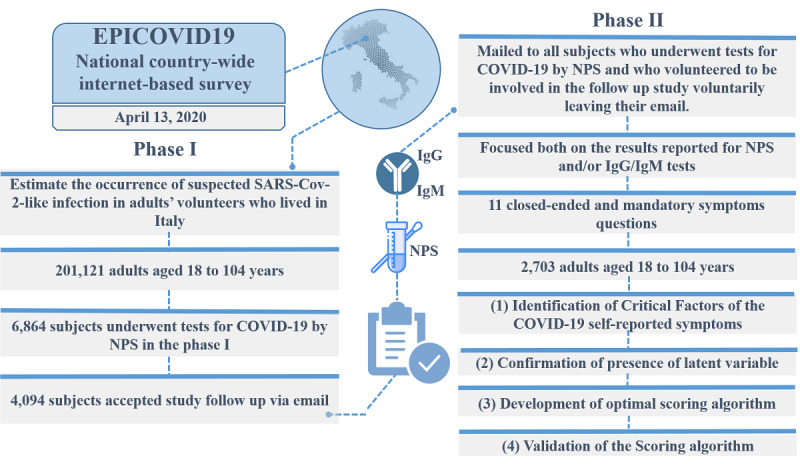
Our study is phase II of the EPICOVID19 Italian national survey, which launched in April 2020 and included a convenience sample of 201,121 adults who completed the EPICOVID19 questionnaire. The Phase II questionnaire, which focused on the results of nasopharyngeal swab (NPS) and serological tests, was mailed to all subjects who previously underwent NPS tests.
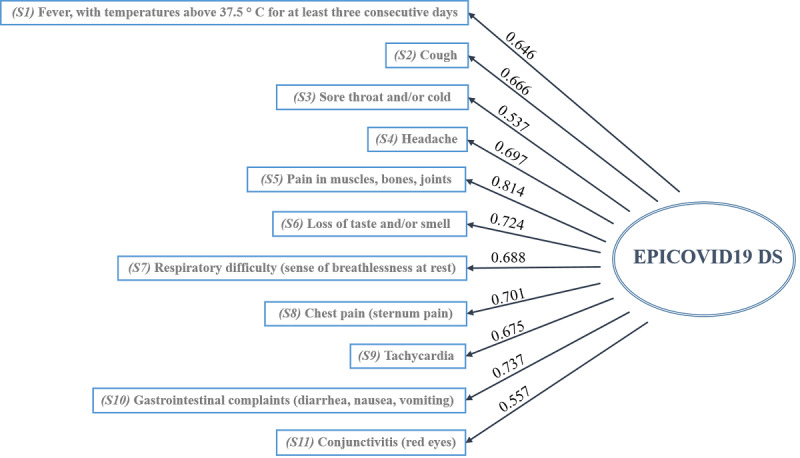
Of 2703 subjects who completed the Phase II questionnaire, 694 (25.7%) were NPS positive. Of the 472 subjects who underwent the immunoglobulin G (IgG) test and 421 who underwent the immunoglobulin M test, 22.9% (108/472) and 11.6% (49/421) tested positive, respectively. Compared to NPS-negative subjects, NPS-positive subjects had a higher incidence of fever (421/694, 60.7% vs 391/2009, 19.5%; P<.001), loss of taste and smell (365/694, 52.6% vs 239/2009, 11.9%; P<.001), and cough (352/694, 50.7% vs 580/2009, 28.9%; P<.001). With regard to subjects who underwent serological tests, IgG-positive subjects had a higher incidence of fever (65/108, 60.2% vs 43/364, 11.8%; P<.001) and pain in muscles/bones/joints (73/108, 67.6% vs 71/364, 19.5%; P<.001) than IgG-negative subjects. An analysis of self-reported COVID-19 symptom items revealed a 1-factor solution, the EPICOVID19 diagnostic scale. The following optimal scores were identified: 1.03 for respiratory problems, 1.07 for chest pain, 0.97 for loss of taste and smell 0.97, and 1.05 for tachycardia (ie, heart palpitations). These were the most important symptoms. For adults aged 18-84 years, the cutoff score was 2.56 (sensitivity: 76.56%; specificity: 68.24%) for NPS-positive subjects and 2.59 (sensitivity: 80.37%; specificity: 80.17%) for IgG-positive subjects. For subjects aged ≥60 years, the cutoff score was 1.28, and accuracy based on the presence of IgG antibodies improved (sensitivity: 88.00%; specificity: 89.58%).
We developed a short diagnostic scale to detect subjects with symptoms that were potentially associated with COVID-19 from a wide population. Our results support the potential of self-reported symptoms in identifying individuals who require immediate clinical evaluations. Although these results come from the Italian pandemic period, this short diagnostic scale could be optimized and tested as a screening tool for future similar pandemics.
200多个国家已登记有确诊的新冠病毒病病例,截至2020年7月28日,向世界卫生组织报告的病例已超过1600万例。本研究在意大利新冠病毒病疫情高峰期开展。尽早识别疑似新冠病毒病患者对于立即隔离这些人至关重要。尽管调查广泛用于识别新冠病毒病病例、结局及相关风险,但尚无经过验证的用于在普通人群中调查严重急性呼吸综合征冠状病毒2(SARS-CoV-2)感染的流行病学工具。
我们评估了自我报告症状在鉴别新冠病毒病方面的能力,以识别需要进行仪器检测的个体。我们定义并验证了一种确定临界值分数的方法。
我们的研究是EPICOVID19意大利全国调查的第二阶段,该调查于2020年4月启动,纳入了201121名完成EPICOVID19问卷的成年便利样本。第二阶段问卷聚焦于鼻咽拭子(NPS)和血清学检测结果,被邮寄给所有先前接受过NPS检测的受试者。
在完成第二阶段问卷的2703名受试者中,694名(25.7%)NPS呈阳性。在接受免疫球蛋白G(IgG)检测的472名受试者和接受免疫球蛋白M检测的421名受试者中,分别有22.9%(108/472)和11.6%(49/421)检测呈阳性。与NPS阴性受试者相比,NPS阳性受试者发热(421/694,60.7%对391/2009,19.5%;P<0.001)、味觉和嗅觉丧失(365/694,52.6%对239/2009;11.9%;P<0.001)以及咳嗽(352/694,50.7%对580/2009,28.9%;P<0.001)的发生率更高。对于接受血清学检测的受试者,IgG阳性受试者发热(65/1,08,60.2%对43/364,11.8%;P<0.001)和肌肉/骨骼/关节疼痛(73/108,67.6%对71/364,19.5%;P<0.001)的发生率高于IgG阴性受试者。对自我报告的新冠病毒病症状项目的分析显示为单因素解决方案,即EPICOVID19诊断量表。确定了以下最佳分数:呼吸问题为1.03,胸痛为1.07,味觉和嗅觉丧失为0.97,心动过速(即心悸)为1.05。这些是最重要的症状。对于18 - 84岁的成年人,NPS阳性受试者的临界值分数为2.56(敏感性:76.56%;特异性:68.24%),IgG阳性受试者为2.59(敏感性:80.37%;特异性:80.17%)。对于年龄≥60岁的受试者,临界值分数为1.28,基于IgG抗体存在情况的准确性有所提高(敏感性:88.00%;特异性:89.58%)。
我们制定了一个简短的诊断量表,以从广泛人群中检测出有潜在新冠病毒病相关症状的受试者。我们的结果支持自我报告症状在识别需要立即进行临床评估的个体方面的潜力。尽管这些结果来自意大利疫情期间,但这个简短的诊断量表可作为未来类似疫情的筛查工具进行优化和测试。