Guillonneau Richard, Baraquet Claudine, Molmeret Maëlle
Laboratoire MAPIEM, EA4323, Université de Toulon, 83130 La Garde, France.
School of Life Sciences, University of Warwick, Coventry CV4 7AL, UK.
Microorganisms. 2020 Dec 12;8(12):1982. doi: 10.3390/microorganisms8121982.
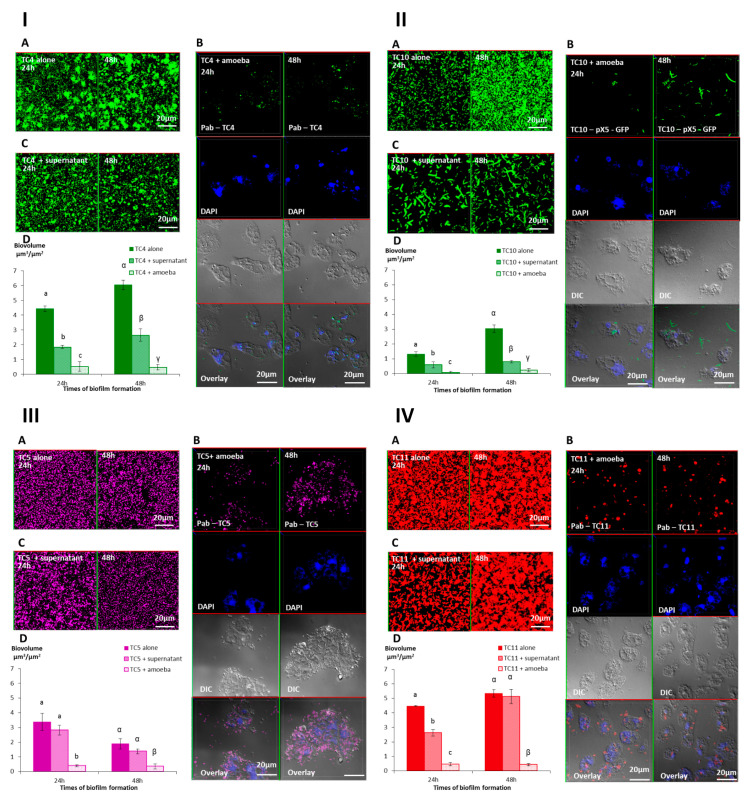
Free-living amoeba are members of microbial communities such as biofilms in terrestrial, fresh, and marine habitats. Although they are known to live in close association with bacteria in many ecosystems such as biofilms, they are considered to be major bacterial predators in many ecosystems. Little is known on the relationship between protozoa and marine bacteria in microbial communities, more precisely on how bacteria are able survive in environmental niches where these bacterial grazers also live. The objective of this work is to study the interaction between the axenized ubiquitous amoeba and four marine bacteria isolated from immersed biofilm, in order to evaluate if they would be all grazed upon by amoeba or if they would be able to survive in the presence of their predator. At a low bacteria-to-amoeba ratio, we show that each bacterium is phagocytized and follows a singular intracellular path within this host cell, which appears to delay or to prevent bacterial digestion. In particular, one of the bacteria was found in the amoeba nucleolar compartment whereas another strain was expelled from the amoeba in vesicles. We then looked at the fate of the bacteria grown in a higher bacteria-to-amoeba ratio, as a preformed mono- or multi-species biofilm in the presence of . We show that all biofilms were subjected to detachment from the surface in the presence of the amoeba or its supernatant. Overall, these results show that bacteria, when facing the same predator, exhibit a variety of escape mechanisms at the cellular and population level, when we could have expected a simple bacterial grazing. Therefore, this study unravels new insights into the survival of environmental bacteria when facing predators that they could encounter in the same microbial communities.
自由生活的变形虫是陆地、淡水和海洋栖息地微生物群落(如生物膜)的成员。尽管已知它们在许多生态系统(如生物膜)中与细菌密切共生,但在许多生态系统中它们被认为是主要的细菌捕食者。关于微生物群落中原生动物与海洋细菌之间的关系,尤其是细菌如何在这些细菌捕食者也生存的环境生态位中存活,人们了解甚少。这项工作的目的是研究无菌的普遍存在的变形虫与从浸没生物膜中分离出的四种海洋细菌之间的相互作用,以评估它们是否都会被变形虫捕食,或者它们是否能够在其捕食者存在的情况下存活。在低细菌与变形虫比例下,我们表明每种细菌都被吞噬,并在这个宿主细胞内遵循独特的细胞内路径,这似乎会延迟或阻止细菌消化。特别是,其中一种细菌被发现在变形虫的核仁区室中,而另一种菌株则被包裹在囊泡中从变形虫中排出。然后,我们研究了在较高细菌与变形虫比例下生长的细菌的命运,即在存在……的情况下作为预先形成的单物种或多物种生物膜。我们表明,在变形虫或其上清液存在的情况下,所有生物膜都会从表面脱落。总体而言,这些结果表明,当面对相同的捕食者时,细菌在细胞和种群水平上表现出多种逃避机制,而我们原本可能预期是简单的细菌捕食。因此,这项研究揭示了环境细菌在面对它们可能在同一微生物群落中遇到的捕食者时生存的新见解。