Rosenbaum Clemens M, Fisch Margit, Vetterlein Malte W
Department of Urology, Asklepios Klinik Barmbek, Hamburg, Germany.
Department of Urology, University Medical Center Hamburg-Eppendorf, Hamburg, Germany.
Front Surg. 2020 Nov 26;7:587271. doi: 10.3389/fsurg.2020.587271. eCollection 2020.
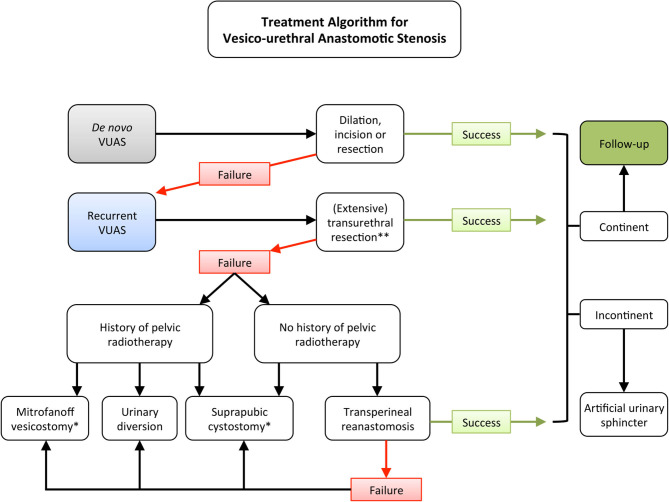
Vesico-urethral anastomotic stenosis is a well-known sequela after radical prostatectomy for prostate cancer and has significant impact on quality of life. This review aims to summarize contemporary therapeutical approaches and to give an overview of the available evidence regarding endoscopic interventions and open reconstruction. Initial treatment may include dilation, incision or transurethral resection. In treatment-refractory stenoses, open reconstruction via an abdominal (retropubic), transperineal or combined abdominoperineal approach is a viable option with high success rates. All of the open surgical procedures are generally accompanied by a high risk of developing incontinence and patients may need further interventions. In such cases, subsequent artificial urinary sphincter implantation is the most common treatment option with the best available evidence.
膀胱尿道吻合口狭窄是前列腺癌根治性前列腺切除术后众所周知的后遗症,对生活质量有重大影响。本综述旨在总结当代治疗方法,并概述有关内镜干预和开放重建的现有证据。初始治疗可能包括扩张、切开或经尿道切除术。对于治疗难治性狭窄,通过腹部(耻骨后)、经会阴或联合腹会阴入路进行开放重建是一种成功率高的可行选择。所有开放性手术通常都伴随着发生尿失禁的高风险,患者可能需要进一步干预。在这种情况下,随后植入人工尿道括约肌是最常见的治疗选择,且有最佳的现有证据支持。