Center for Microbial Pathogenesis, Institute for Biomedical Sciences, Georgia State University, Atlanta, Georgia, USA.
Department of Microbiology, Icahn School of Medicine at Mount Sinai, New York, New York, USA.
mSphere. 2020 Dec 16;5(6):e00449-20. doi: 10.1128/mSphere.00449-20.
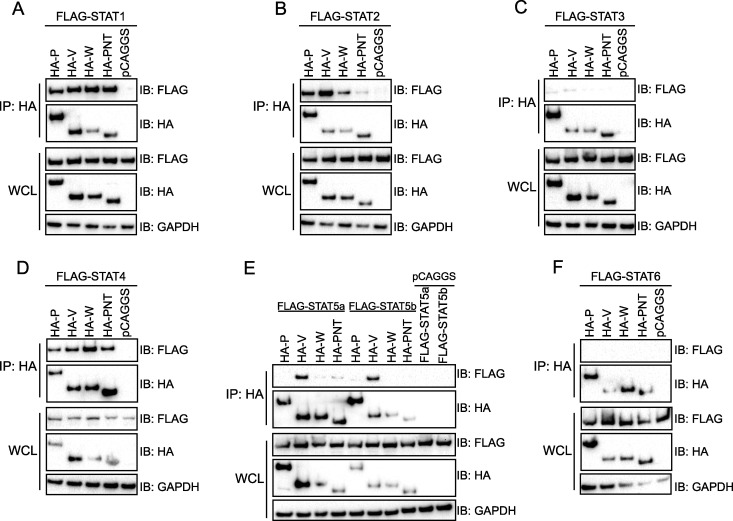
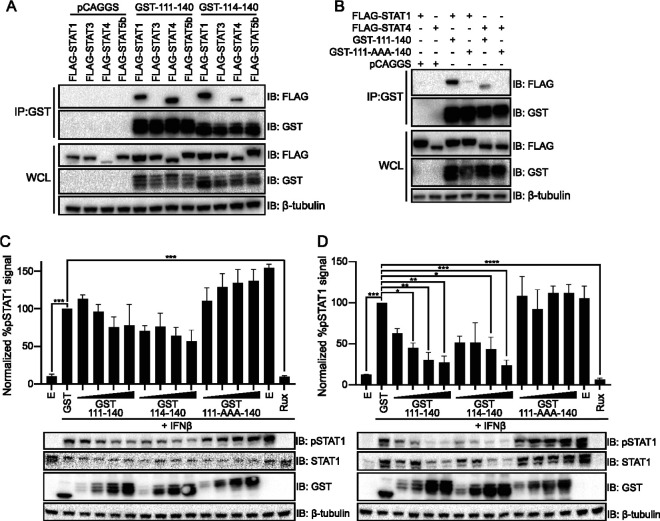
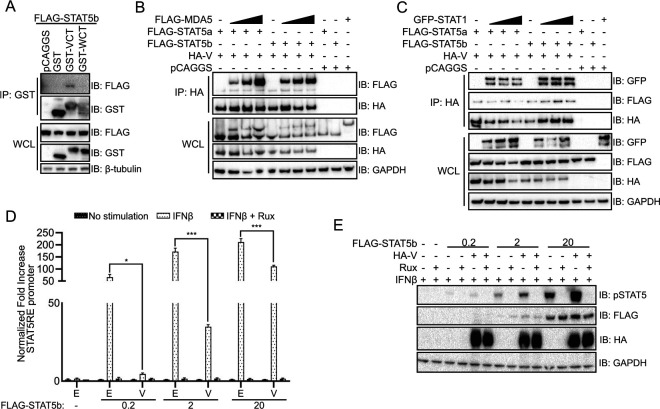
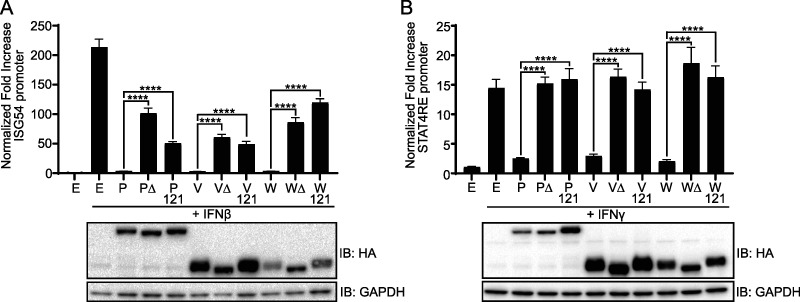
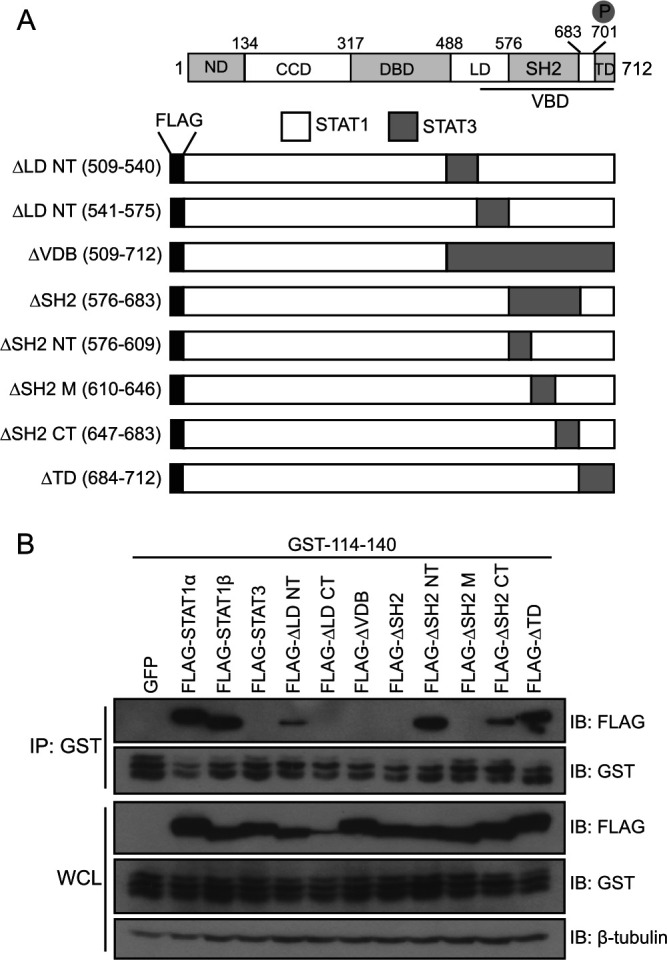
The Nipah virus (NiV) phosphoprotein (P) gene encodes four proteins. Three of these-P, V, and W-possess a common N-terminal domain but distinct C termini. These proteins interact with immune modulators. Previous studies demonstrated that P, V, and W bind STAT1 and STAT4 and that V also interacts with STAT2 but not with STAT3. The STAT1 and STAT2 interactions block interferon (IFN)-induced STAT tyrosine phosphorylation. To more fully characterize the interactions of P, V, and W with the STATs, we screened for interaction of each viral protein with STATs 1 to 6 by coimmunoprecipitation. We demonstrate that NiV P, V, and W interact with STAT4 through their common N-terminal domain and block STAT4 activity, based on a STAT4 response element reporter assay. Although none of the NiV proteins interact with STAT3 or STAT6, NiV V, but not P or W, interacts with STAT5 through its unique C terminus. Furthermore, the interaction of NiV V with STAT5 was not disrupted by overexpression of the N-terminal binding STAT1 or the C-terminal binding MDA5. NiV V also inhibits a STAT5 response element reporter assay. Residues 114 to 140 of the common N-terminal domain of the NiV P gene products were found to be sufficient to bind STAT1 and STAT4. Analysis of STAT1-STAT3 chimeras suggests that the P gene products target the STAT1 SH2 domain. When fused to GST, the 114-140 peptide is sufficient to decrease STAT1 phosphorylation in IFN-β-stimulated cells, suggesting that this peptide could potentially be fused to heterologous proteins to confer inhibition of STAT1- and STAT4-dependent responses. How Nipah virus (NiV) antagonizes innate immune responses is incompletely understood. The P gene of NiV encodes the P, V, and W proteins. These proteins have a common N-terminal sequence that is sufficient to bind to STAT1 and STAT2 and block IFN-induced signal transduction. This study sought to more fully understand how P, V, and W engage with the STAT family of transcription factors to influence their functions. The results identify a novel interaction of V with STAT5 and demonstrate V inhibition of STAT5 function. We also demonstrate that the common N-terminal residues 114 to 140 of P, V, and W are critical for inhibition of STAT1 and STAT4 function, map the interaction to the SH2 region of STAT1, and show that a fusion construct with this peptide significantly inhibits cytokine-induced STAT1 phosphorylation. These data clarify how these important virulence factors modulate innate antiviral defenses.
寨卡病毒(NiV)磷蛋白(P)基因编码四种蛋白。其中三种-P、V 和 W-具有共同的 N 端结构域,但 C 端不同。这些蛋白与免疫调节剂相互作用。先前的研究表明,P、V 和 W 与 STAT1 和 STAT4 结合,而 V 还与 STAT2 结合,但不与 STAT3 结合。STAT1 和 STAT2 的相互作用阻止了干扰素(IFN)诱导的 STAT 酪氨酸磷酸化。为了更全面地描述 P、V 和 W 与 STATs 的相互作用,我们通过共免疫沉淀筛选每种病毒蛋白与 STATs 1 到 6 的相互作用。我们证明 NiV P、V 和 W 通过其共同的 N 端结构域与 STAT4 相互作用,并基于 STAT4 反应元件报告基因测定阻断 STAT4 活性。尽管 NiV 蛋白均不与 STAT3 或 STAT6 相互作用,但 NiV V 而非 P 或 W 通过其独特的 C 端与 STAT5 相互作用。此外,NiV V 与 STAT5 的相互作用不受 N 端结合 STAT1 或 C 端结合 MDA5 的过表达破坏。NiV V 还抑制 STAT5 反应元件报告基因测定。发现 NiV P 基因产物的共同 N 端结构域的 114 至 140 个残基足以结合 STAT1 和 STAT4。对 STAT1-STAT3 嵌合体的分析表明,P 基因产物靶向 STAT1 SH2 结构域。当融合到 GST 时,114-140 肽足以减少 IFN-β 刺激细胞中的 STAT1 磷酸化,这表明该肽可与异源蛋白融合以赋予抑制 STAT1 和 STAT4 依赖性反应的能力。寨卡病毒(NiV)如何拮抗先天免疫反应尚不完全清楚。NiV 的 P 基因编码 P、V 和 W 蛋白。这些蛋白具有共同的 N 端序列,足以与 STAT1 和 STAT2 结合并阻断 IFN 诱导的信号转导。本研究旨在更全面地了解 P、V 和 W 如何与 STAT 转录因子家族相互作用以影响其功能。结果鉴定了 V 与 STAT5 的新相互作用,并证明 V 抑制 STAT5 功能。我们还证明了 P、V 和 W 的共同 N 端残基 114 至 140 对抑制 STAT1 和 STAT4 功能至关重要,将相互作用定位到 STAT1 的 SH2 区域,并表明该肽的融合构建体显著抑制细胞因子诱导的 STAT1 磷酸化。这些数据阐明了这些重要的毒力因子如何调节先天抗病毒防御。