Department of Psychology, Faculty of Science, University of Alberta, Edmonton, AB, Canada.
Neuroscience and Mental Health Institute, University of Alberta, Edmonton, Canada.
Sci Rep. 2020 Dec 16;10(1):22013. doi: 10.1038/s41598-020-78880-4.
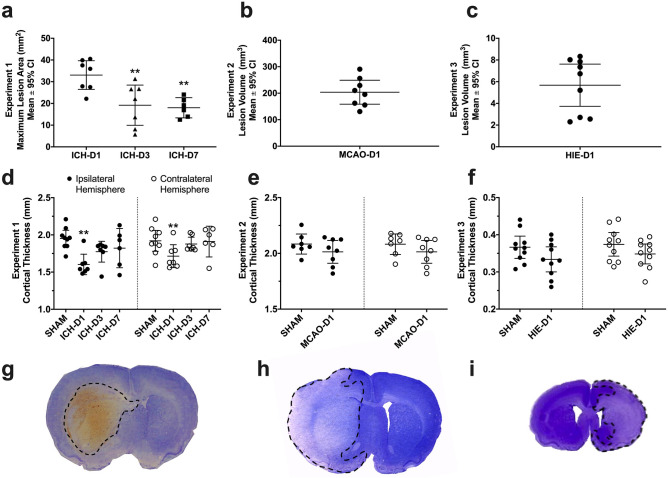
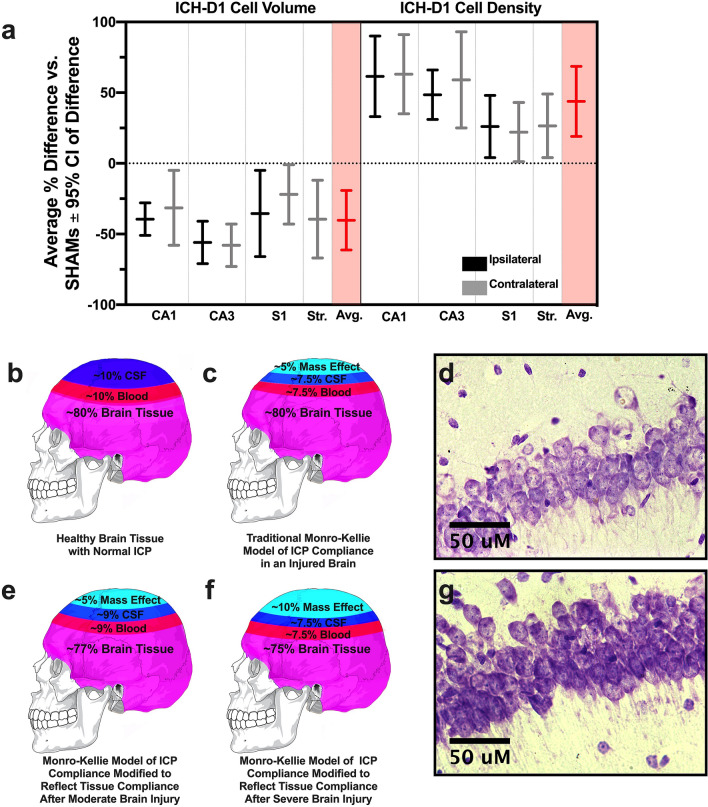
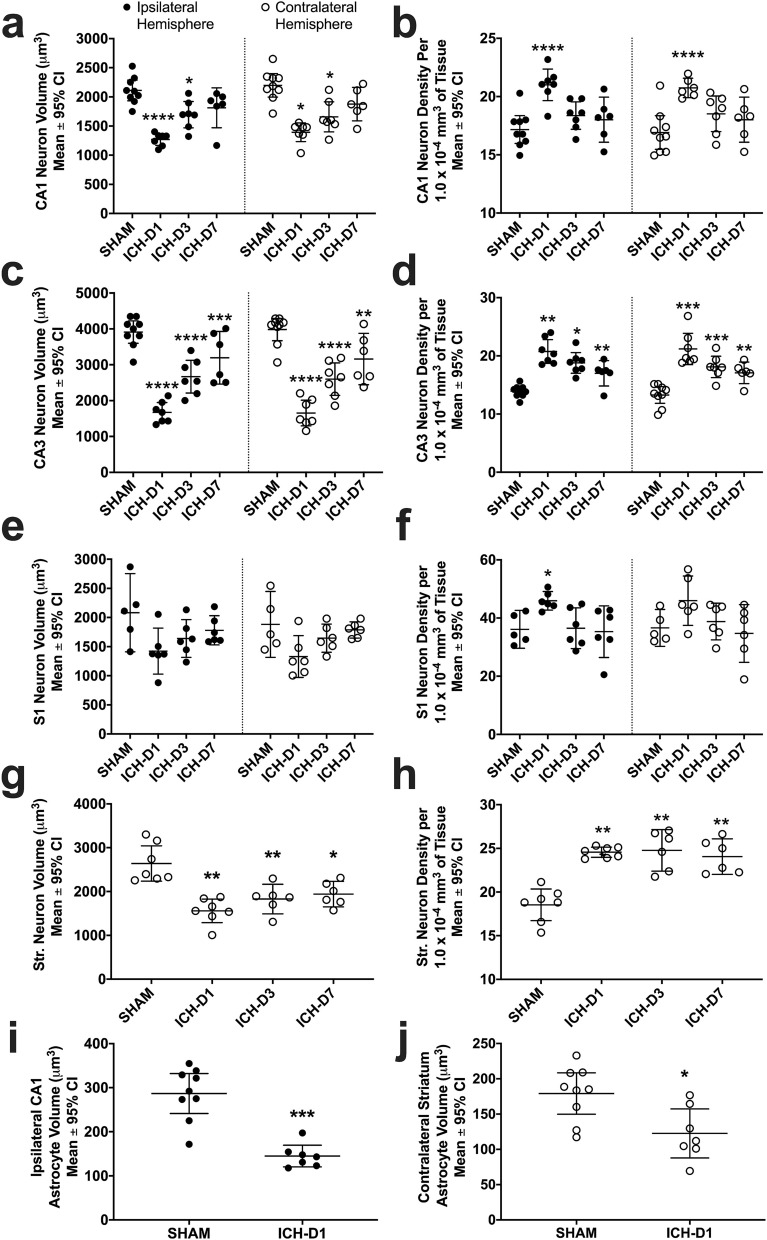
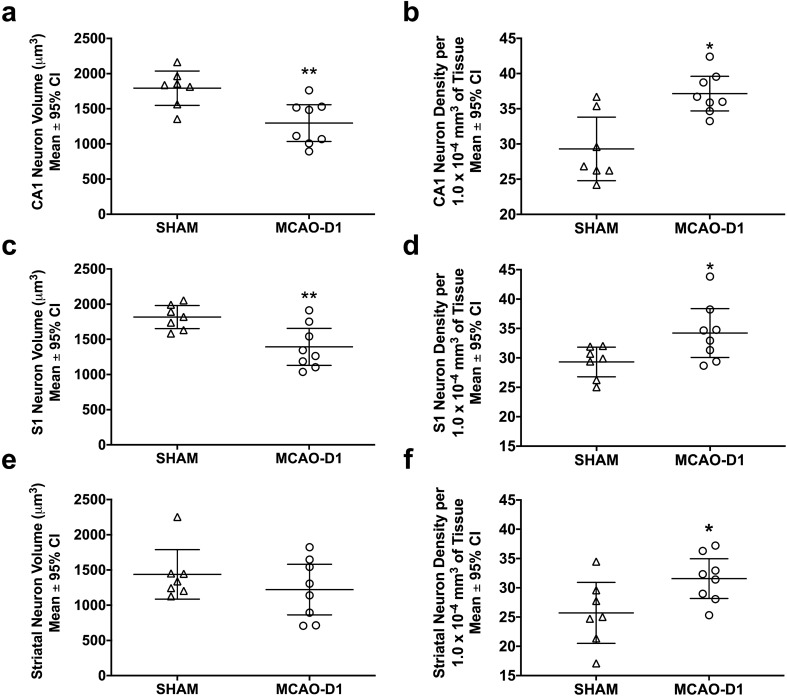
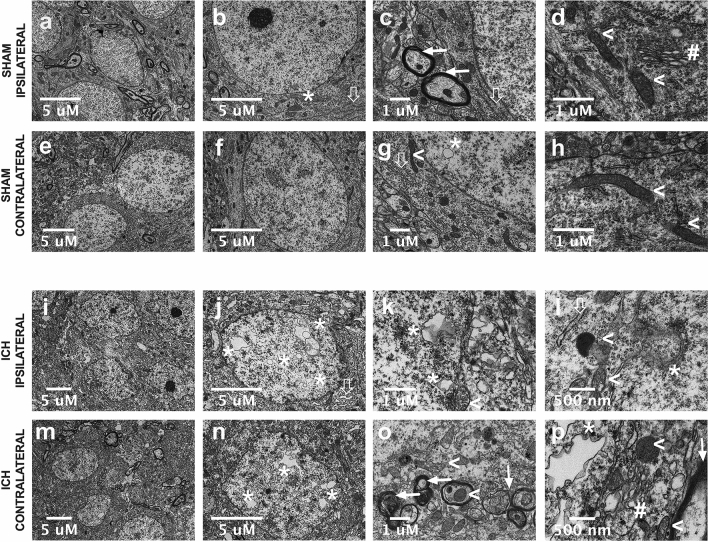
High intracranial pressure (ICP) can impede cerebral blood flow resulting in secondary injury or death following severe stroke. Compensatory mechanisms include reduced cerebral blood and cerebrospinal fluid volumes, but these often fail to prevent raised ICP. Serendipitous observations in intracerebral hemorrhage (ICH) suggest that neurons far removed from a hematoma may shrink as an ICP compliance mechanism. Here, we sought to critically test this observation. We tracked the timing of distal tissue shrinkage (e.g. CA1) after collagenase-induced striatal ICH in rat; cell volume and density alterations (42% volume reduction, 34% density increase; p < 0.0001) were highest day one post-stroke, and rebounded over a week across brain regions. Similar effects were seen in the filament model of middle cerebral artery occlusion (22% volume reduction, 22% density increase; p ≤ 0.007), but not with the Vannucci-Rice model of hypoxic-ischemic encephalopathy (2.5% volume increase, 14% density increase; p ≥ 0.05). Concerningly, this 'tissue compliance' appears to cause sub-lethal damage, as revealed by electron microscopy after ICH. Our data challenge the long-held assumption that 'healthy' brain tissue outside the injured area maintains its volume. Given the magnitude of these effects, we posit that 'tissue compliance' is an important mechanism invoked after severe strokes.
颅内压(ICP)升高可阻碍脑血流,从而导致严重中风后的继发性损伤或死亡。代偿机制包括脑血流和脑脊液体积减少,但这些通常不足以防止 ICP 升高。在脑出血(ICH)中的偶然观察表明,血肿远处的神经元可能会收缩,作为 ICP 顺应机制。在这里,我们试图批判性地检验这一观察结果。我们跟踪了胶原酶诱导的纹状体 ICH 后大鼠远端组织收缩(例如 CA1)的时间;细胞体积和密度的改变(体积减少 42%,密度增加 34%;p<0.0001)在中风后第一天最高,并在一周内跨越大脑区域反弹。在大脑中动脉闭塞的纤维模型中也观察到类似的影响(体积减少 22%,密度增加 22%;p≤0.007),但在缺氧缺血性脑病的 Vannucci-Rice 模型中则没有(体积增加 2.5%,密度增加 14%;p≥0.05)。令人担忧的是,这种“组织顺应性”似乎会导致亚致死性损伤,这在 ICH 后的电子显微镜下得到了揭示。我们的数据挑战了“健康”脑损伤区域外的脑组织保持其体积的长期假设。鉴于这些影响的巨大程度,我们假设“组织顺应性”是严重中风后调用的一个重要机制。