Chen Po-Hung, Chen Wei, Wang Cheng-Wei, Yang Hui-Fei, Huang Wan-Ting, Huang Hsiu-Chen, Chou Che-Yi
Division of Occupational Therapy, Ditmanson Medical Foundation Chiayi Christian Hospital, Chiayi City, Taiwan.
Department of Psychiatry, Ditmanson Medical Foundation Chiayi Christian Hospital, Chiayi City, Taiwan.
Front Physiol. 2020 Nov 20;11:583692. doi: 10.3389/fphys.2020.583692. eCollection 2020.
The association between physical fitness performance tests and anthropometric indices is not clear. The study aims to explore the association between physical fitness performance and anthropometric indices in Taiwanese community-dwelling adults. This may help in monitoring anthropometric indices to improve physical fitness.
We recruited 2216 participants aged 23-64 years between 2014 and 2017. Physical fitness performance, including abdominal muscular endurance (60-s sit-up test), flexibility (sit-and-reach test), and cardiorespiratory endurance (3-min step test), was evaluated in all participants. The association of the physical fitness performance and anthropometric indices, including body mass index (BMI), waist circumference (WC), waist-to-hip ratio (WHR), and waist-to-height ratio (WHtR), was analyzed using linear regression, with adjustments for age and gender.
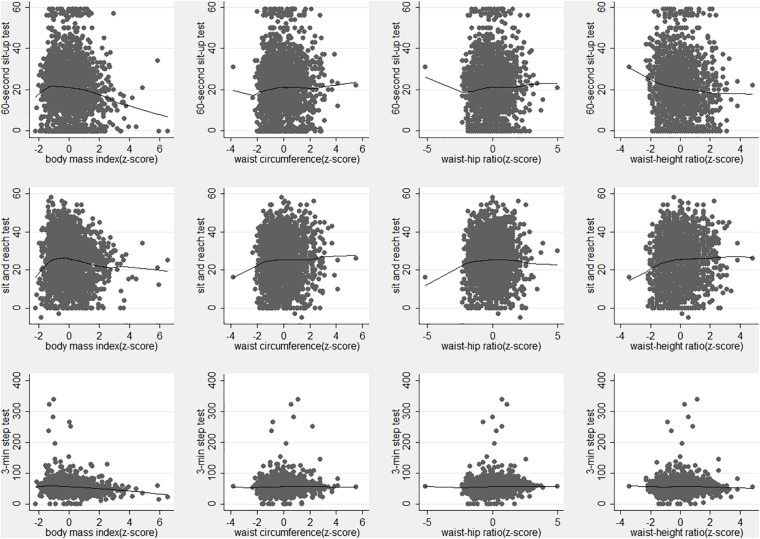
Body mass index was negatively associated with abdominal muscular endurance ( < 0.001) and cardiorespiratory endurance ( < 0.001). Neither BMI, WC, WHR, nor WHtR were significantly associated with flexibility. Abdominal muscle endurance, flexibility, and cardiorespiratory endurance were significantly lower in obese participants when obesity was defined using a BMI of ≥27, 30, and 35 kg/m. Participants with central obesity that was defined as WC ≥ 90 cm in men and 80 cm in women and WHtR ≥ 0.6 had lower abdominal muscular endurance than those without central obesity.
Body mass index is associated with abdominal muscular endurance and cardiorespiratory endurance in a reverse J-shaped manner. None of the anthropometric indices are significantly associated with flexibility. Obesity defined by BMI is linked to worse physical fitness performance and obesity defined using WHtR is linked to lower abdominal muscular endurance in Taiwanese community-dwelling adults.
体能测试与人体测量指标之间的关联尚不清楚。本研究旨在探讨台湾社区居住成年人的体能与人体测量指标之间的关联。这可能有助于监测人体测量指标以改善体能。
我们在2014年至2017年期间招募了2216名年龄在23 - 64岁之间的参与者。对所有参与者进行了体能测试,包括腹部肌肉耐力(60秒仰卧起坐测试)、柔韧性(坐位体前屈测试)和心肺耐力(3分钟台阶测试)。使用线性回归分析体能与人体测量指标之间的关联,人体测量指标包括体重指数(BMI)、腰围(WC)、腰臀比(WHR)和腰高比(WHtR),并对年龄和性别进行了调整。
体重指数与腹部肌肉耐力(<0.001)和心肺耐力(<0.001)呈负相关。BMI、WC、WHR和WHtR与柔韧性均无显著关联。当使用BMI≥27、30和35kg/m²定义肥胖时,肥胖参与者的腹部肌肉耐力、柔韧性和心肺耐力显著较低。将男性腰围≥90cm、女性腰围≥80cm以及WHtR≥0.6定义为中心性肥胖,与无中心性肥胖者相比,中心性肥胖参与者的腹部肌肉耐力较低。
体重指数与腹部肌肉耐力和心肺耐力呈倒J形关联。人体测量指标与柔韧性均无显著关联。在台湾社区居住成年人中,用BMI定义的肥胖与较差的体能表现相关,用WHtR定义的肥胖与较低的腹部肌肉耐力相关。