Levy Jonathan, Bader Oren
Department of Neuroscience and Biomedical Engineering, Aalto University, Espoo, Finland.
Baruch Ivcher School of Psychology, Interdisciplinary Center Herzliya, Herzliya, Israel.
Front Psychiatry. 2020 Nov 24;11:554848. doi: 10.3389/fpsyt.2020.554848. eCollection 2020.
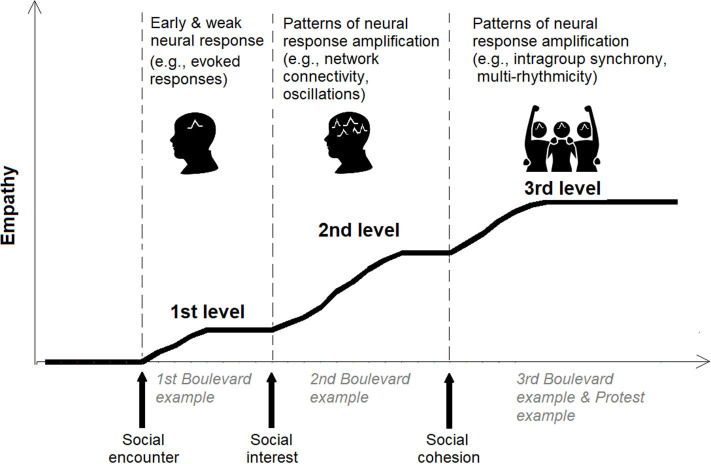
The neuroscience of empathy has enormously expanded in the past two decades, thereby making instrumental progress for the understanding of neural substrates involved in affective and cognitive aspects of empathy. Yet, these conclusions have relied on ultrasimplified tasks resulting in the affective/cognitive dichotomy that was often modeled and overemphasized in pathological, developmental, and genetic studies of empathy. As such, the affective/cognitive model of empathy could not straightforwardly accommodate and explain the recent surge of neuroscientific data obtained from studies employing naturalistic approaches and intergroup conditions. Inspired by phenomenological philosophy, this article paves the way for a new scientific perspective on empathy that breaks thorough the affective/cognitive dichotomy. This neuro-phenomenological account leans on phenomenological analyses and can straightforwardly explain recent neuroscience data. It emphasizes the dynamic, subjective, and piecemeal features of empathic experiences and unpicks the graded nature of empathy. postulates that attending to others' expressions always facilitates empathy, but the parametric modulation in the levels of the empathic experience varies as a function of one's social interest (e.g., via intergroup or inter-personal cues) in the observed other. Drawing on multiple resources that integrate neuroscience with phenomenology, we describe the potential of this graded framework in an era of real-life experimentation. By wearing lenses of neuro-phenomenology, this original perspective can change the way empathy is considered.
在过去二十年中,共情的神经科学得到了极大的扩展,从而在理解共情的情感和认知方面所涉及的神经基质方面取得了显著进展。然而,这些结论依赖于过于简化的任务,导致了情感/认知二分法,这种二分法在共情的病理学、发展学和遗传学研究中经常被建模和过度强调。因此,共情的情感/认知模型无法直接容纳和解释最近从采用自然主义方法和群体间条件的研究中获得的大量神经科学数据。受现象学哲学的启发,本文为一种突破情感/认知二分法的共情新科学视角铺平了道路。这种神经现象学解释依赖于现象学分析,能够直接解释最近的神经科学数据。它强调共情体验的动态、主观和零碎特征,并揭示了共情的分级性质。它假设关注他人的表达总是有助于共情,但共情体验水平的参数调制会根据个体对观察对象的社会兴趣(例如,通过群体间或人际线索)而变化。借助将神经科学与现象学相结合的多种资源,我们描述了这个分级框架在现实生活实验时代的潜力。通过神经现象学的视角,这种原创观点可以改变人们对共情的思考方式。