Sung Pil Soo, Choi Moon Hyung, Yang Hyun, Lee Soon Kyu, Chun Ho Jong, Jang Jeong Won, Choi Jong Young, Yoon Seung Kew, Choi Joon-Il, Lee Young Joon, Bae Si Hyun
The Catholic University Liver Research Center, College of Medicine, The Catholic University of Korea, Seoul, South Korea.
Division of Gastroenterology and Hepatology, Department of Internal Medicine, College of Medicine, Seoul St. Mary's Hospital, The Catholic University of Korea, Seoul, South Korea.
Front Oncol. 2020 Nov 19;10:600233. doi: 10.3389/fonc.2020.600233. eCollection 2020.
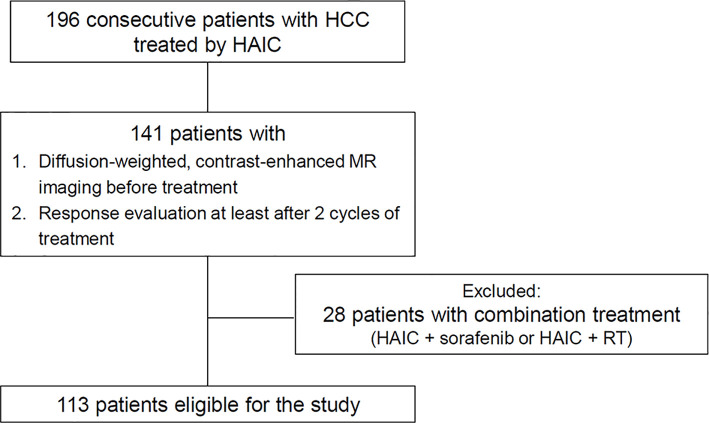
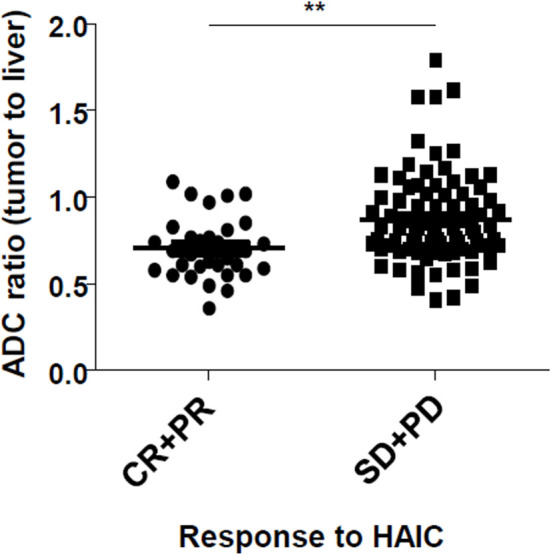
This study aimed to identify the utility of diffusion-weighted magnetic resonance (MR) imaging with an apparent diffusion coefficient (ADC) map as a predictor of the response of hepatocellular carcinoma (HCC) to cisplatin-based hepatic arterial infusion chemotherapy (HAIC). We retrospectively evaluated 113 consecutive patients with Barcelona Clinical Liver Cancer (BCLC) stage B or C HCC, who underwent gadoxetic acid-enhanced and diffusion-weighted MR imaging. The appropriate cutoff for the pretreatment tumor-to-liver ADC ratio was determined to be 0.741. Of the 113 patients, 50 (44%) presented with a pretreatment tumor-to-liver ADC ratio < 0.741 (low group). Evaluation of the treatment response after 2-3 cycles of HAIC in these 50 patients revealed that 21 patients (42%) experienced an objective response to HAIC. On the other hand, only 11 of the 63 patients (17%) with a pretreatment tumor-to-liver ADC ratio ≥ 0.741 (high group) showed an objective response. Thus, the objective response rate was significantly higher in the low group than in the high group ( = 0.006). Multivariate logistic regression analysis using parameters including perfusion alteration, percentage of non-enhancing portions, and pretreatment tumor-to-liver ADC ratio revealed that a pretreatment tumor-to-liver ADC ratio < 0.741 (odds ratio 3.217; = 0.014) was the sole predictor of an objective response to HAIC. Overall survival rates were significantly higher in patients with objective responses to HAIC than in those without objective responses ( = 0.001 by log-rank test). In conclusion, patients with BCLC stage C or C HCC with a pretreatment tumor-to-liver ADC ratio < 0.741 showed a favorable intrahepatic response to cisplatin-based HAIC. Therefore, diffusion-weighted MR imaging can play a critical role as a predictor of response to cisplatin-based HAIC in unresectable HCC.
本研究旨在确定采用表观扩散系数(ADC)图的扩散加权磁共振(MR)成像作为肝细胞癌(HCC)对基于顺铂的肝动脉灌注化疗(HAIC)反应的预测指标的效用。我们回顾性评估了113例连续的巴塞罗那临床肝癌(BCLC)B期或C期HCC患者,这些患者均接受了钆塞酸增强和扩散加权MR成像检查。确定治疗前肿瘤与肝脏ADC比值的合适临界值为0.741。在这113例患者中,50例(44%)治疗前肿瘤与肝脏ADC比值<0.741(低组)。对这50例患者在2 - 3个周期的HAIC治疗后的反应进行评估发现,21例患者(42%)对HAIC有客观反应。另一方面,在63例治疗前肿瘤与肝脏ADC比值≥0.741的患者(高组)中,只有11例(17%)有客观反应。因此,低组的客观反应率显著高于高组(P = 0.006)。使用包括灌注改变、无强化部分百分比和治疗前肿瘤与肝脏ADC比值等参数进行多因素逻辑回归分析显示,治疗前肿瘤与肝脏ADC比值<0.741(比值比3.217;P = 0.014)是对HAIC有客观反应的唯一预测指标。HAIC治疗有客观反应的患者的总生存率显著高于无客观反应的患者(对数秩检验P = 0.001)。总之,BCLC C期或C期HCC且治疗前肿瘤与肝脏ADC比值<0.741的患者对基于顺铂的HAIC表现出良好的肝内反应。因此,扩散加权MR成像可作为不可切除HCC对基于顺铂HAIC反应的预测指标发挥关键作用。