Department of Pediatric Hematology and Oncology, University Medical Center Hamburg-Eppendorf, Hamburg, Germany.
Research Institute Children's Cancer Center Hamburg, Martinistrasse 52, N63 (HPI), 20251, Hamburg, Germany.
Acta Neuropathol. 2021 Feb;141(2):291-301. doi: 10.1007/s00401-020-02250-7. Epub 2020 Dec 17.
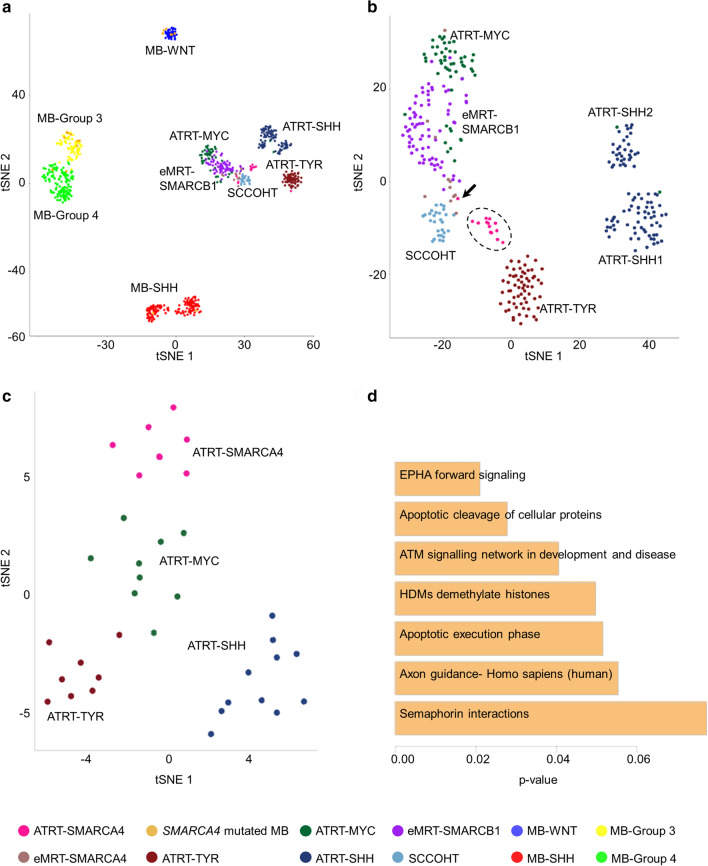
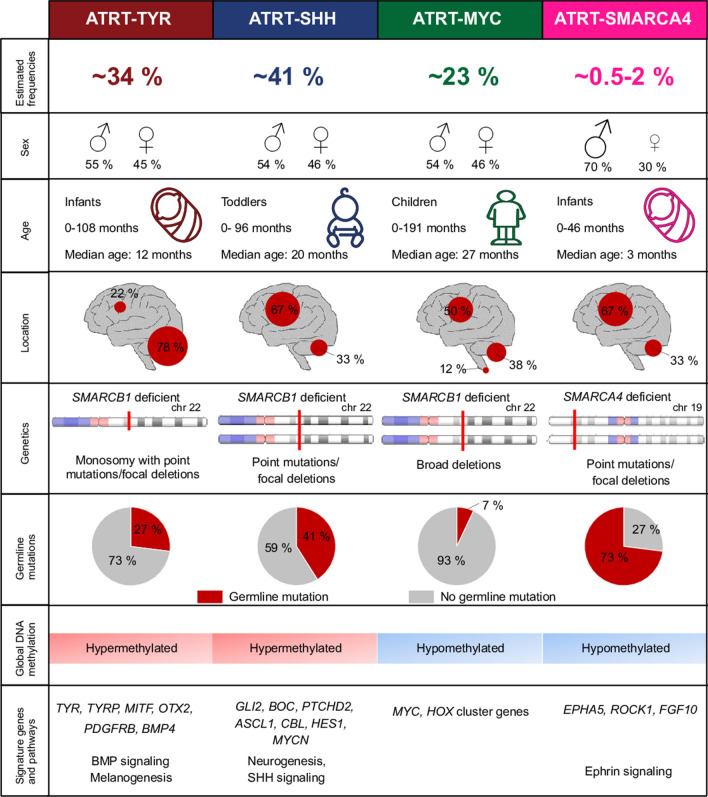
Atypical teratoid/rhabdoid tumors (ATRTs) are very aggressive childhood malignancies of the central nervous system. The underlying genetic cause are inactivating bi-allelic mutations in SMARCB1 or (rarely) in SMARCA4. ATRT-SMARCA4 have been associated with a higher frequency of germline mutations, younger age, and an inferior prognosis in comparison to SMARCB1 mutated cases. Based on their DNA methylation profiles and transcriptomics, SMARCB1 mutated ATRTs have been divided into three distinct molecular subgroups: ATRT-TYR, ATRT-SHH, and ATRT-MYC. These subgroups differ in terms of age at diagnosis, tumor location, type of SMARCB1 alterations, and overall survival. ATRT-SMARCA4 are, however, less well understood, and it remains unknown, whether they belong to one of the described ATRT subgroups. Here, we examined 14 ATRT-SMARCA4 by global DNA methylation analyses. We show that they form a separate group segregating from SMARCB1 mutated ATRTs and from other SMARCA4-deficient tumors like small cell carcinoma of the ovary, hypercalcemic type (SCCOHT) or SMARCA4 mutated extra-cranial malignant rhabdoid tumors. In contrast, medulloblastoma (MB) samples with heterozygous SMARCA4 mutations do not group separately, but with established MB subgroups. RNA sequencing of ATRT-SMARCA4 confirmed the clustering results based on DNA methylation profiling and displayed an absence of typical signature genes upregulated in SMARCB1 deleted ATRT. In summary, our results suggest that, in line with previous clinical observations, ATRT-SMARCA4 should be regarded as a distinct molecular subgroup.
非典型畸胎样/横纹肌样肿瘤(ATRTs)是一种非常侵袭性的儿童中枢神经系统恶性肿瘤。其潜在的遗传原因是 SMARCB1 或(很少)SMARCA4 的双等位基因失活突变。与 SMARCB1 突变病例相比,ATRT-SMARCA4 与更高频率的种系突变、更年轻的年龄和更差的预后相关。基于其 DNA 甲基化谱和转录组学,SMARCB1 突变的 ATRTs 已分为三个不同的分子亚群:ATRT-TYR、ATRT-SHH 和 ATRT-MYC。这些亚群在诊断时的年龄、肿瘤位置、SMARCB1 改变的类型和总生存率方面存在差异。然而,ATRT-SMARCA4 了解得较少,并且尚不清楚它们是否属于描述的 ATRT 亚群之一。在这里,我们通过全基因组 DNA 甲基化分析检查了 14 例 ATRT-SMARCA4。我们表明,它们形成了一个单独的亚群,与 SMARCB1 突变的 ATRTs 以及其他 SMARCA4 缺失的肿瘤(如卵巢小细胞癌,高钙血症型(SCCOHT)或 SMARCA4 突变的颅外恶性横纹肌样肿瘤)分离。相比之下,杂合性 SMARCA4 突变的髓母细胞瘤(MB)样本不会单独分组,而是与已建立的 MB 亚组分组。ATRT-SMARCA4 的 RNA 测序基于 DNA 甲基化谱分析证实了聚类结果,并显示出典型的 SMARCB1 缺失 ATRT 上调的特征基因缺失。总之,我们的结果表明,与先前的临床观察一致,ATRT-SMARCA4 应被视为一个独特的分子亚群。