Augustyńska-Prejsnar Anna, Sokołowicz Zofia, Hanus Paweł, Ormian Małgorzata, Kačániová Miroslava
Department of Animal Production and Poultry Products Evaluation, Institute of Food and Nutrition Technology, University of Rzeszow, 35-959 Rzeszow, Poland.
Department of Food Technology and Human Nutrition, Institute of Food and Nutrition Technology, University of Rzeszow, 35-959 Rzeszow, Poland.
Animals (Basel). 2020 Dec 15;10(12):2393. doi: 10.3390/ani10122393.
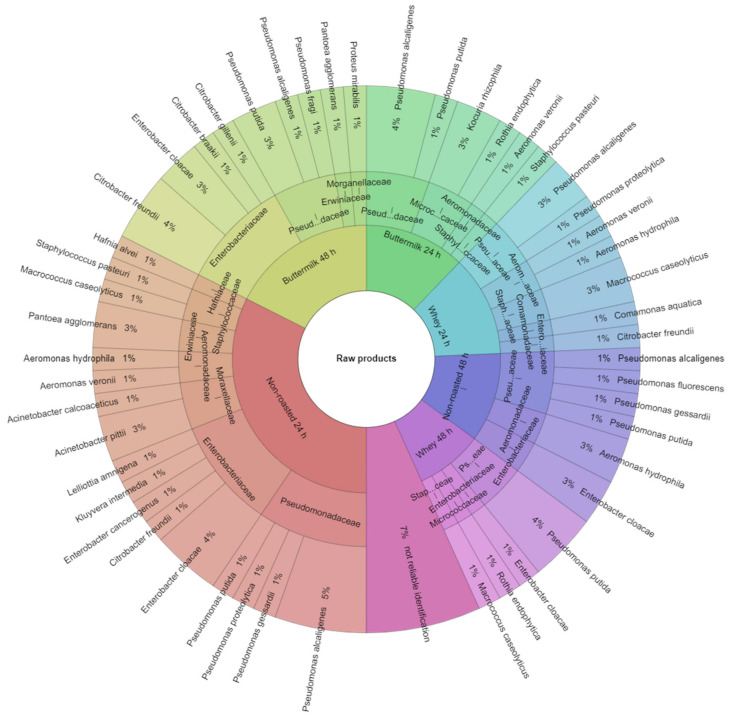
The material for the study was the breast muscles of hens after the laying period which were marinated with buttermilk and acid whey for 24 and 48 h. The quality parameters of non-marinated and marinated raw and roast products were evaluated in respect of physical traits (marinade absorption, pH, colour Lab*, shear force, TPA texture profile analysis test), microbiological parameters and sensory characteristics. The microbiological parameters were determined as the total viable counts of mesophilic aerobic bacteria of the family and spp. Bacterial identification was performed by MALDI-TOF MS. The study showed that marinating the breast muscles of hens after the laying period with buttermilk and whey lightened the colour ( < 0.05), decreased the shear force value ( < 0.05), and reduced hardness and chewiness ( < 0.05) both after 24 and 48 h of marinating compared to the control product. The 24-h time of marinating with buttermilk and whey inhibited ( < 0.05) the growth of aerobic bacteria and spp. and had a positive effect on the desirable odour, the intensity and desirability of flavour as well as the roast product tenderness. Longer marinating time reduced the product palatability and decreased its microbiological safety. The obtained results suggest that the 24-h time of marinating hen meat after the laying period with buttermilk and acid whey allows to obtainment of a high-quality product.
本研究的材料是产蛋期过后的母鸡胸肌,将其用酪乳和酸乳清腌制24小时和48小时。对未腌制和腌制后的生制品及烤制产品的质量参数进行了评估,涉及物理特性(腌料吸收、pH值、色泽Lab*、剪切力、TPA质地剖面分析测试)、微生物参数和感官特性。微生物参数测定为嗜温需氧菌总数及相关菌种。通过基质辅助激光解吸电离飞行时间质谱(MALDI-TOF MS)进行细菌鉴定。研究表明,与对照产品相比,产蛋期过后的母鸡胸肌用酪乳和乳清腌制24小时和48小时后,颜色变浅(P<0.05),剪切力值降低(P<0.05),硬度和咀嚼性也降低(P<0.05)。用酪乳和乳清腌制24小时可抑制(P<0.05)需氧菌及相关菌种的生长,并对理想气味、风味强度和适宜性以及烤制产品的嫩度有积极影响。腌制时间延长会降低产品的适口性并降低其微生物安全性。所得结果表明,产蛋期过后的母鸡肉用酪乳和酸乳清腌制24小时可获得高质量产品。