Moi University School of Medicine, Eldoret, Kenya.
Division of Neonatal-Perinatal Medicine, Indiana University School of Medicine, Indianapolis, IN, USA.
Reprod Health. 2020 Dec 17;17(Suppl 3):176. doi: 10.1186/s12978-020-01026-2.
Birth weight (BW) is a strong predictor of neonatal outcomes. The purpose of this study was to compare BWs between global regions (south Asia, sub-Saharan Africa, Central America) prospectively and to determine if trends exist in BW over time using the population-based maternal and newborn registry (MNHR) of the Global Network for Women'sand Children's Health Research (Global Network).
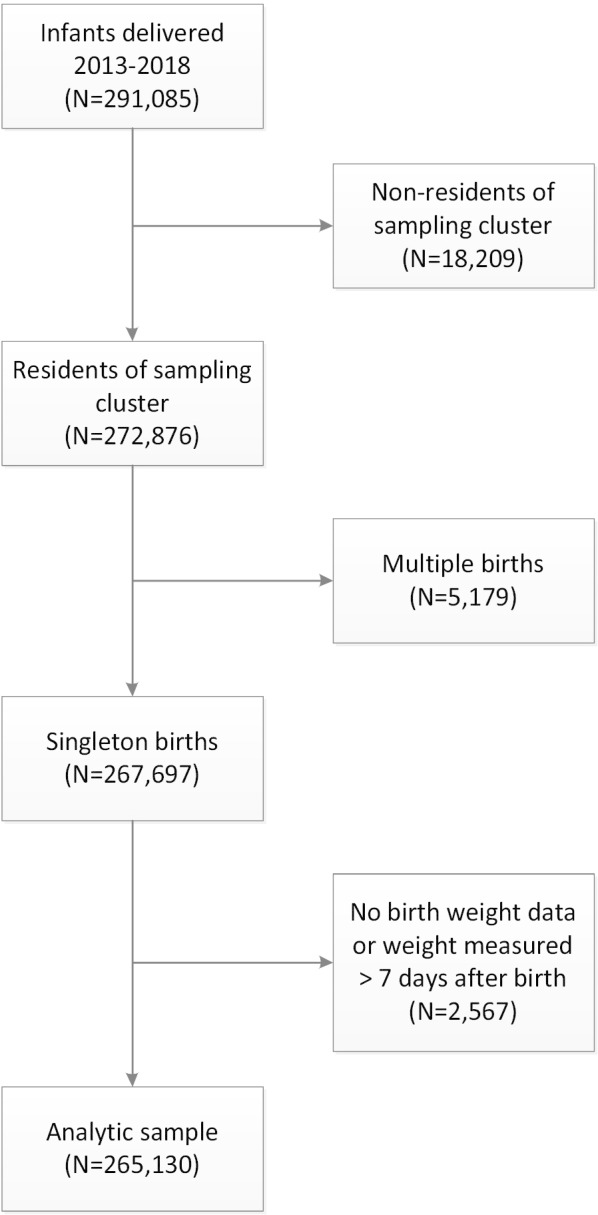
The MNHR is a prospective observational population-based registryof six research sites participating in the Global Network (2013-2018), within five low- and middle-income countries (Kenya, Zambia, India, Pakistan, and Guatemala) in threeglobal regions (sub-Saharan Af rica, south Asia, Central America). The birth weights were obtained for all infants born during the study period. This was done either by abstracting from the infants' health facility records or from direct measurement by the registry staff for infants born at home. After controlling for demographic characteristics, mixed-effect regression models were utilized to examine regional differences in birth weights over time.
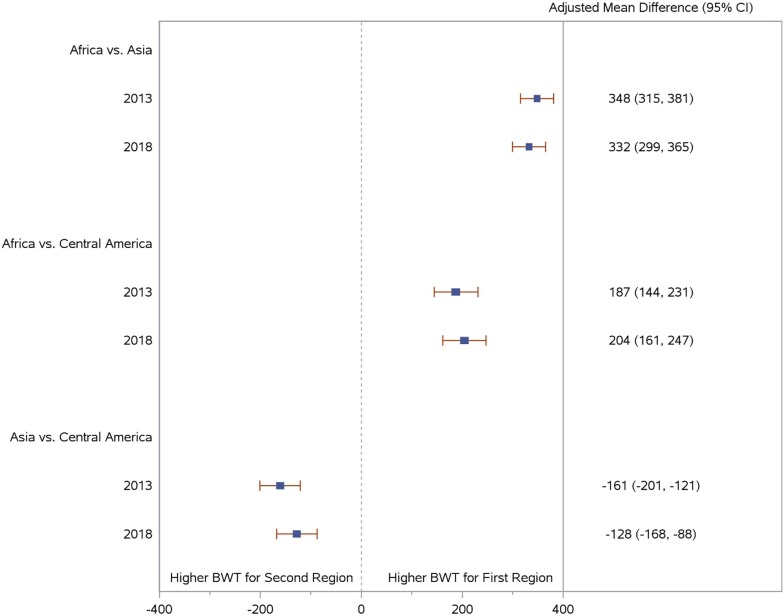
The overall BW meanswere higher for the African sites (Zambia and Kenya), 3186 g (SD 463 g) in 2013 and 3149 g (SD 449 g) in 2018, ascompared to Asian sites (Belagavi and Nagpur, India and Pakistan), 2717 g (SD450 g) in 2013 and 2713 g (SD 452 g) in 2018. The Central American site (Guatemala) had a mean BW intermediate between the African and south Asian sites, 2928 g (SD 452) in 2013, and 2874 g (SD 448) in 2018. The low birth weight (LBW) incidence was highest in the south Asian sites (India and Pakistan) and lowest in the African sites (Kenya and Zambia). The size of regional differences varied somewhat over time with slight decreases in the gap in birth weights between the African and Asian sites and slight increases in the gap between the African and Central American sites.
Overall, BWmeans by global region did not change significantly over the 5-year study period. From 2013 to 2018, infants enrolled at the African sites demonstrated the highest BW means overall across the entire study period, particularly as compared to Asian sites. The incidence of LBW was highest in the Asian sites (India and Pakistan) compared to the African and Central American sites. Trial registration The study is registered at clinicaltrials.gov. ClinicalTrial.gov Trial Registration: NCT01073475.
出生体重(BW)是新生儿结局的强有力预测指标。本研究的目的是前瞻性比较全球各地区(南亚、撒哈拉以南非洲、中美洲)的 BW,并利用全球妇女和儿童健康研究网络(全球网络)的基于人群的母婴和新生儿登记处(MNHR)确定 BW 随时间的趋势是否存在。
MNHR 是一个前瞻性的基于人群的母婴登记处,有六个参与全球网络的研究点(2013-2018 年),位于五个低收入和中等收入国家(肯尼亚、赞比亚、印度、巴基斯坦和危地马拉)中的三个全球地区(撒哈拉以南非洲、南亚、中美洲)。在研究期间出生的所有婴儿的出生体重均通过以下方式获得:从婴儿的医疗机构记录中提取,或由登记处工作人员为在家中出生的婴儿直接测量。在控制人口统计学特征后,利用混合效应回归模型来检查随时间推移的出生体重的区域差异。
非洲地区(赞比亚和肯尼亚)的总体 BW 均值较高,2013 年为 3186g(SD 463g),2018 年为 3149g(SD 449g),而亚洲地区(印度的 Belagavi 和 Nagpur 以及巴基斯坦)的 BW 均值较低,2013 年为 2717g(SD 450g),2018 年为 2713g(SD 452g)。中美洲地区(危地马拉)的 BW 均值位于非洲和南亚地区之间,2013 年为 2928g(SD 452),2018 年为 2874g(SD 448)。南亚地区(印度和巴基斯坦)的低出生体重(LBW)发生率最高,而非洲地区(肯尼亚和赞比亚)的发生率最低。区域差异的大小随时间略有变化,非洲和亚洲地区之间的 BW 差异略有缩小,而非洲和中美洲地区之间的差异略有增加。
总体而言,全球各地区的 BW 均值在 5 年研究期间没有显著变化。从 2013 年到 2018 年,在整个研究期间,参加非洲地区研究的婴儿的 BW 均值总体上最高,尤其是与亚洲地区相比。与非洲和中美洲地区相比,亚洲地区(印度和巴基斯坦)的 LBW 发生率最高。
该研究在 clinicaltrials.gov 上注册。clinicaltrials.gov 注册号:NCT01073475。