Stem Cell Biochemistry Unit, National Institute of Dental and Craniofacial Research, National Institutes of Health, Bethesda, MD, 20892, USA.
Metabolic, Cardiovascular and Inflammatory Disease Genomics Branch, National Human Genome Research Institute, National Institutes of Health, Bethesda, MD, 20892, USA.
Cell Death Differ. 2021 Feb;28(2):538-556. doi: 10.1038/s41418-020-00697-5. Epub 2020 Dec 17.
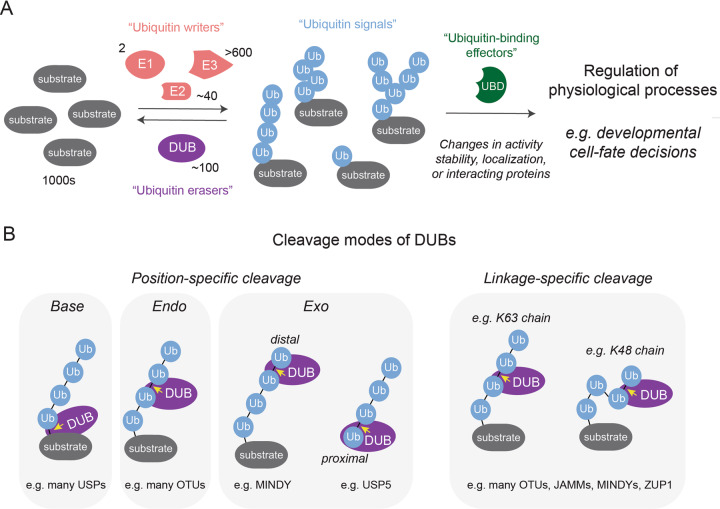
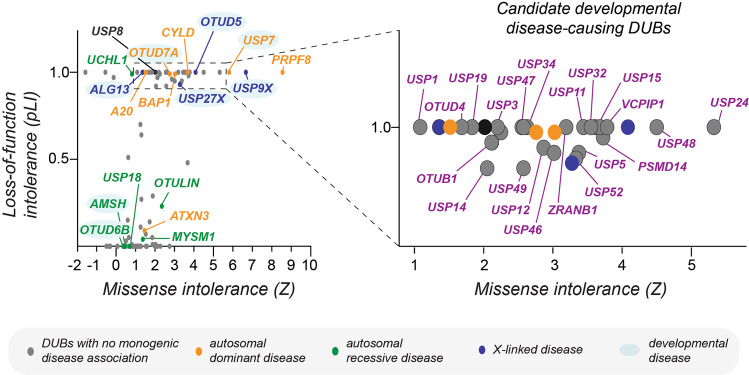
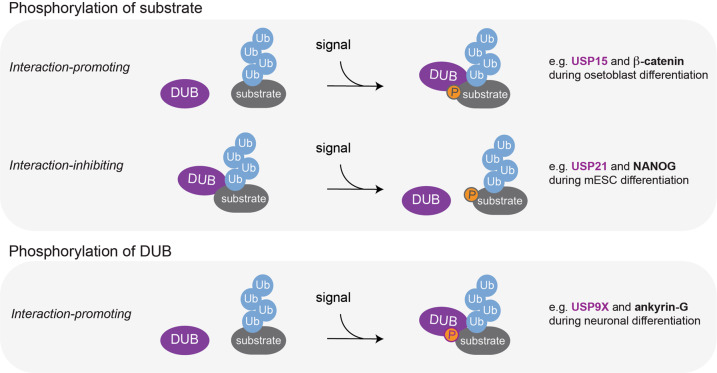
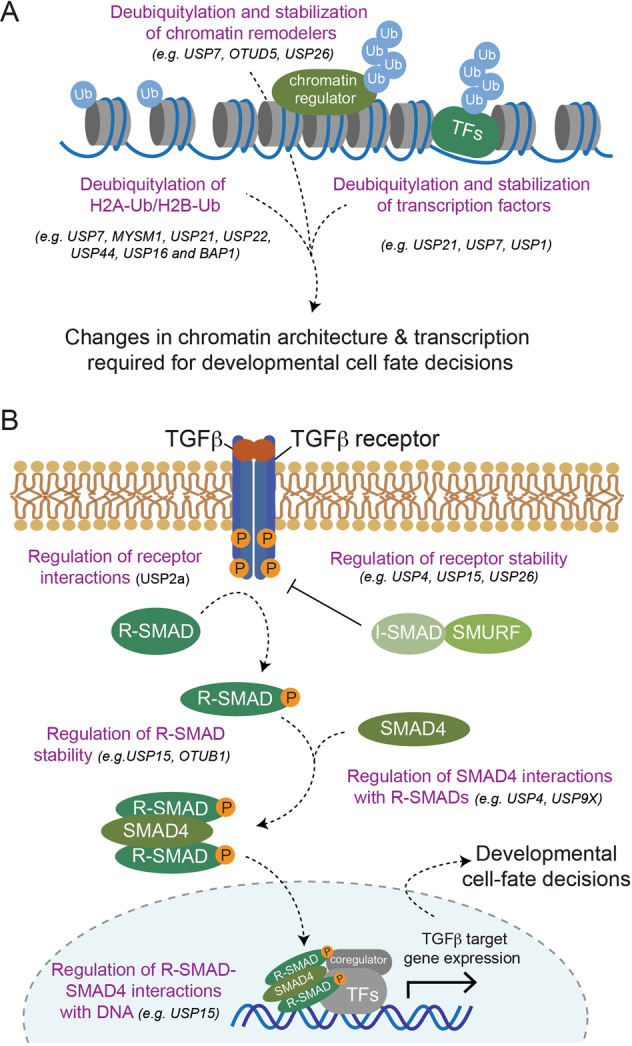
Metazoan development from a one-cell zygote to a fully formed organism requires complex cellular differentiation and communication pathways. To coordinate these processes, embryos frequently encode signaling information with the small protein modifier ubiquitin, which is typically attached to lysine residues within substrates. During ubiquitin signaling, a three-step enzymatic cascade modifies specific substrates with topologically unique ubiquitin modifications, which mediate changes in the substrate's stability, activity, localization, or interacting proteins. Ubiquitin signaling is critically regulated by deubiquitylases (DUBs), a class of ~100 human enzymes that oppose the conjugation of ubiquitin. DUBs control many essential cellular functions and various aspects of human physiology and development. Recent genetic studies have identified mutations in several DUBs that cause developmental disorders. Here we review principles controlling DUB activity and substrate recruitment that allow these enzymes to regulate ubiquitin signaling during development. We summarize key mechanisms of how DUBs control embryonic and postnatal differentiation processes, highlight developmental disorders that are caused by mutations in particular DUB members, and describe our current understanding of how these mutations disrupt development. Finally, we discuss how emerging tools from human disease genetics will enable the identification and study of novel congenital disease-causing DUBs.
从单细胞受精卵到完全形成的生物体,后生动物的发育需要复杂的细胞分化和通讯途径。为了协调这些过程,胚胎经常将信号信息编码到小分子蛋白修饰物泛素中,泛素通常附着在底物的赖氨酸残基上。在泛素信号传导过程中,三步酶级联反应以拓扑独特的泛素修饰来修饰特定的底物,从而介导底物稳定性、活性、定位或相互作用蛋白的变化。泛素信号传导受到去泛素化酶 (DUBs) 的严格调控,DUBs 是一类约 100 种人类酶,它们与泛素的缀合作用相反。DUBs 控制着许多重要的细胞功能和人类生理学和发育的各个方面。最近的遗传研究已经确定了几个 DUB 基因突变会导致发育障碍。在这里,我们回顾了控制 DUB 活性和底物招募的原则,这些原则允许这些酶在发育过程中调节泛素信号传导。我们总结了 DUB 如何控制胚胎和出生后分化过程的关键机制,强调了由特定 DUB 成员突变引起的发育障碍,并描述了我们目前对这些突变如何破坏发育的理解。最后,我们讨论了来自人类疾病遗传学的新兴工具将如何使识别和研究新的先天性疾病引起的 DUB 成为可能。