Department of Anesthesia, Women's Hospital, Zhejiang University School of Medicine, Hangzhou 310006, People's Republic of China.
Department of Anesthesia, Jiaxing University Affiliated Women and Children Hospital, Jiaxing 314000, People's Republic of China.
Drug Des Devel Ther. 2020 Dec 8;14:5451-5458. doi: 10.2147/DDDT.S258651. eCollection 2020.
Oxytocin is the first-line agent to prevent and treat uterine atony during cesarean delivery (CD). We compared the effective dose in 50% of the parturients (ED) of a prophylactic oxytocin bolus during CD in young (<35 years) and old parturients (≥35 years) using Dixon's up-and-down method.
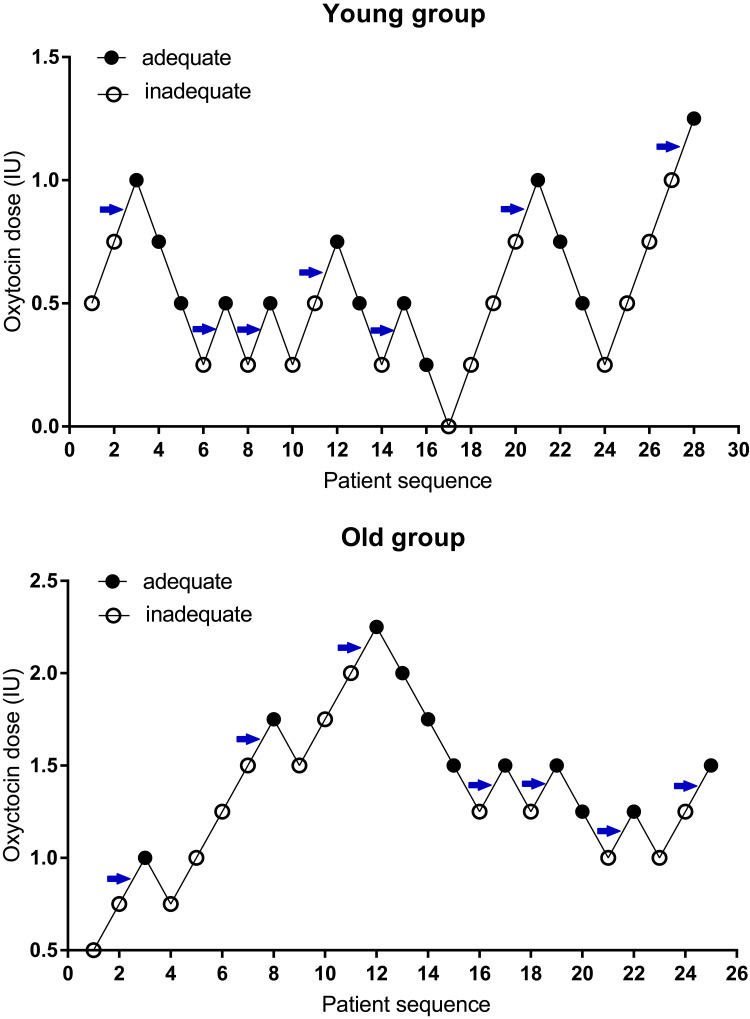
Twenty-eight young parturients (young group) and 25 old parturients (old group) undergoing CD under combined spinal-epidural anesthesia were enrolled. The initial oxytocin bolus was 0.5 IU, with increments or decrements of 0.25 IU. Maternal adverse effects, requirement for additional uterotonic agents, and estimated blood loss were recorded.
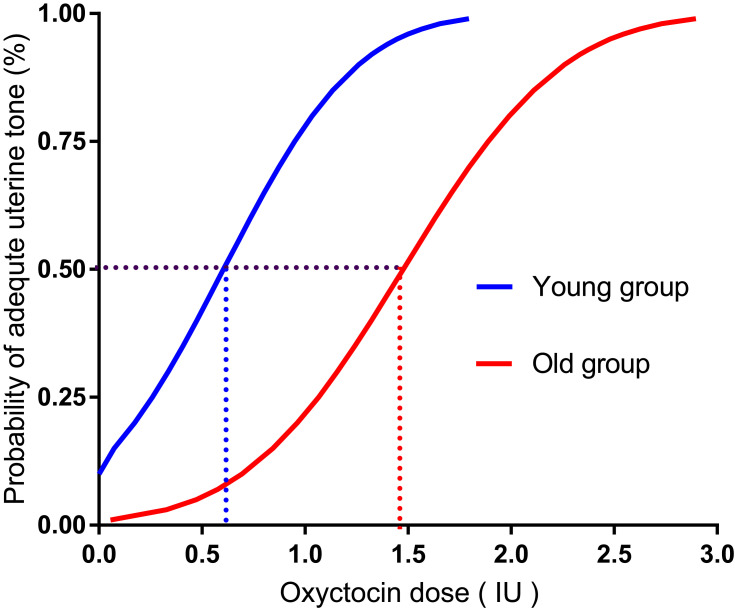
The ED for oxytocin in the old group was higher than that in the young group (1.41 IU; 95% confidence interval, 0.63-2.19) vs 0.66 IU (0.04-1.29), < 0.001). The total oxytocin dose in the old group was higher than in the young group (5.9 ± 2.9 vs 4.1 ± 2.1 IU, = 0.01). The estimated blood loss in the older group and young group was 401.2 ± 204.5 mL and 289.3 ± 104.6 mL, respectively ( =0.01). The overall prevalence of adverse effects was higher in the old group than in the young group (68.0% vs 21.4%, < 0.001).
The initial bolus and total requirement of oxytocin for preventing uterine atony were higher in old parturients than in young parturients during CD. Advanced maternal age may necessitate higher doses of oxytocin.
缩宫素是预防和治疗剖宫产术中子宫收缩乏力的一线药物。我们使用 Dixon 的上下法比较了年轻(<35 岁)和老年(≥35 岁)产妇在剖宫产时预防性缩宫素推注的半数有效剂量(ED)。
纳入了 28 名年轻产妇(年轻组)和 25 名老年产妇(老年组),均接受椎管内联合麻醉下的剖宫产术。初始缩宫素推注量为 0.5IU,递增或递减 0.25IU。记录产妇不良反应、对额外宫缩剂的需求以及估计失血量。
老年组的缩宫素 ED 高于年轻组(1.41IU;95%置信区间,0.63-2.19)vs 0.66IU(0.04-1.29),<0.001)。老年组的总缩宫素剂量高于年轻组(5.9±2.9IU vs 4.1±2.1IU,=0.01)。老年组和年轻组的估计失血量分别为 401.2±204.5mL 和 289.3±104.6mL(=0.01)。老年组的不良反应总发生率高于年轻组(68.0% vs 21.4%,<0.001)。
在剖宫产术中,老年产妇预防子宫收缩乏力所需的初始推注量和总缩宫素剂量均高于年轻产妇。高龄产妇可能需要更高剂量的缩宫素。