Paredes-Echeverri Sara, Rodríguez Ayda N, Cárdenas Wilmer A, Mendoza de Molano Belén, González John M
Grupo de Ciencias Básicas Médicas, School of Medicine, Universidad de Los Andes, Bogotá, Colombia.
National Blood Bank Colombian Red Cross, Bogotá, Colombia.
Can J Gastroenterol Hepatol. 2020 Nov 30;2020:7541941. doi: 10.1155/2020/7541941. eCollection 2020.
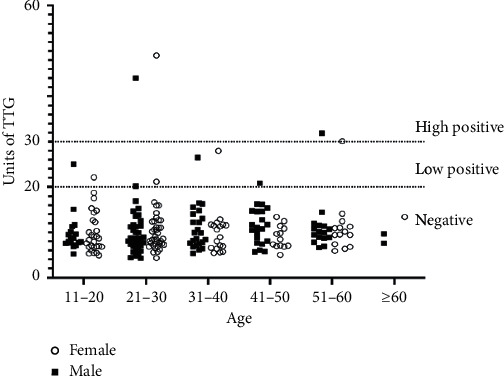
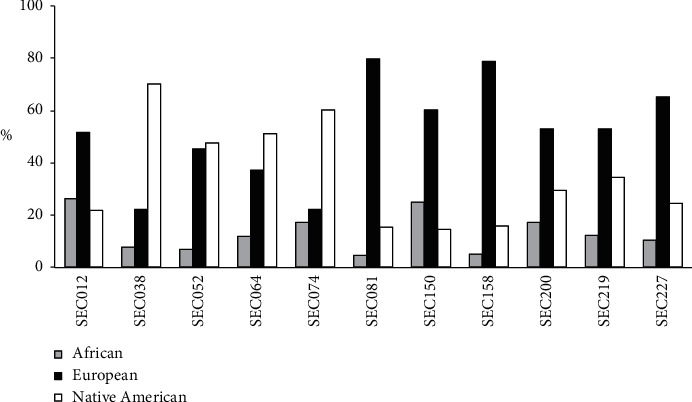
Celiac disease (CD) is an autoimmune enteropathy induced by the ingestion of gluten from wheat, barley, and rye in genetically susceptible individuals. The global prevalence of CD is 1.4%. However, most of the prevalence studies have been conducted in Caucasian populations; few studies have been performed in Latin America. The aim of this study is to determine the seroprevalence of auto-antibodies used as markers for CD in a Colombian cohort. In this cross-sectional study, the serum samples from Colombian donors of the National Red Cross Blood Bank were collected between June and September 2017 in Bogotá, Colombia. All sera were tested for IgA antitissue transglutaminase (TTG) by enzyme-linked immunosorbent assay. Seropositive sera were tested for IgA antiendomysium (EMA) using indirect immunofluorescence assay. The ancestral genetic composition was determined in donor samples with antibody assay reactivity. Those with two seroreactive assays were typed for HLA class II DQ2 and DQ8. In total, 228 blood donors participated in the study. Among them, 113 were females (49.56%) with an average age of 31.63 years (SD ± 12.99); males had an average of 34.71 years (SD ± 13.01). Only 3 (1.31%) donors reported chronic diarrhea and nonintentional weight loss; 11 (4.82%) had a family history of CD. For the serological assays, 11 donors (4.82%) were seroreactive to IgA anti-TTG: 3 had high reactivity and 8 had low reactivity. Of those seroreactive to IgA anti-TTG, 3 (1.32%) were also seroreactive to anti-EMA, and they were typed as HLA-DQ8 or HLA-DQ2. The baseline ancestral percentage of the seroreactive donors was higher for European and Native American than for African genes. The seroprevalence for anti-TTG and anti-EMA with the presence of HLA-DQ8 and HLA-DQ2 was 1.32%. Additionally, 4.82% donor participants were reactive only for anti-TTG. Compared with other studies, our findings suggest that Colombia has a high prevalence of CD markers.
乳糜泻(CD)是一种自身免疫性肠病,由遗传易感性个体摄入小麦、大麦和黑麦中的麸质引发。全球乳糜泻患病率为1.4%。然而,大多数患病率研究是在白种人群中进行的;在拉丁美洲进行的研究较少。本研究的目的是确定哥伦比亚队列中用作乳糜泻标志物的自身抗体的血清阳性率。在这项横断面研究中,2017年6月至9月期间在哥伦比亚波哥大收集了来自国家红十字会血库的哥伦比亚献血者的血清样本。所有血清均通过酶联免疫吸附测定法检测抗组织转谷氨酰胺酶(TTG)IgA。血清反应阳性的血清通过间接免疫荧光测定法检测抗肌内膜(EMA)IgA。在具有抗体检测反应性的供体样本中确定祖先基因组成。对两项血清反应性检测呈阳性的个体进行HLA II类DQ2和DQ8分型。共有228名献血者参与了该研究。其中,113名是女性(49.56%),平均年龄为31.63岁(标准差±12.99);男性平均年龄为34.71岁(标准差±13.01)。只有3名(1.31%)献血者报告有慢性腹泻和非故意体重减轻;11名(4.82%)有乳糜泻家族史。对于血清学检测,11名(4.82%)献血者对IgA抗TTG呈血清反应性:3名反应性高,8名反应性低。在对IgA抗TTG呈血清反应性的个体中,3名(1.32%)对抗EMA也呈血清反应性,并且他们被分型为HLA - DQ8或HLA - DQ2。血清反应性献血者的欧洲和美洲原住民祖先基因百分比基线高于非洲基因。抗TTG和抗EMA在存在HLA - DQ8和HLA - DQ2时的血清阳性率为1.32%。此外,4.82%的献血者仅对抗TTG呈反应性。与其他研究相比,我们的研究结果表明哥伦比亚乳糜泻标志物的患病率较高。