Moudjou Mohammed, Castille Johan, Passet Bruno, Herzog Laetitia, Reine Fabienne, Vilotte Jean-Luc, Rezaei Human, Béringue Vincent, Igel-Egalon Angélique
Université Paris Saclay, INRAE, UVSQ, VIM, Jouy-en-Josas, France.
Université Paris Saclay, INRAE, AgroParisTech, GABI, Jouy-en-Josas, France.
Front Bioeng Biotechnol. 2020 Dec 1;8:591024. doi: 10.3389/fbioe.2020.591024. eCollection 2020.
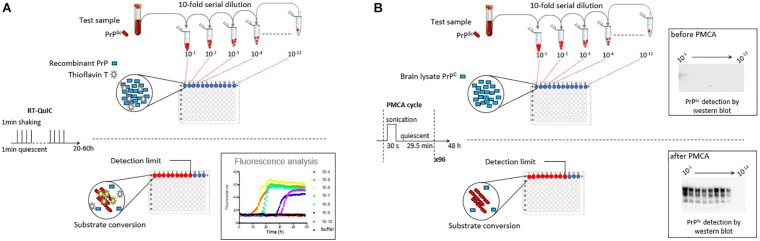
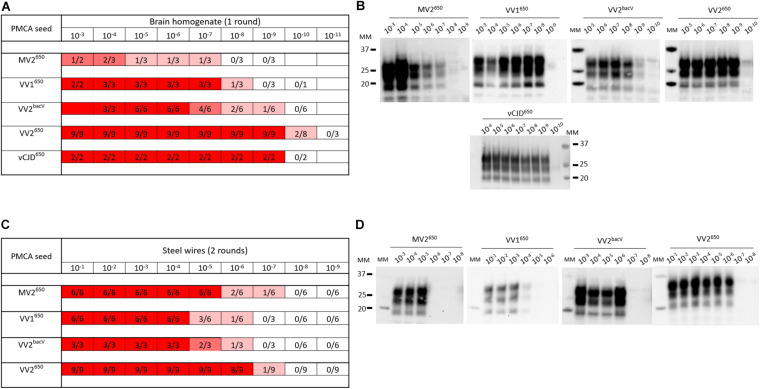
Prions are pathogenic infectious agents responsible for fatal, incurable neurodegenerative diseases in animals and humans. Prions are composed exclusively of an aggregated and misfolded form (PrP ) of the cellular prion protein (PrP). During the propagation of the disease, PrP recruits and misfolds PrP into further PrP. In human, iatrogenic prion transmission has occurred with incompletely sterilized medical material because of the unusual resistance of prions to inactivation. Most commercial prion disinfectants validated against the historical, well-characterized laboratory strain of 263K hamster prions were recently shown to be ineffective against variant Creutzfeldt-Jakob disease human prions. These observations and previous reports support the view that any inactivation method must be validated against the prions for which they are intended to be used. Strain-specific variations in PrP physico-chemical properties and conformation are likely to explain the strain-specific efficacy of inactivation methods. Animal bioassays have long been used as gold standards to validate prion inactivation methods, by measuring reduction of prion infectivity. Cell-free assays such as the real-time quaking-induced conversion (RT-QuIC) assay and the protein misfolding cyclic amplification (PMCA) assay have emerged as attractive alternatives. They exploit the seeding capacities of PrP to exponentially amplify minute amounts of prions in biospecimens. European and certain national medicine agencies recently implemented their guidelines for prion inactivation of non-disposable medical material; they encourage or request the use of human prions and cell-free assays to improve the predictive value of the validation methods. In this review, we discuss the methodological and technical issues regarding the choice of (i) the cell-free assay, (ii) the human prion strain type, (iii) the prion-containing biological material. We also introduce a new optimized substrate for high-throughput PMCA amplification of human prions bound on steel wires, as translational model for prion-contaminated instruments.
朊病毒是导致动物和人类致命且无法治愈的神经退行性疾病的致病性感染因子。朊病毒仅由细胞朊蛋白(PrP)的聚集且错误折叠形式(PrP )组成。在疾病传播过程中,PrP招募PrP并将其错误折叠成更多的PrP 。在人类中,由于朊病毒对灭活具有异常抗性,医源性朊病毒传播已通过未完全灭菌的医疗材料发生。最近发现,大多数针对历史上特征明确的263K仓鼠朊病毒实验室菌株验证有效的商业朊病毒消毒剂,对变异型克雅氏病人类朊病毒无效。这些观察结果和先前的报告支持这样一种观点,即任何灭活方法都必须针对其预期使用的朊病毒进行验证。PrP物理化学性质和构象的菌株特异性差异可能解释了灭活方法的菌株特异性功效。长期以来,动物生物测定一直被用作通过测量朊病毒感染性降低来验证朊病毒灭活方法的金标准。无细胞测定,如实时光振荡诱导转化(RT-QuIC)测定和蛋白质错误折叠循环扩增(PMCA)测定,已成为有吸引力的替代方法。它们利用PrP的种子形成能力,在生物标本中指数级放大微量朊病毒。欧洲和某些国家药品机构最近实施了关于一次性医疗材料朊病毒灭活的指南;它们鼓励或要求使用人类朊病毒和无细胞测定来提高验证方法的预测价值。在本综述中,我们讨论了关于(i)无细胞测定、(ii)人类朊病毒菌株类型、(iii)含朊病毒生物材料选择的方法学和技术问题。我们还介绍了一种新的优化底物,用于高通量PMCA扩增结合在钢丝上的人类朊病毒,作为朊病毒污染仪器的转化模型。