Clinic for Thoracic and Cardiovascular Surgery, Herz- und Diabeteszentrum Nordrhein-Westfalen, Universitätsklinik der Ruhr-Universität Bochum, Georgstrasse 11, 32503, Bad Oeynhausen, Germany.
J Artif Organs. 2021 Jun;24(2):173-181. doi: 10.1007/s10047-020-01228-2. Epub 2020 Dec 18.
Redictors of repetitive left-ventricular assist device (LVAD)-thrombosis have not been studied yet.
We identified predictors of recurrent LVAD thrombosis in HeartWare (HVAD) patients in a long-term study from 2010 until 2020. We included all patients with two or more thrombolysis treatments for repetitive HVAD thrombosis and effectiveness of thrombolytic therapy was defined as freedom from stroke, death, another HVAD thrombosis, or surgical device exchange within 30 days after the event. Study endpoints also include all-cause mortality and heart transplantation.
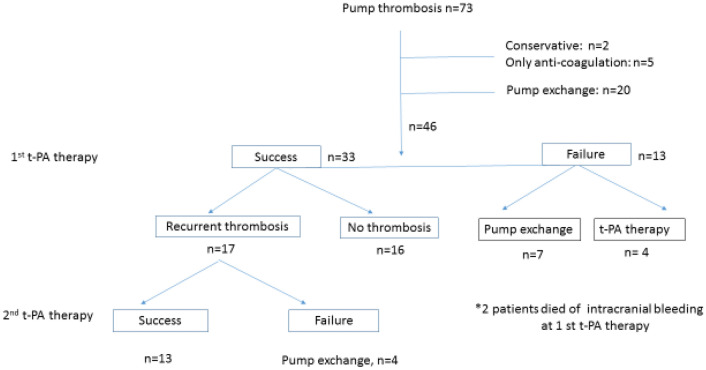
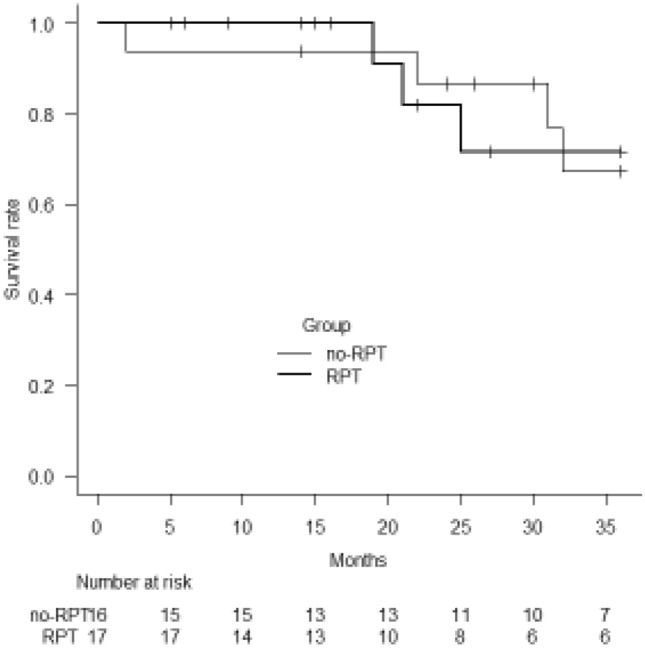
A total of 534 HVAD implantations have been screened, and 73 patients (13.7%) developed first HVAD thrombosis after a median of 10 months (IQR; 6-21 months). 46 of these patients had effective thrombolysis in 71.7% (n = 33/46). After a median of 14 months (IQR 4-32 months) follow-up, 17 patients (51.5%) had developed a second HVAD thrombosis and all were treated with t-PA therapy again, resulting in effectiveness in 76.5% (n = 13/17). The four patients with ineffective t-PA therapy underwent subsequent surgical HVAD exchange. Multiple Cox regression model analysis revealed time interval between HVAD implantation and first thrombosis as an independent risk factor of recurrent thrombosis (HR, 0.93, 95% CI 0.87-0.99, p = 0.031). Kaplan-Meier analysis at 3 year follow-up showed no significant difference in overall survival for recurrent vs non-recurrent thrombosis groups (log-rank test, p = 0.959).
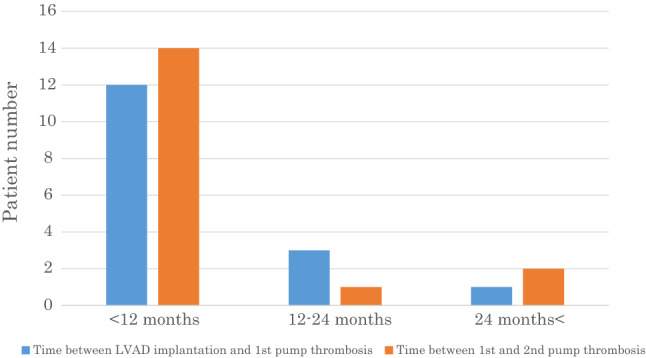
Recurrent HVAD thrombosis mostly appears within 12 months after first thrombosis. Systemic t-PA therapy for recurrent pump thrombosis seems safe, achieving comparable effectiveness rates to initial t-PA therapy. Survival does not differ between patients with or without recurrent HVAD thrombosis.
重复性左心室辅助装置(LVAD)血栓形成的预测因素尚未研究。
我们在 2010 年至 2020 年的一项长期研究中确定了 HeartWare(HVAD)患者复发性 LVAD 血栓形成的预测因素。我们纳入了所有因重复性 HVAD 血栓形成而接受两次或更多次溶栓治疗的患者,并将溶栓治疗的有效性定义为在事件发生后 30 天内免于中风、死亡、再次 HVAD 血栓形成或手术装置更换。研究终点还包括全因死亡率和心脏移植。
共筛选了 534 例 HVAD 植入患者,73 例(13.7%)在中位 10 个月(IQR;6-21 个月)后首次发生 HVAD 血栓形成。其中 46 例患者的溶栓治疗有效,占 71.7%(n=33/46)。在中位 14 个月(IQR 4-32 个月)的随访后,17 例患者(51.5%)发生了第二次 HVAD 血栓形成,所有患者均再次接受 t-PA 治疗,有效性为 76.5%(n=13/17)。4 例 t-PA 治疗无效的患者随后接受了手术 HVAD 更换。多变量 Cox 回归模型分析显示,HVAD 植入与首次血栓形成之间的时间间隔是复发性血栓形成的独立危险因素(HR,0.93,95%CI 0.87-0.99,p=0.031)。3 年随访的 Kaplan-Meier 分析显示,复发性与非复发性血栓形成组的总生存率无显著差异(对数秩检验,p=0.959)。
复发性 HVAD 血栓形成大多出现在首次血栓形成后 12 个月内。复发性泵血栓形成的全身 t-PA 治疗似乎是安全的,与初始 t-PA 治疗的有效性相当。有或没有复发性 HVAD 血栓形成的患者之间的生存率没有差异。