Department of Cardiology, University Medical Center Utrecht, Utrecht University, Utrecht, The Netherlands.
Department of Cardiac Surgery, Medical University of Vienna, Vienna, Austria.
ESC Heart Fail. 2023 Jun;10(3):1656-1665. doi: 10.1002/ehf2.14308. Epub 2023 Feb 16.
Since the withdrawal of HeartWare (HVAD) from the global market, there is an ongoing discussion if and which patients require prophylactically exchange for a HeartMate 3 (HM3). Therefore, it is important to study outcome differences between HVAD and HM3 patients. Because centres differ in patient selection and standard of care, we performed a propensity score (PS)-based study including centres that implanted both devices and aimed to identify which HVAD patients are at highest risk.
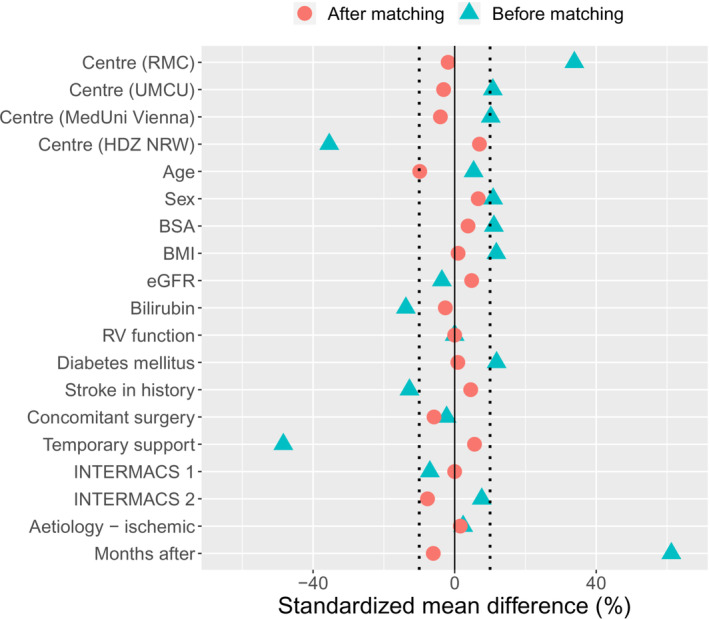
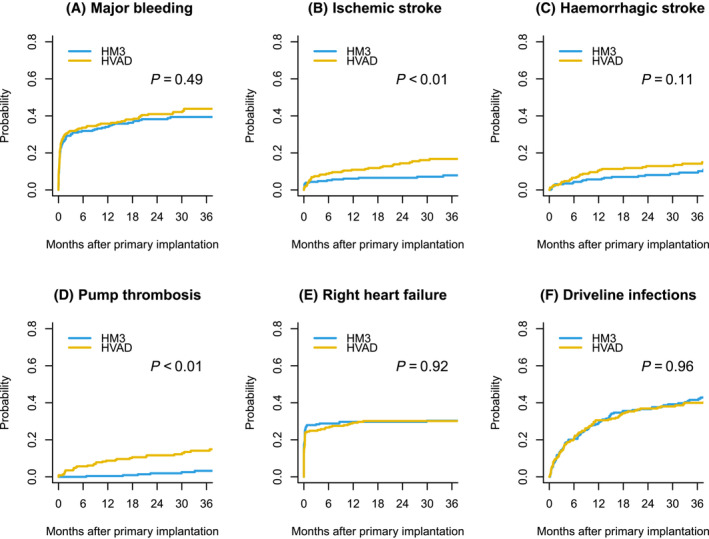
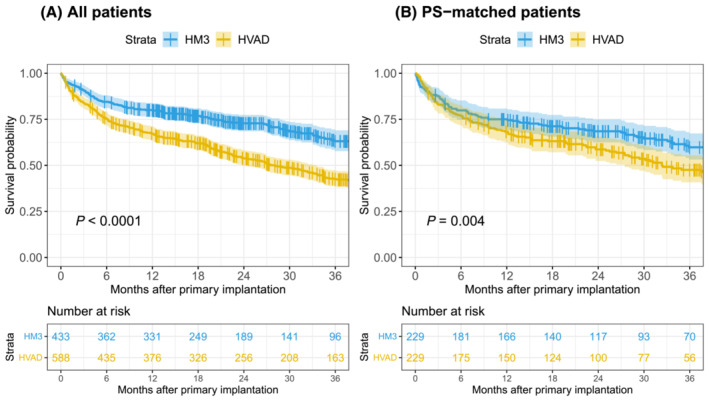
We performed an international multi-centre study (n = 1021) including centres that implanted HVAD and HM3. PS-matching was performed using clinical variables and the implanting centre. Survival and complications were compared. As a sensitivity analysis, PS-adjusted Cox regression was performed. Landmark analysis with conditional survival >2 years was conducted to evaluate long-term survival differences. To identify which HVAD patients may benefit from a HM3 upgrade, Cox regression using pre-operative variables and their interaction with device type was performed. Survival was significantly better for HM3 patients (P < 0.01) in 458 matched patients, with a median follow-up of 23 months. Within the matched cohort, HM3 patients had a median age of 58 years, and 83% were male, 80% of the HVAD patients were male, with a median age of 59 years. PS-adjusted Cox regression confirmed a significantly better survival for HM3 patients when compared with HVAD, with a HR of 1.46 (95% confidence interval 1.14-1.85, P < 0.01). Pump thrombosis (P < 0.01) and ischaemic stroke (P < 0.01) occurred less in HM3 patients. No difference was found for haemorrhagic stroke, right heart failure, driveline infection, and major bleeding. Landmark-analysis confirmed a significant difference in conditional survival >2 years after implantation (P = 0.03). None of the pre-operative variable interactions in the Cox regression were significant.
HM3 patients have a significantly better survival and a lower incidence of ischaemic strokes and pump thrombosis than HVAD patients. This survival difference persisted after 2 years of implantation. Additional research using post-operative variables is warranted to identify which HVAD patients need an upgrade to HM3 or expedited transplantation.
由于 HeartWare(HVAD)从全球市场撤出,人们一直在讨论哪些患者需要预防性地更换为 HeartMate 3(HM3)。因此,研究 HVAD 和 HM3 患者之间的结果差异非常重要。由于中心在患者选择和标准治疗方面存在差异,我们进行了一项基于倾向评分(PS)的研究,其中包括植入这两种设备的中心,并旨在确定哪些 HVAD 患者风险最高。
我们进行了一项国际多中心研究(n=1021),其中包括植入 HVAD 和 HM3 的中心。使用临床变量和植入中心进行 PS 匹配。比较了生存率和并发症。作为敏感性分析,进行了 PS 调整的 Cox 回归。进行了生存时间 >2 年的标记分析,以评估长期生存差异。为了确定哪些 HVAD 患者可能受益于 HM3 升级,使用术前变量及其与设备类型的交互作用进行了 Cox 回归。在 458 例匹配患者中,HM3 患者的生存率显著优于 HVAD 患者(P<0.01),中位随访时间为 23 个月。在匹配队列中,HM3 患者的中位年龄为 58 岁,83%为男性,HVAD 患者中 80%为男性,中位年龄为 59 岁。PS 调整的 Cox 回归证实,与 HVAD 相比,HM3 患者的生存率显著提高,HR 为 1.46(95%置信区间 1.14-1.85,P<0.01)。HM3 患者的泵血栓形成(P<0.01)和缺血性中风(P<0.01)发生率较低。HM3 患者的出血性中风、右心衰竭、驱动线感染和大出血发生率无差异。标记分析证实,植入后 >2 年的条件生存率存在显著差异(P=0.03)。Cox 回归中没有术前变量交互作用具有统计学意义。
与 HVAD 患者相比,HM3 患者的生存率显著提高,缺血性中风和泵血栓形成的发生率较低。这种生存差异在植入后 2 年仍然存在。需要使用术后变量进行进一步研究,以确定哪些 HVAD 患者需要升级为 HM3 或加快移植。