Max Superspecialty Hospital, Saket, New Delhi, India.
Tata Memorial Centre, ACTREC, Mumbai, India.
Blood Cells Mol Dis. 2021 Mar;87:102525. doi: 10.1016/j.bcmd.2020.102525. Epub 2020 Dec 8.
There is scarcity of data on outcome of COVID-19 in patients with hematological malignancies. Primary objective of study was to analyse the 14-day and 28-day mortality. Secondary objectives were to correlate age, comorbidities and remission status with outcome.
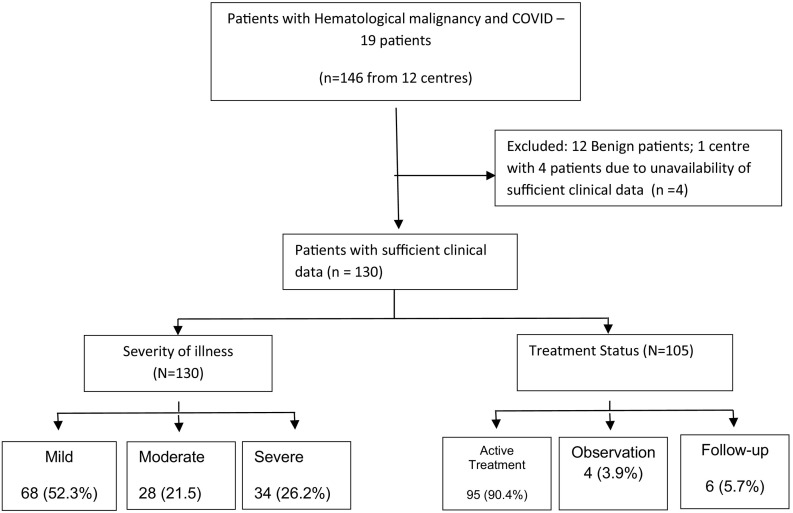
Retrospective multicentre observational study conducted in 11 centres across India. Total 130 patients with hematological malignancies and COVID-19 were enrolled.
Fever and cough were commonest presentation. Eleven percent patients were incidentally detected. Median age of our cohort was 49.5 years. Most of our patients had a lymphoid malignancy (n = 91). One-half patients (52%) had mild infection, while moderate and severe infections contributed to one-fourth each. Sixty seven patients (52%) needed oxygen For treatment of COVID-19 infection, half(n = 66) received antivirals. Median time to RT-PCR COVID-19 negativity was 17 days (7-49 days). Nearly three-fourth (n = 95) of our patients were on anticancer treatment at time of infection, of which nearly two-third (n = 59;64%) had a delay in chemotherapy. Overall, 20% (n = 26) patients succumbed. 14-day survival and 28-day survival for whole cohort was 85.4% and 80%, respectively. One patient succumbed outside the study period on day 39. Importantly, death rate at 1 month was 50% and 60% in relapse/refractory and severe disease cohorts, respectively. Elderly patients(age ≥ 60) (p = 0.009), and severe COVID-19 infection (p = 0.000) had a poor 14-day survival. The 28-day survival was significantly better for patients in remission (p = 0.04), non-severe infection (p = 0.00), and age < 60 years (p = 0.05).
Elderly patients with hematological malignancy and severe covid-19 have worst outcomes specially when disease is not in remission.
目前关于血液恶性肿瘤患者 COVID-19 结局的数据稀缺。本研究的主要目的是分析 14 天和 28 天死亡率。次要目标是将年龄、合并症和缓解状态与结局相关联。
这是一项在印度 11 个中心进行的回顾性多中心观察性研究。共纳入 130 名血液恶性肿瘤合并 COVID-19 的患者。
发热和咳嗽是最常见的表现。有 11%的患者是偶然发现的。本队列的中位年龄为 49.5 岁。我们的大多数患者患有淋巴恶性肿瘤(n=91)。一半患者(52%)感染较轻,中度和重度感染各占四分之一。67 名患者(52%)需要吸氧治疗 COVID-19 感染,一半(n=66)接受抗病毒治疗。RT-PCR 检测 COVID-19 转为阴性的中位时间为 17 天(7-49 天)。将近四分之三(n=95)的患者在感染时正在接受抗癌治疗,其中近三分之二(n=59;64%)的化疗出现延迟。总体而言,20%(n=26)的患者死亡。整个队列的 14 天生存率和 28 天生存率分别为 85.4%和 80%。一名患者在第 39 天研究期外死亡。重要的是,复发/难治性和重症疾病组在 1 个月时的死亡率分别为 50%和 60%。老年患者(年龄≥60 岁)(p=0.009)和重症 COVID-19 感染(p=0.000)的 14 天生存率较差。缓解(p=0.04)、非重症感染(p=0.00)和年龄<60 岁(p=0.05)的患者 28 天生存率显著提高。
患有血液恶性肿瘤和重症 COVID-19 的老年患者预后最差,特别是当疾病未缓解时。