Olaya José, Noé Enrique, Navarro María Dolores, O'Valle Myrtha, Colomer Carolina, Moliner Belén, Ippoliti Camilla, Ferri Joan, Maza Anny, Llorens Roberto
NEURORHB, Servicio de Neurorrehabilitación de Hospitales Vithas, Fundación Vithas, Callosa d'En Sarrià 12, 46007 València, Spain.
Neurorehabilitation and Brain Research Group, Instituto de Investigación e Innovación en Bioingeniería, Universitat Politècnica de València, Camino de Vera s/n, 46011 València, Spain.
Brain Sci. 2020 Dec 16;10(12):990. doi: 10.3390/brainsci10120990.
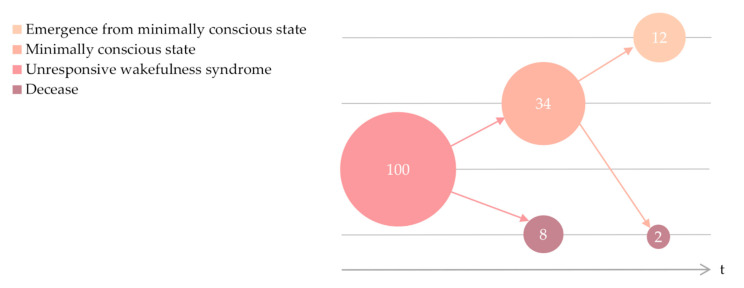
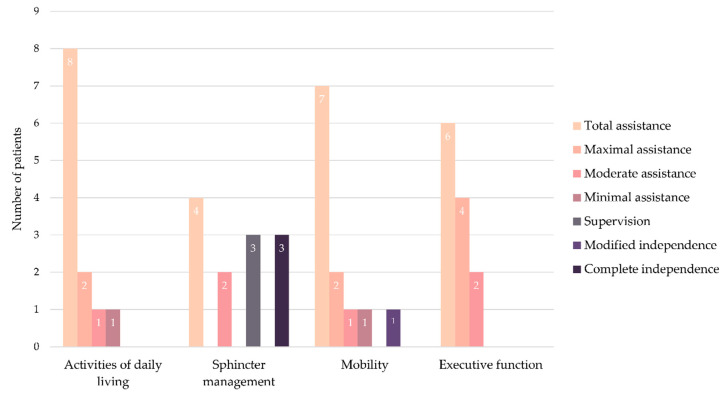
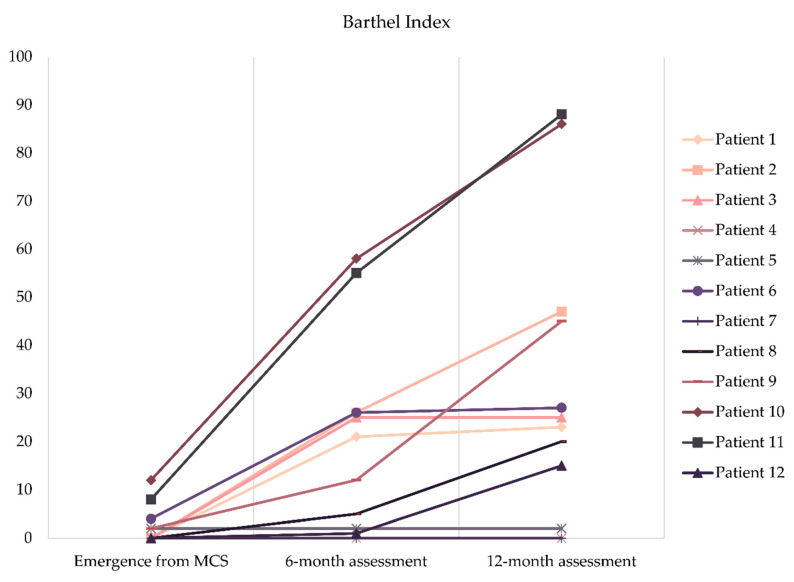
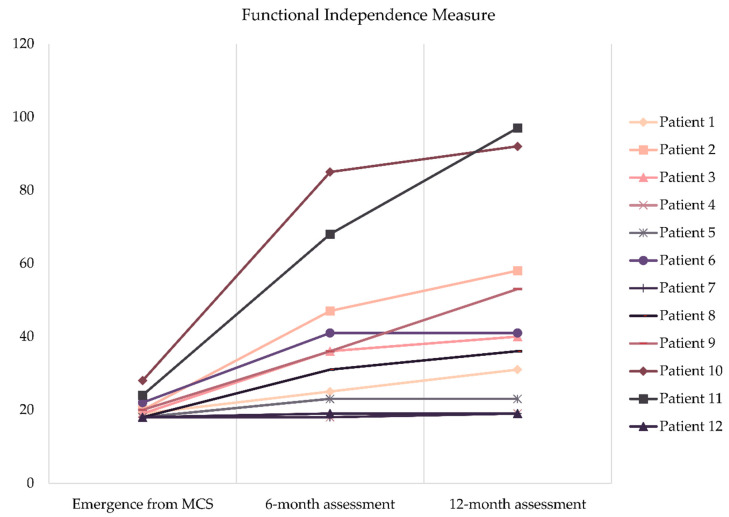
Accurate estimation of the functional independence of patients with unresponsive wakefulness syndrome (UWS) is essential to adjust family and clinical expectations and plan long-term necessary resources. Although different studies have described the clinical course of these patients, they have methodological limitations that could restrict generalization of the results. This study investigates the neurobehavioral progress of 100 patients with UWS consecutively admitted to a neurorehabilitation center using systematic weekly assessments based on standardized measures, and the functional independence staging of those patients who emerged from a minimally conscious state (MCS) during the first year post-emergence. Our results showed that one year after emergence, most patients were severely dependent, although some of them showed extreme or moderate severity. Clinically meaningful functional improvement was less likely to occur in cognitively-demanding activities, such as activities of daily living and executive function. Consequently, the use of specific and staging functional independence measures, with domain-specific evaluations, are recommended to detect the functional changes that might be expected in these patients. The information provided by these instruments, together with that obtained from repeated assessments of the preserved consciousness with standardized instruments, could help clinicians to adjust expectations and plan necessary resources for this population.
准确评估无反应觉醒综合征(UWS)患者的功能独立性对于调整家庭和临床预期以及规划长期所需资源至关重要。尽管不同研究描述了这些患者的临床病程,但它们存在方法学上的局限性,可能会限制结果的推广。本研究通过基于标准化测量的每周系统评估,调查了连续入住神经康复中心的100例UWS患者的神经行为进展,以及那些在出现后第一年内从最低意识状态(MCS)中苏醒的患者的功能独立性分期。我们的结果显示,出现后一年,大多数患者严重依赖他人,尽管其中一些患者表现出极重度或中度严重程度。在认知要求较高的活动中,如日常生活活动和执行功能,临床上有意义的功能改善不太可能发生。因此,建议使用特定的、分阶段的功能独立性测量方法,并进行特定领域的评估,以检测这些患者可能出现的功能变化。这些工具提供的信息,连同通过标准化工具对保留意识进行反复评估所获得的信息,可帮助临床医生调整预期,并为这一人群规划所需资源。