Research Center, Faculty of Medicine Ramathibodi Hospital, Mahidol University, Bangkok 10400, Thailand.
Section for Translational Medicine, Faculty of Medicine Ramathibodi Hospital, Mahidol University, Bangkok 10400, Thailand.
Biomolecules. 2020 Dec 16;10(12):1680. doi: 10.3390/biom10121680.
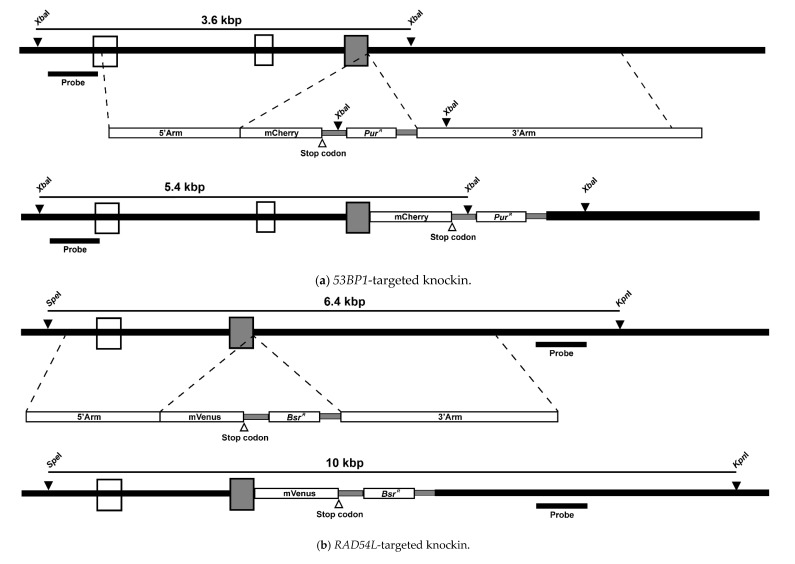
Recent developments in chemotherapy focus on target-specific mechanisms, which occur only in cancer cells and minimize the effects on normal cells. DNA damage and repair pathways are a promising target in the treatment of cancer. In order to identify novel compounds targeting DNA repair pathways, two key proteins, 53BP1 and RAD54L, were tagged with fluorescent proteins as indicators for two major double strand break (DSB) repair pathways: non-homologous end-joining (NHEJ) and homologous recombination (HR). The engineered biosensor cells exhibited the same DNA repair properties as the wild type. The biosensor cells were further used to investigate the DNA repair activities of natural biological compounds. An extract from sp., the endophyte isolated from the medicinal plant Roxb. ex Choisy, was tested. The results showed that the crude extract induced DSB, as demonstrated by the increase in the DNA DSB marker γH2AX. The damaged DNA appeared to be repaired through NHEJ, as the 53BP1 focus formation in the treated fraction was higher than in the control group. In conclusion, DNA repair-based biosensors are useful for the preliminary screening of crude extracts and biological compounds for the identification of potential targeted therapeutic drugs.
近年来,化疗的发展重点在于针对特定靶点的机制,这些机制只在癌细胞中发生,最大限度地减少对正常细胞的影响。DNA 损伤和修复途径是癌症治疗的一个有前途的靶点。为了鉴定针对 DNA 修复途径的新型化合物,将两种关键蛋白 53BP1 和 RAD54L 标记为荧光蛋白,作为两种主要双链断裂 (DSB) 修复途径的指标:非同源末端连接 (NHEJ) 和同源重组 (HR)。工程生物传感器细胞表现出与野生型相同的 DNA 修复特性。进一步将生物传感器细胞用于研究天然生物化合物的 DNA 修复活性。测试了一种来自内生真菌的提取物,该内生真菌从药用植物 Roxb. ex Choisy 中分离得到。结果表明,粗提取物诱导了 DSB,这可以通过增加 DNA DSB 标志物 γH2AX 来证明。受损的 DNA 似乎通过 NHEJ 进行了修复,因为处理组中的 53BP1 焦点形成高于对照组。总之,基于 DNA 修复的生物传感器可用于粗提取物和生物化合物的初步筛选,以鉴定潜在的靶向治疗药物。