Imperial Centre for Translational and Experimental Medicine, Cardiovascular Division, National Heart and Lung Institute, Imperial College London, London W12 0NN, UK.
National Centre for Pharmaceutical Technology, King Abdulaziz City for Science and Technology, Riyadh 11461, Saudi Arabia.
Int J Mol Sci. 2020 Dec 16;21(24):9599. doi: 10.3390/ijms21249599.
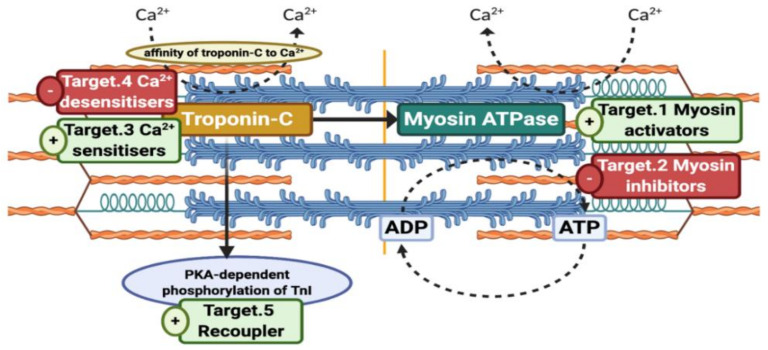
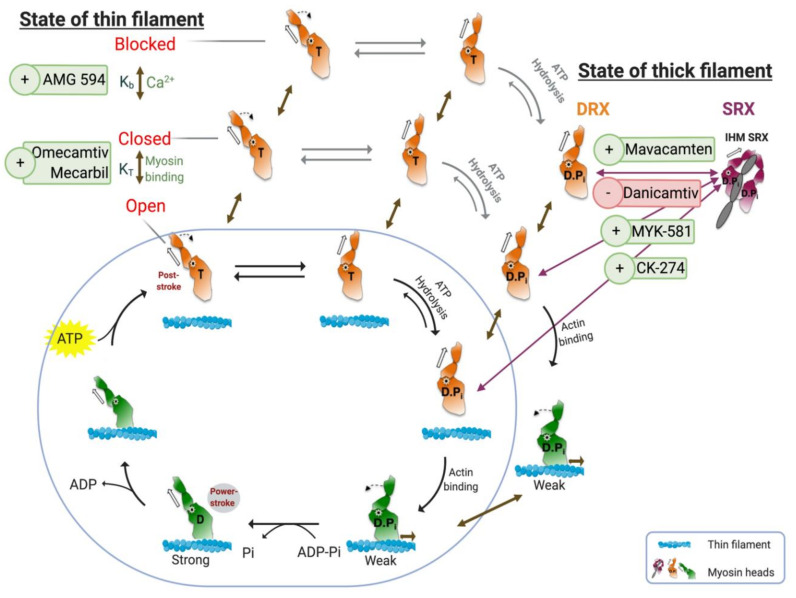
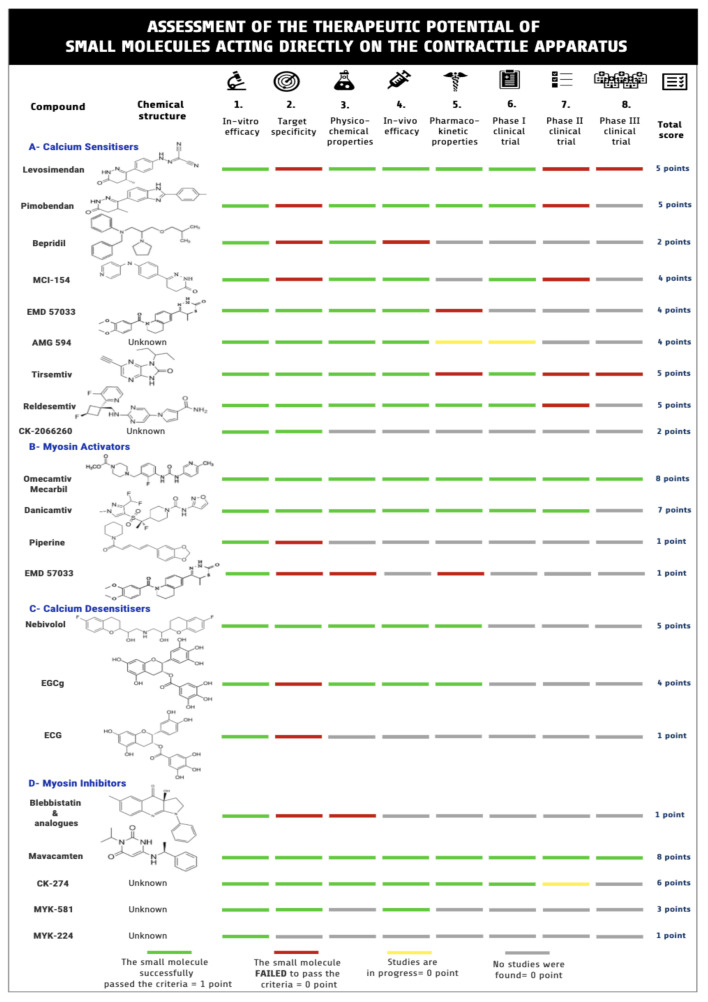
Hypertrophic cardiomyopathy (HCM) and dilated cardiomyopathy (DCM) are the most prevalent forms of the chronic and progressive pathological condition known as cardiomyopathy. These diseases have different aetiologies; however, they share the feature of haemodynamic abnormalities, which is mainly due to dysfunction in the contractile proteins that make up the contractile unit known as the sarcomere. To date, pharmacological treatment options are not disease-specific and rather focus on managing the symptoms, without addressing the disease mechanism. Earliest attempts at improving cardiac contractility by modulating the sarcomere indirectly (inotropes) resulted in unwanted effects. In contrast, targeting the sarcomere directly, aided by high-throughput screening systems, could identify small molecules with a superior therapeutic value in cardiac muscle disorders. Herein, an extensive literature review of 21 small molecules directed to five different targets was conducted. A simple scoring system was created to assess the suitability of small molecules for therapy by evaluating them in eight different criteria. Most of the compounds failed due to lack of target specificity or poor physicochemical properties. Six compounds stood out, showing a potential therapeutic value in HCM, DCM or heart failure (HF). Omecamtiv Mecarbil and Danicamtiv (myosin activators), Mavacamten, CK-274 and MYK-581 (myosin inhibitors) and AMG 594 (Ca-sensitiser) are all small molecules that allosterically modulate troponin or myosin. Omecamtiv Mecarbil showed limited efficacy in phase III GALACTIC-HF trial, while, results from phase III EXPLORER-HCM trial were recently published, indicating that Mavacamten reduced left ventricular outflow tract (LVOT) obstruction and diastolic dysfunction and improved the health status of patients with HCM. A novel category of small molecules known as "recouplers" was reported to target a phenomenon termed uncoupling commonly found in familial cardiomyopathies but has not progressed beyond preclinical work. In conclusion, the contractile apparatus is a promising target for new drug development.
肥厚型心肌病(HCM)和扩张型心肌病(DCM)是一种慢性进行性病理疾病——心肌病中最常见的两种形式。这两种疾病的病因不同,但它们都具有血液动力学异常的特征,主要是由于构成收缩单位——肌节的收缩蛋白功能障碍所致。迄今为止,药物治疗的选择不是针对特定疾病的,而是侧重于治疗症状,而不针对疾病机制。通过调节肌节间接(变力药)改善心肌收缩力的最早尝试导致了不良反应。相比之下,通过高通量筛选系统直接靶向肌节,可以识别出在心肌疾病中具有更高治疗价值的小分子。在此,对 21 种针对 5 个不同靶点的小分子进行了广泛的文献综述。创建了一个简单的评分系统,通过在 8 个不同标准下评估小分子,来评估它们用于治疗的适用性。大多数化合物因缺乏靶向特异性或较差的理化性质而失败。有 6 种化合物脱颖而出,显示出在 HCM、DCM 或心力衰竭(HF)中具有潜在的治疗价值。Omecamtiv Mecarbil 和 Danicamtiv(肌球蛋白激活剂)、Mavacamten、CK-274 和 MYK-581(肌球蛋白抑制剂)和 AMG 594(钙敏化剂)都是通过变构调节肌钙蛋白或肌球蛋白的小分子。Omecamtiv Mecarbil 在 III 期 GALACTIC-HF 试验中显示出有限的疗效,而最近公布了 III 期 EXPLORER-HCM 试验的结果,表明 Mavacamten 降低了左心室流出道(LVOT)阻塞和舒张功能障碍,并改善了 HCM 患者的健康状况。据报道,一种称为“再耦联剂”的新型小分子类别靶向一种在家族性心肌病中常见的现象——解耦联,但尚未超出临床前研究工作。总之,收缩装置是新药开发的一个有前途的靶点。