Department of Neurosurgery, University Medical Center Hamburg-Eppendorf, Martinistr. 52, 20246, Hamburg, Germany.
Institute of Research in Operative Medicine (IFOM), University Witten/Herdecke, Cologne, Germany.
Neurosurg Rev. 2021 Oct;44(5):2697-2706. doi: 10.1007/s10143-020-01456-3. Epub 2020 Dec 18.
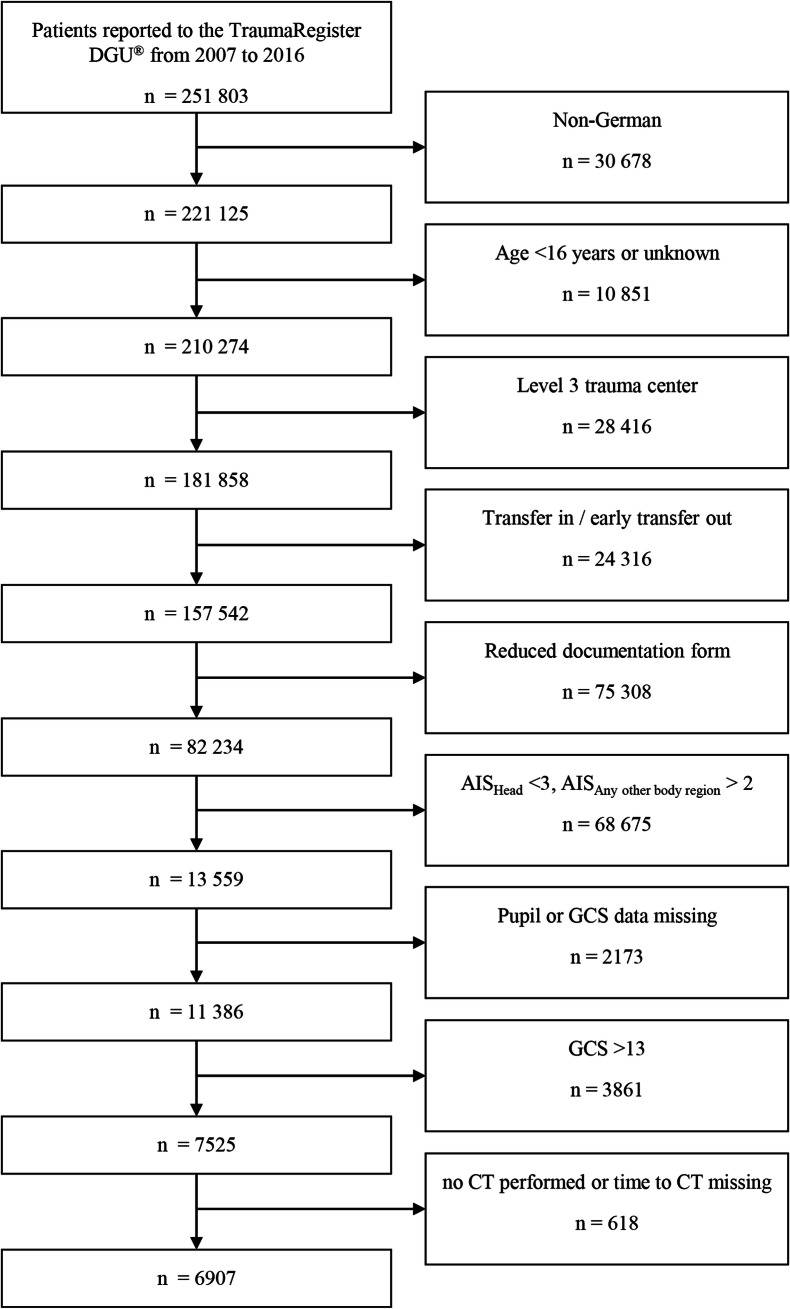
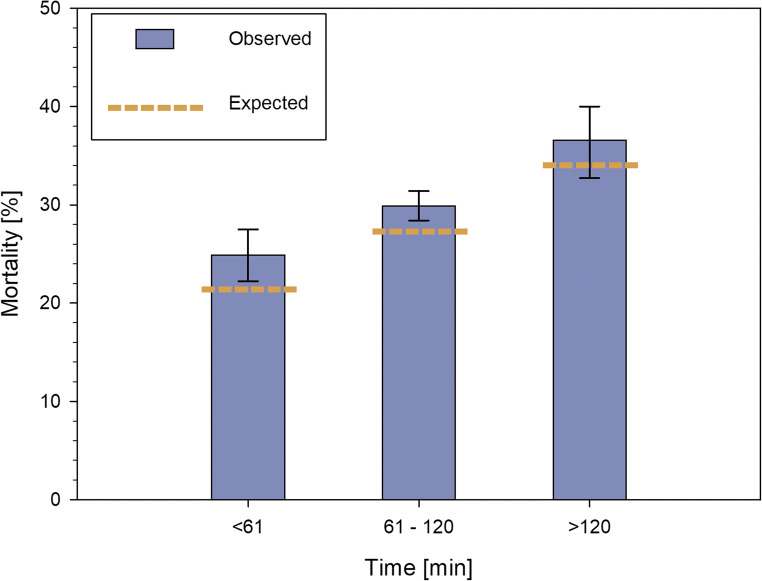
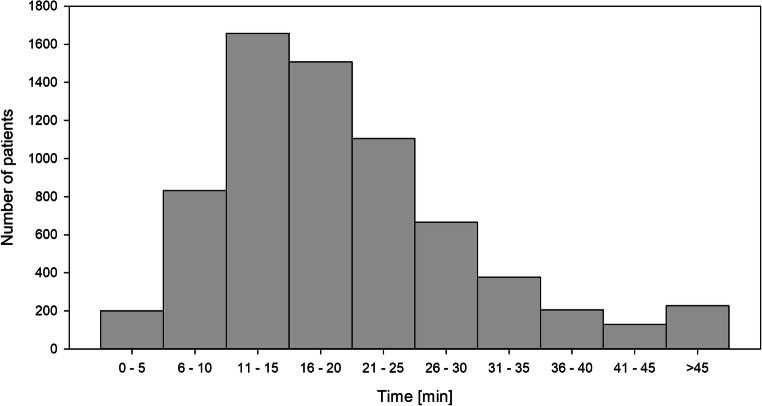
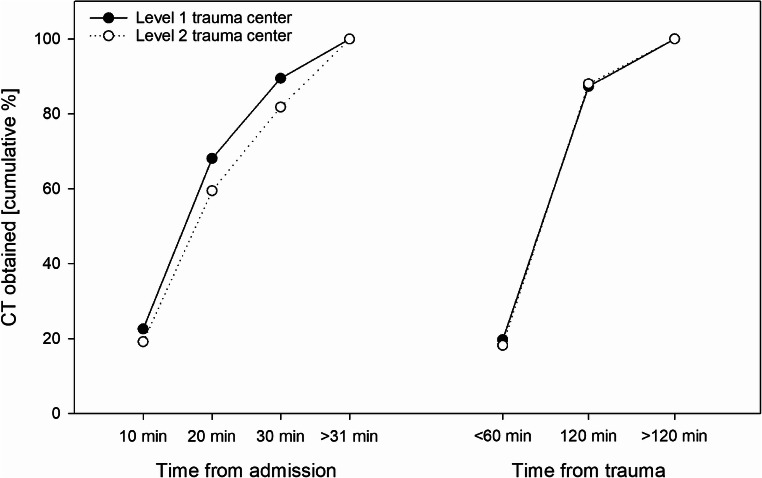
Fast acquisition of a first computed tomography (CT) scan after traumatic brain injury (TBI) is recommended. This study is aimed at investigating whether the length of the period preceding initial CT scan influences mortality in patients with leading TBI. A retrospective cohort analysis of patients registered in the TraumaRegister DGU® was conducted including adult patients with TBI, defined as Abbreviated Injury Scale ≥ 3 and GCS ≤ 13 who had been treated in level 1 or 2 trauma centers from 2007-2016. Patients were grouped according to time intervals either from trauma or from admission to CT. A total of 6904 patients met the inclusion criteria. Mean time period from trauma to hospital admission was 68.8 min. From admission to first CT, a mean of 19.0 min elapsed. Trauma severity was higher in groups with a longer duration from trauma to CT as represented by a mean (± standard deviation) Injury Severity Score (ISS) of 19.8 ± 9.0, 20.7 ± 9.3, and 21.4 ± 7.5 and similar distribution of mortality of 24.9%, 29.9%, and 36.3% in the ≤ 60-min, 61-120-min, and ≥ 121-min groups, respectively. An adjusted multivariable logistic regression model showed a significant influence of the level of the trauma center (p = 0.037) but not for interval from admission to CT (p = 0.528). TBI patients with a longer time span from trauma to first CT were more severely injured and demonstrated a worse prognosis, but received a CT scan faster when duration from admission is observed. The duration until the CT scan was obtained showed no significant impact on the mortality.
颅脑创伤(TBI)后应尽快进行首次计算机断层扫描(CT)。本研究旨在探讨初次 CT 扫描前的时间间隔是否会影响 TBI 患者的死亡率。这是一项对 TraumaRegister DGU®注册的患者进行的回顾性队列分析,纳入了 2007 年至 2016 年期间在 1 级或 2 级创伤中心治疗的,损伤严重程度评分(Abbreviated Injury Scale,AIS)≥ 3 分和格拉斯哥昏迷评分(GCS)≤ 13 分的成年 TBI 患者。患者根据从创伤到入院或从入院到首次 CT 的时间间隔分组。共有 6904 例患者符合纳入标准。从创伤到入院的平均时间间隔为 68.8 分钟。从入院到首次 CT 的平均时间为 19.0 分钟。从创伤到 CT 的时间间隔较长的患者创伤严重程度更高,其损伤严重程度评分(Injury Severity Score,ISS)的平均值(±标准差)分别为 19.8 ± 9.0、20.7 ± 9.3 和 21.4 ± 7.5,死亡率分别为 24.9%、29.9%和 36.3%,分别在≤60 分钟、61-120 分钟和≥121 分钟组。调整后的多变量逻辑回归模型显示,创伤中心的级别(p = 0.037)具有显著影响,但入院到 CT 时间间隔(p = 0.528)无显著影响。从创伤到首次 CT 的时间间隔较长的 TBI 患者损伤更严重,预后更差,但从入院到进行 CT 扫描的速度更快。从入院到获得 CT 扫描的时间间隔对死亡率没有显著影响。