Department of Family and Community Medicine, Women's College Hospital, Toronto, ON, Canada.
Department of Family and Community Medicine, University of Toronto, Toronto, ON, Canada.
Fam Pract. 2021 Sep 25;38(5):549-555. doi: 10.1093/fampra/cmaa130.
Virtual consults have replaced in-person visits for many home-isolated patients with COVID-19 disease.
To describe the natural history, clinical management and outcomes of community-dwelling patients with COVID-19, who received support from a family medicine-led, virtual CovidCare@Home program in Toronto, Ontario, Canada.
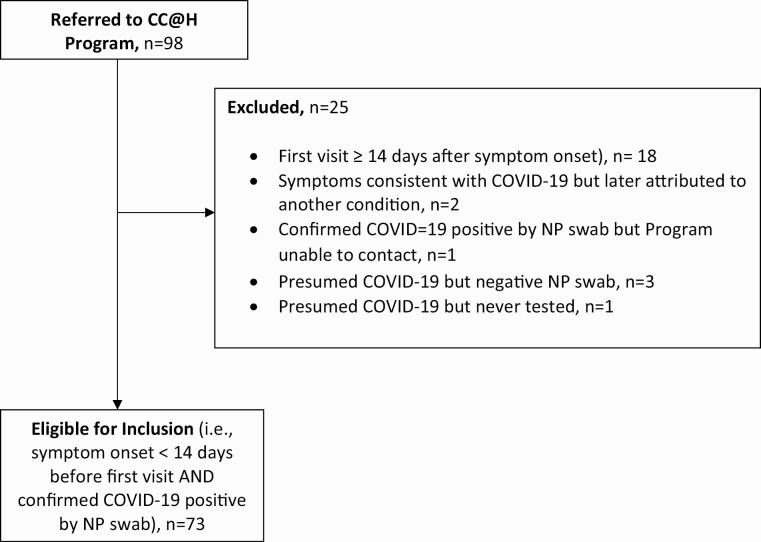
Observational, descriptive study conducted by retrospective chart review of 98 patients enrolled during the first 5 weeks of program implementation (8 April-11 May 2020); 73 patients with laboratory-confirmed COVID-19, with symptom onset ≤ 14 days before initial consult were included for analysis. Patients were classified as mild, moderate or severe based on WHO Criteria.
All patients in the program experienced mild (88%) or moderate (12.3%) disease. No patients were hospitalized or died. Patients were mainly female (70%); with mean age of 43.3 years. Most patients (82.2%) worked in higher risk, healthcare settings. Almost 40% had no medical co-morbidities. Common symptoms were cough (65.8%), fatigue (60.3%), headache (42.5%) and myalgia (39.7%), followed by fever (32.9%), sore throat (21.9%), nasal congestion (21.9%) and rhinorrhea (20.5%). Headache (51%) and anosmia (45.1%) were common among females; fever and breathlessness among males (40.9%). Nine patients (12.3%) experienced worsening of symptoms (mainly respiratory) or exacerbation of co-morbidities, which required care outside the virtual service.
Patients with mild to moderate COVID-19 disease can be managed safely and effectively in a family medicine-led virtual program. Some sex differences in symptoms were observed. Future work should focus on long-term follow up in view of the existence of so-called 'long-haulers'.
对于许多患有 COVID-19 的居家隔离患者,虚拟咨询已经取代了面对面就诊。
描述在加拿大安大略省多伦多市,由家庭医学主导的虚拟 CovidCare@Home 项目为社区居住的 COVID-19 患者提供支持的自然病史、临床管理和结局。
这是一项观察性、描述性研究,通过对 2020 年 4 月 8 日至 5 月 11 日项目实施的前 5 周期间纳入的 98 名患者的病历回顾进行回顾性分析;纳入了 73 名症状发作≤14 天的实验室确诊 COVID-19 患者进行分析。根据世界卫生组织(WHO)标准,患者被分为轻症、中症或重症。
该项目中的所有患者均患有轻症(88%)或中症(12.3%)疾病。无患者住院或死亡。患者主要为女性(70%);平均年龄为 43.3 岁。大多数患者(82.2%)在高风险的医疗保健环境中工作。近 40%的患者无合并症。常见症状为咳嗽(65.8%)、疲劳(60.3%)、头痛(42.5%)和肌痛(39.7%),其次为发热(32.9%)、咽痛(21.9%)、鼻塞(21.9%)和流涕(20.5%)。头痛(51%)和嗅觉丧失(45.1%)在女性中更为常见;发热和呼吸困难在男性中更为常见(40.9%)。9 名患者(12.3%)出现症状恶化(主要为呼吸道症状)或合并症加重,需要在虚拟服务之外进行治疗。
由家庭医学主导的虚拟项目可安全有效地管理轻症至中症 COVID-19 患者。观察到一些症状的性别差异。鉴于存在所谓的“长新冠”患者,未来应重点进行长期随访。