Translational Psychiatry Program, Louis A. Faillace, MD, Department of Psychiatry and Behavioral Sciences at McGovern Medical School, The University of Texas Health Science Center at Houston (UT Health), Houston, TX, USA.
Laboratory of Experimental Neurology, Graduate Program in Health Sciences, University of Southern Santa Catarina (UNESC), Criciúma, SC, Brazil.
Mitochondrion. 2021 Mar;57:23-36. doi: 10.1016/j.mito.2020.12.002. Epub 2020 Dec 17.
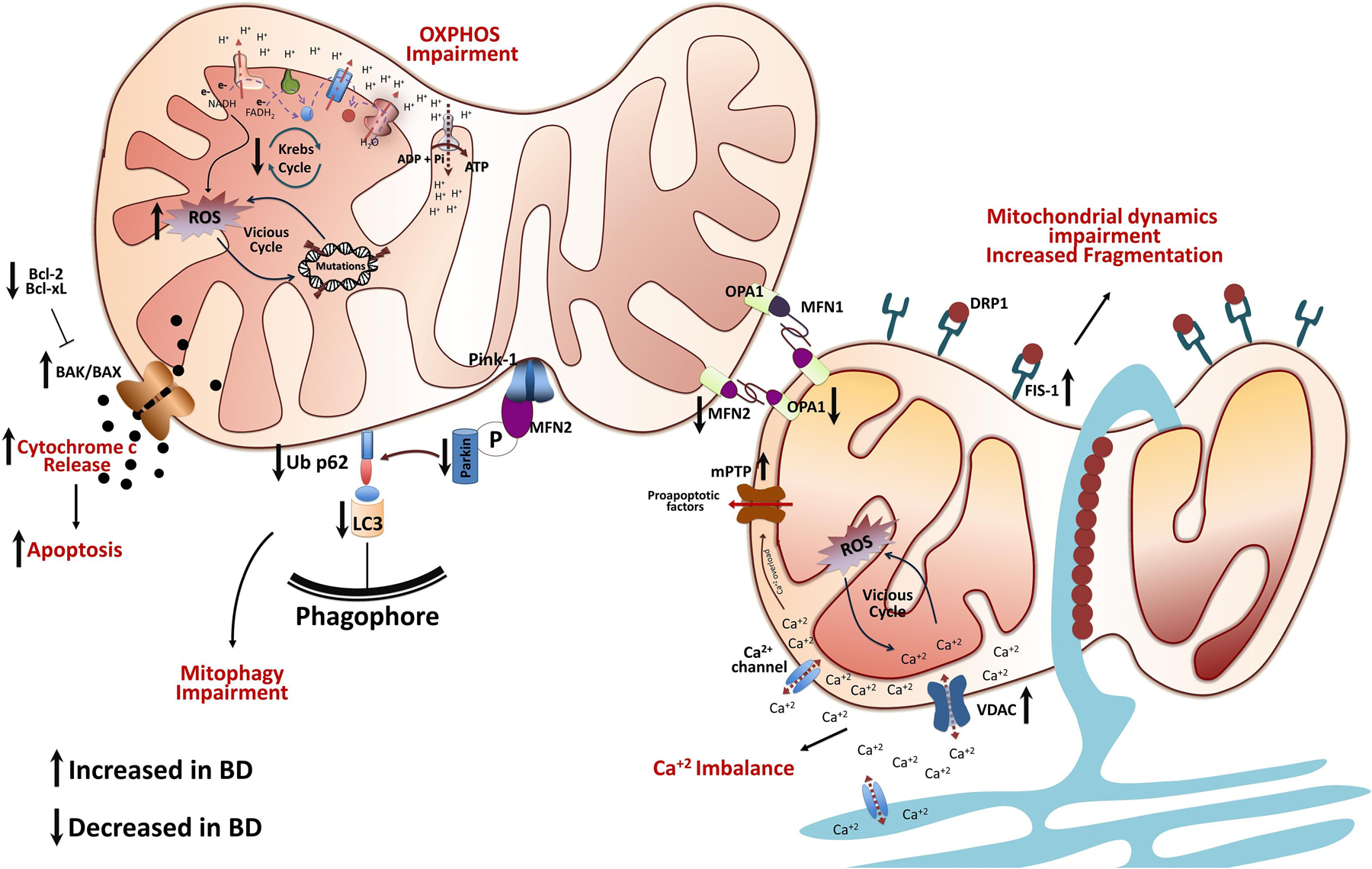
The understanding of the pathophysiology of bipolar disorder (BD) remains modest, despite recent advances in neurobiological research. The mitochondrial dysfunction hypothesis of bipolar disorder has been corroborated by several studies involving postmortem brain analysis, neuroimaging, and specific biomarkers in both rodent models and humans. Evidence suggests that BD might be related to abnormal mitochondrial morphology and dynamics, neuroimmune dysfunction, and atypical mitochondrial metabolism and oxidative stress pathways. Mitochondrial dysfunction in mood disorders is also associated with abnormal Ca levels, glutamate excitotoxicity, an imbalance between pro- and antiapoptotic proteins towards apoptosis, abnormal gene expression of electron transport chain complexes, and decreased ATP synthesis. This paper aims to review and discuss the implications of mitochondrial dysfunction in BD etiology and to explore mitochondria as a potential target for novel therapeutic agents.
尽管神经生物学研究取得了一些新进展,但人们对双相情感障碍(BD)的病理生理学的理解仍然有限。多项涉及死后大脑分析、神经影像学和啮齿动物模型及人类特定生物标志物的研究证实了双相情感障碍的线粒体功能障碍假说。有证据表明,BD 可能与线粒体形态和动力学异常、神经免疫功能障碍以及非典型线粒体代谢和氧化应激途径有关。心境障碍中的线粒体功能障碍也与 Ca 水平异常、谷氨酸兴奋性毒性、促凋亡和抗凋亡蛋白之间的失衡导致细胞凋亡、电子传递链复合物的异常基因表达以及 ATP 合成减少有关。本文旨在综述和讨论线粒体功能障碍在 BD 发病机制中的意义,并探讨线粒体作为新型治疗药物潜在靶点的可能性。