Qiu Xianxin, Han Xu, Wang Yao, Ding Weina, Sun Yawen, Zhou Yan, Lei Hao, Lin Fuchun
National Center for Magnetic Resonance in Wuhan, State Key Laboratory of Magnetic Resonance and Atomic and Molecular Physics, Wuhan Institute of Physics and Mathematics, Innovation Academy for Precision Measurement Science and Technology, Chinese Academy of Sciences, Wuhan, China.
University of Chinese Academy of Sciences, Beijing, China.
Front Psychiatry. 2020 Dec 3;11:586114. doi: 10.3389/fpsyt.2020.586114. eCollection 2020.
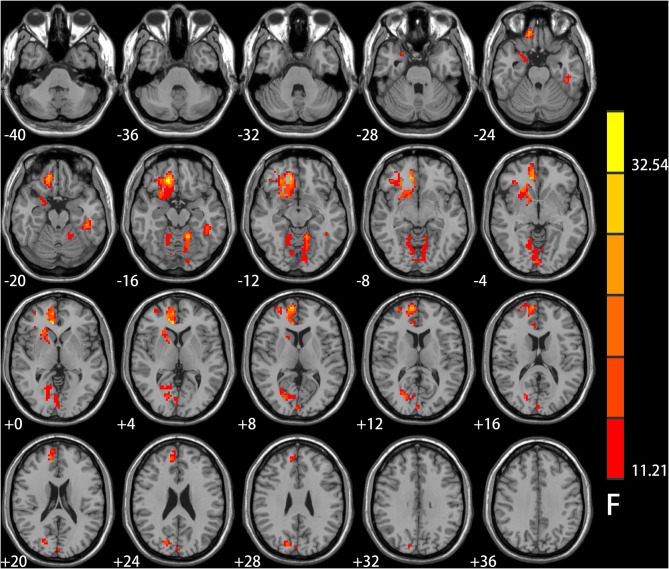
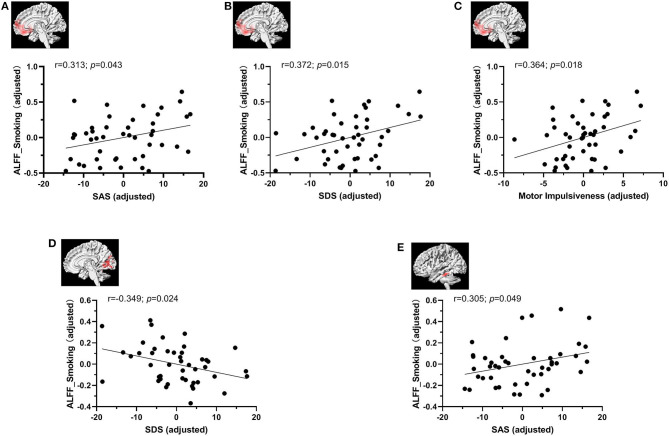
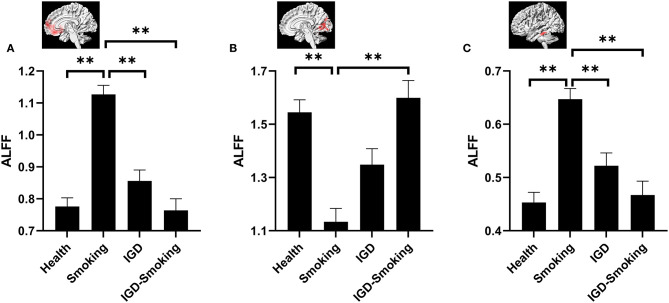
Converging lines of evidence indicates that smoking and internet gaming disorder (IGD) affect spontaneous brain activity, respectively. However, little is known about whether these two factors work together on the human brain. In this study, we investigated the interaction between smoking and IGD on local spontaneous brain activity using amplitude of low-frequency fluctuation (ALFF) based on resting-state fMRI (rs-fMRI). Forty-six cigarette smokers, 38 IGD individuals, 34 participants with both IGD and cigarette smoking (IGD-Smoking), and 60 healthy individuals involved in the study. Voxel-wise analysis of covariance of ALFF revealed that there were significant interactions between IGD by smoking in the right medial pre-frontal cortex (MPFC)/ventral striatum, bilateral cerebellar, and visual-related regions as well as the left temporal gyrus. In the right MPFC/ventral striatum and left temporal gyrus, ALFF in smoking group was significantly higher than healthy group while there were no significant ALFF differences between IGD-Smoking group and IGD group. While in the bilateral cerebellar and visual-related regions, ALFF in the smoking group was significantly lower than healthy group while ALFF in IGD-Smoking group did not show significant difference with IGD group. In addition, in the smoking group, ALFF of the right MPFC/ventral striatum was associated positively with anxiety and depression scores while the ALFF value in the smoking group had a trend toward negative correlation with SDS scores in the bilateral cerebellar and visual-related regions. The ALFF value in the smoking group was associated positively with anxiety score in the left temporal gyrus. These findings indicate that smoking and IGD interacted with each other in the human brain. Our results, in terms of spontaneous brain activity, may imply the fact that IGD people are more tended to get smoking. Moreover, it is possible to predict that smokers may be more easily to get internet addiction than healthy people.
越来越多的证据表明,吸烟和网络游戏障碍(IGD)分别会影响大脑的自发活动。然而,对于这两个因素是否会共同作用于人类大脑,我们却知之甚少。在本研究中,我们基于静息态功能磁共振成像(rs-fMRI),使用低频振幅(ALFF)来研究吸烟和IGD对局部大脑自发活动的相互作用。46名吸烟者、38名IGD患者、34名同时患有IGD和吸烟的参与者(IGD-吸烟组)以及60名健康个体参与了本研究。对ALFF进行基于体素的协方差分析发现,在右侧内侧前额叶皮质(MPFC)/腹侧纹状体、双侧小脑、视觉相关区域以及左侧颞回,IGD和吸烟之间存在显著的相互作用。在右侧MPFC/腹侧纹状体和左侧颞回,吸烟组的ALFF显著高于健康组,而IGD-吸烟组和IGD组之间的ALFF没有显著差异。而在双侧小脑和视觉相关区域,吸烟组的ALFF显著低于健康组,而IGD-吸烟组和IGD组之间的ALFF没有显著差异。此外,在吸烟组中,右侧MPFC/腹侧纹状体的ALFF与焦虑和抑郁评分呈正相关,而吸烟组在双侧小脑和视觉相关区域的ALFF值与抑郁自评量表(SDS)评分呈负相关趋势。吸烟组在左侧颞回的ALFF值与焦虑评分呈正相关。这些发现表明,吸烟和IGD在人类大脑中相互作用。就大脑自发活动而言,我们的结果可能意味着IGD患者更容易吸烟这一事实。此外,有可能预测吸烟者比健康人更容易患上网络成瘾。