Sucu Mete, Demir Süleyman Cansun
Çukurova University Faculty of Medicine, Department of Obstetrics and Gynecology, Adana, Turkey.
Turk J Obstet Gynecol. 2020 Dec;17(4):270-277. doi: 10.4274/tjod.galenos.2020.60669. Epub 2020 Dec 10.
Congenital pes equinovarus (PEV) is the most common congenital deformity of the foot, characterized by plantar flexion with a frequency of 0.2-0.3%. It can be diagnosed from the 12 week of pregnancy. Non-isolated cases tend to be syndromic and complex. We aimed to evaluate the results of perinatally diagnosed isolated PEV.
This was a retrospective cohort study conducted between March 2015-March 2020. Women who presented for fetal anomaly screening or were referred due to any suspected fetal anomaly were subjected to detailed fetal anomaly scans and checked for the presence of PEV. Karyotype analysis was discussed for patients with PEV. Pregnancy termination was recommended for those with chromosomal/life-threatening anomalies. The diagnosis was confirmed by postnatal examination/autopsy. Postnatal diagnosis was accepted as false-positive in those with no PEV.
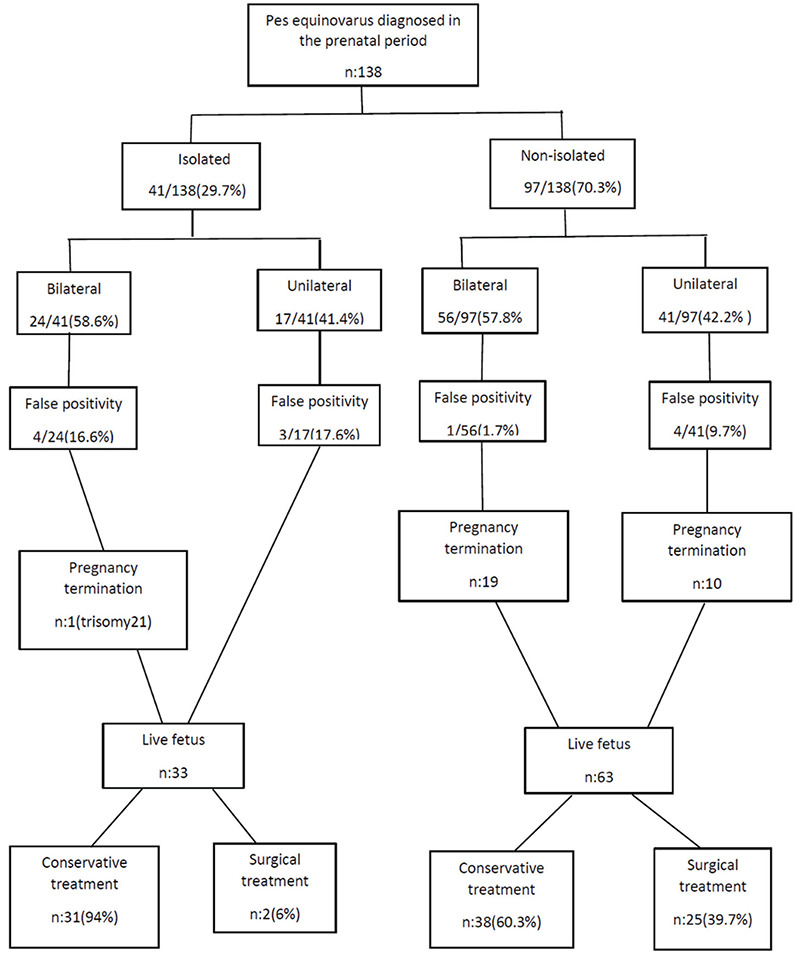
One-hundred thirty-eight patients were found to have PEV, 41 (29.7%) of which were isolated. In the isolated group, the false-positive rate in the first trimester was significantly higher compared with the second trimester, 50%/15.3%, respectively (p<0.05). Chromosomal anomalies were detected in 2 (4.8%) patients in the isolated group. Termination was performed to 1 (2.4%) patients due to trisomy 21. In the non-isolated group, chromosomal anomalies were detected in 13 (13.4%) patients, and termination was recommended. Termination was also recommended to 18 (18.5%) patients due to anomalies incompatible with life. In the postnatal evaluation, the surgical treatment rate in the isolated/non-isolated groups was 6%/39.7% (p<0.05).
When PEV is diagnosed, detailed fetal anomaly screening must be performed, patients should be informed about the chromosomal anomaly risk. High false-positive rates in the first trimester should be kept in mind for diagnosis. Karyotype analysis should be recommended also to isolated cases. It should be remembered that some neuromuscular/skeletal system anomalies may occur for the first time in the postnatal period in isolated cases.
先天性马蹄内翻足(PEV)是最常见的先天性足部畸形,以足跖屈为特征,发病率为0.2 - 0.3%。在妊娠12周时即可诊断。非孤立性病例往往伴有综合征且较为复杂。我们旨在评估围产期诊断的孤立性PEV的结果。
这是一项于2015年3月至2020年3月进行的回顾性队列研究。前来进行胎儿异常筛查或因任何疑似胎儿异常而转诊的女性接受了详细的胎儿异常扫描,并检查是否存在PEV。对患有PEV的患者进行了核型分析讨论。对于患有染色体/危及生命异常的患者,建议终止妊娠。诊断通过产后检查/尸检得以证实。对于无PEV的患者,产后诊断被视为假阳性。
发现138例患者患有PEV,其中41例(29.7%)为孤立性。在孤立性组中,孕早期的假阳性率显著高于孕中期,分别为50%/15.3%(p<0.05)。在孤立性组中,2例(4.8%)患者检测到染色体异常。1例(2.4%)因21三体综合征患者终止妊娠。在非孤立性组中,13例(13.4%)患者检测到染色体异常,并建议终止妊娠。由于存在与生命不相容的异常,还建议18例(18.5%)患者终止妊娠。在产后评估中,孤立性/非孤立性组的手术治疗率分别为6%/39.7%(p<0.05)。
诊断PEV时,必须进行详细的胎儿异常筛查,应告知患者染色体异常风险。诊断时应牢记孕早期的高假阳性率。对于孤立性病例也应建议进行核型分析。应记住,在孤立性病例中,一些神经肌肉/骨骼系统异常可能在产后首次出现。